Leviathan as Problem
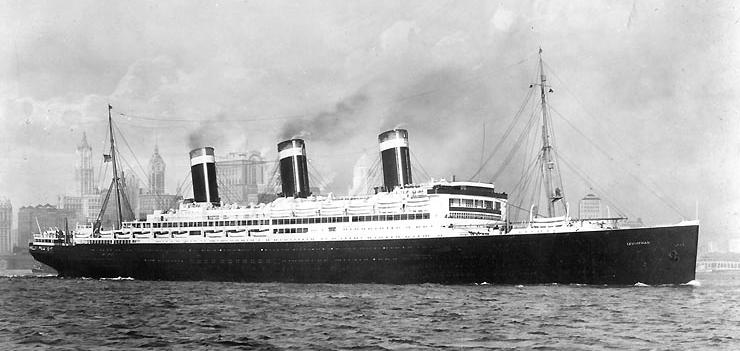
An immense liner in American service, but not an American conception. Its presence clarified what had been acquired and what still had not been truly created.
A curator-minded path through American liner ambition: from the adopted giant Leviathan, through the long and disciplined thinking of William Francis Gibbs, to the eventual realization of SS United States.
Research Collections group ship guides and interpretive themes into curator-framed pathways that emphasize shared ambitions, structural continuities, and larger historical meanings. This collection is less about a simple succession of ships than about a long line of intent in American liner history.
SS Leviathan made visible the scale of Atlantic ambition under American operation, but it did so through a ship not originally conceived within an American design framework. William Francis Gibbs occupies the crucial middle ground: the sustained intellectual and technical discipline between inherited magnitude and the eventual realization of a distinctively American answer in SS United States.
An immense liner in American service, but not an American conception. Its presence clarified what had been acquired and what still had not been truly created.
Gibbs treated speed, safety, structural discipline, and systems planning as one design problem. Decoration was secondary to performance, survivability, and technical coherence.
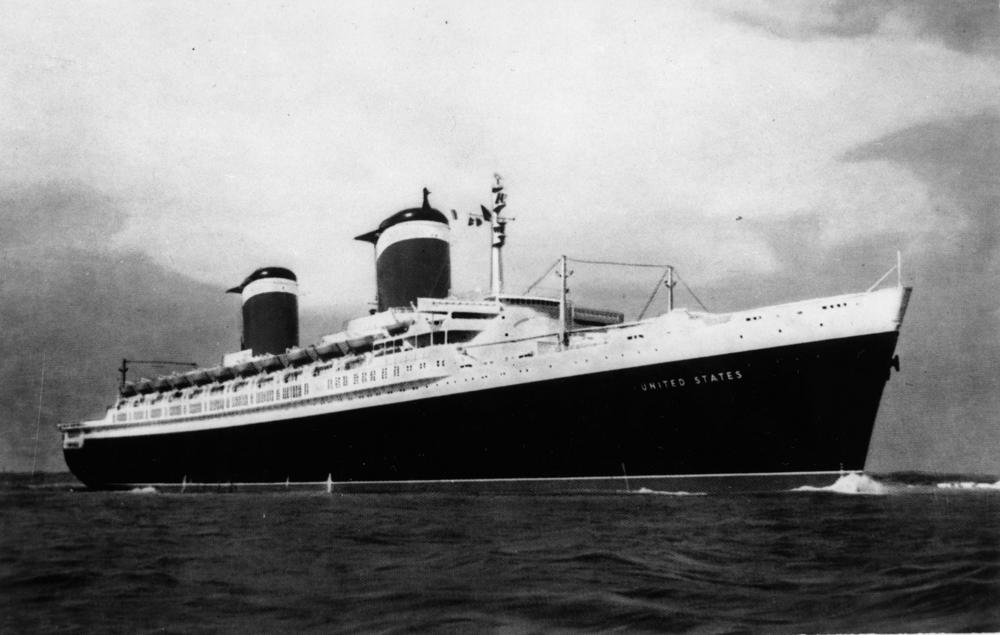
The final ship was not a revival of earlier Atlantic grandeur in old terms, but a distilled and highly disciplined American answer to the liner question.
Built for Hamburg America, the ship that would later become Leviathan belonged first to a German prestige and scale logic. It established a benchmark in size, but not one rooted in American design priorities.
Under U.S. control and later operation, Leviathan became a powerful symbol of American Atlantic presence. Yet it remained, in conception, an adopted ship. That distinction matters for how this collection is read.
Gibbs’ thinking matured around safety, weight control, compartmentation, structural integrity, and propulsion efficiency. The great ship of the future, in his view, had to be designed as a total system.
Ambition outran opportunity. Proposals, studies, and design thinking continued, but economic realities and shifting markets limited the immediate creation of an American-built answer at the highest level.
Strategic transport, safety, and structural resilience gained even greater importance. The future liner would need to satisfy both civilian prestige and national utility.
The result was a ship of exceptional speed and severe discipline. Fire-resistant construction, careful weight control, and technical rigor defined it. In spirit, it was less a descendant of Leviathan than an answer to the questions Leviathan had exposed.
One productive way to read this sequence is to see Leviathan as the inherited giant, Gibbs as the intervening mind, and United States as the fully argued vessel.
Places United States within the wider culture of prestige, speed, and transatlantic competition.
Useful for thinking about delay, contingency, and how major liner ambitions were often shaped by disruption.
A strong companion theme for Gibbs, whose design logic privileged system performance over ornamental excess.
Helps situate American liner ambition within the larger competitive and institutional history of Atlantic service.
Read Leviathan not just as a great liner in service, but as an adopted giant whose career illuminates the distinction between possession and conception.
Open ship guideRead United States as the disciplined culmination of a long design philosophy: speed, safety, lightness, and technical control brought into unusually concentrated form.
Open ship guide