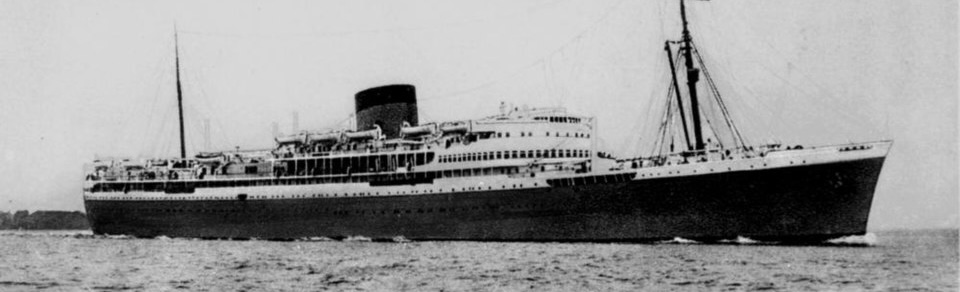
Athlone Castle
Union-Castle Line · entered service 1936 · Ship Guide
Overview
Athlone Castle was a major Union-Castle Line mail and passenger liner built for the Southampton–Cape Town service in the late interwar period. She belonged to the important group of fast diesel-powered Union-Castle mail ships that symbolized the line’s mature identity: lavender hull, disciplined schedule, and a route structure centered on Britain and South Africa rather than the North Atlantic. Her career bridged two distinct worlds, first as a prewar imperial mail liner and then as a wartime troopship before returning to commercial service after 1945.
In collecting and interpretation, Athlone Castle is especially valuable because she represents late Union-Castle service at a high level of refinement. Material tied to her often reflects mail-contract prestige, South African route culture, and the transition from peacetime passenger elegance to wartime military transport.
Key Facts
Design & Construction Context
Athlone Castle was built for one of the most distinctive route identities in liner history. Union-Castle did not compete on the North Atlantic; instead, it cultivated a precise and highly branded mail service between Britain and South Africa. Her design reflects that world: fast enough to support a demanding schedule, large enough for meaningful passenger service, and refined enough to represent the line’s established prestige.
She also belongs to the late generation of important British motor liners, when diesel propulsion had become central to long-distance passenger and mail service. In that sense, she stands in a different technical and stylistic world from the earlier steam-era Castle and Union liners, even while continuing the same route tradition.
Service History (Summary)
1935–1936: Built by Harland & Wolff at Belfast, launched in November 1935, completed in May 1936, and sent on her maiden voyage from Southampton to Cape Town on 22 May 1936.
1936–1939: Entered Union-Castle’s South African mail service and quickly became one of the line’s principal ships. In April 1937 she set a new record time to Cape Town, and in November 1937 she became the first mail ship to call at East London.
1938: Helped inaugurate the accelerated 14-days-or-under schedule associated with the 1936 mail contract, reinforcing her role as a route-defining mail ship rather than just a conventional passenger vessel.
1940–1946: Requisitioned for wartime troopship service. During the war she participated in major military transport operations, including North African campaign movement, and over six years carried roughly 148,000 people without being lost.
1946–1947: After troop repatriation voyages to Australia and Singapore, she went to Belfast for refurbishment and then returned to Union-Castle commercial service in 1947.
1947–1965: Resumed the Southampton–Cape Town service in peacetime and remained in operation until 1965, an unusually long life for a prewar liner whose career had been interrupted but not destroyed by war.
1965: Left Cape Town for the last time in July, was withdrawn from service, sailed to Taiwan in August, and arrived at Kaohsiung for scrapping in September 1965.
Interpretive Notes
This is a South African mail liner, not an Atlantic liner: Athlone Castle should be interpreted through the Union-Castle Southampton–Cape Town service framework, where mail-contract discipline and route identity matter as much as passenger comfort.
Peacetime and wartime material should be separated carefully: prewar passenger ephemera, wartime troopship references, and postwar return-to-service material belong to distinct interpretive phases and should not be casually merged.
She represents mature Union-Castle style: because she was a late and important expression of the line’s branded South African service, artifacts tied to her can be particularly useful for documenting the final strong phase of that route tradition before later contraction and change.
Built for the accelerated Cape Mail system: Athlone Castle belonged to Union-Castle’s disciplined Britain–South Africa service, where reliability, port sequence, and schedule adherence were part of the ship’s identity. Her peacetime passenger role should therefore be read within the operating system of the Cape Mail rather than as an isolated liner career.
Wartime troop service created a sharply different phase. Passenger accommodations, route priorities, and onboard use changed substantially under military requirements, so wartime photographs and documents should not be treated as straightforward evidence for the prewar passenger configuration.
The ship’s value as evidence lies partly in that contrast: prewar mail schedules and wartime troop records describe the same hull under fundamentally different operating priorities.
Evidence-first ship guide