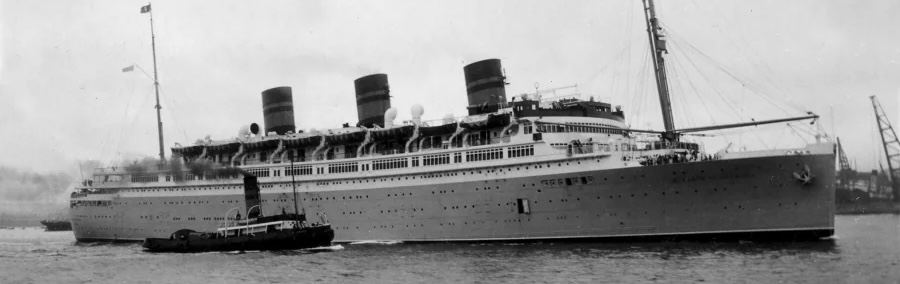
Monarch of Bermuda
Furness Bermuda Line · 1931 · Ship Guide
Overview
Monarch of Bermuda was built for the Furness Bermuda Line and entered service in 1931 as a luxury passenger ship intended specifically for the New York–Bermuda route. She belongs to that interesting category of “destination liners”: vessels whose public identity was inseparable from the tourist appeal of the place they served. In this case, the ship was marketed not as a migrant carrier or Atlantic greyhound, but as part of the Bermuda holiday experience itself.
Her later career sharply divides into distinct collecting eras: prewar Bermuda tourism material, wartime troopship references, and postwar fire / rebuilding narratives leading into her later life as New Australia. For cataloging, it helps to keep those phases separate rather than flattening everything into a single ship story.
Key Facts
Secondary sources differ slightly on rounded dimensions and on whether they foreground builder yard naming as Walker, Newcastle, or Vickers-Armstrongs in broader form. When precision matters, a dated register entry or builder record is the best anchor.
Design & Route Context
Monarch of Bermuda was designed for a very specific trade: affluent vacation travel from New York to Bermuda. That made her different in tone from many better-known ocean liners. Her appeal lay in comfort, climate, leisure, and route branding rather than speed records or immigrant volume.
In collecting terms, that matters because surviving ephemera often presents the ship and destination as a package. Brochures, menus, passenger lists, and labels frequently foreground Bermuda scenery, resort imagery, or the glamour of the island season. The ship is often less a subject in isolation than a floating extension of Bermuda tourism marketing.
Service History (Summary)
1931–1939: Entered Furness Bermuda Line service on the New York–Hamilton route. This is the key period for classic passenger ephemera and destination-driven advertising material.
1939–1945: Requisitioned for wartime service and used as a troopship. Civilian luxury identity gave way to military utility, as happened with many interwar passenger vessels.
1945–1947: Intended to return to civilian service after the war, but while undergoing reconversion work she was devastated by fire in 1947.
After 1947: Rather than disappearing entirely, the ship entered a new life through rebuilding and later service under other names, especially New Australia. That later career is historically important, but it should not be allowed to blur the prewar Bermuda identity when describing original Furness Bermuda Line artifacts.
Interpretive Notes
Destination-first collecting: objects tied to Monarch of Bermuda often belong as much to Bermuda tourism history as to ship history. Postcards and brochures may show hotels, palm-lined quays, or harbor scenes just as prominently as the vessel.
Name discipline matters: pre-1947 Furness Bermuda Line material should remain cataloged to Monarch of Bermuda. Later emigrant-ship or Greek Line material belongs to New Australia or Arkadia, even though it is the same hull.
“Luxury liner” claims: they are often justified in period marketing, but still should be treated as descriptive language rather than objective rank unless supported by dated comparative sources.
Evidence-first ship guideSources (Selected)
- Ocean Liner Curator — Sources (master bibliography)
- Royal Museums Greenwich — Monarch of Bermuda object record / later New Australia context
- Shipping Wonders of the World — contemporary-style technical and descriptive summary
- SSMaritime — Monarch of Bermuda illustrated history (research aid)
- SS New Australia (includes Monarch of Bermuda origins; cross-check recommended)