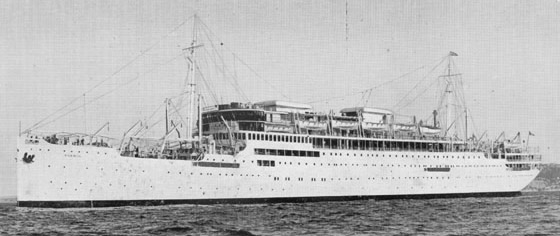
MS Aramis (1932)
Messageries Maritimes · entered service 1932 · Ship Guide
Overview
MS Aramis was the third of Messageries Maritimes' closely related interwar motor liners built for the Far East service, alongside Félix Roussel and Georges Philippar. Launched at La Seyne in June 1931 and entering service in October 1932, she combined diesel propulsion, substantial passenger accommodation, and a distinctive twin-square-funnel profile.
Her career later became one of the most complex in the group. She grounded near the Chuzan Islands in 1933, was uprated for higher speed in the mid-1930s, converted into the French auxiliary cruiser X1 in 1939, seized by Japan in 1942 and renamed Teia Maru, used in prisoner-exchange and military transport work, and finally sunk by USS Rasher during the destruction of convoy HI-71 in August 1944.
Key Facts
The Third Far East Motor Liner
Aramis completed the trio of modern motor liners that represented the high point of Messageries Maritimes' early-1930s Far East fleet modernization. She was very close in concept to Félix Roussel and Georges Philippar, though not identical in every dimension or detail.
The three ships were designed for long-distance operation between Marseille and Asian ports rather than for North Atlantic express competition. Their diesel propulsion, large passenger capacity, and mixed-class arrangements reflected the requirements of the colonial and commercial route system through Suez and across the Indian Ocean.
Passenger Spaces
Surviving photographic collections show extensive first-, second-, and third-class interiors aboard Aramis. First-class facilities included luxury cabins, a dining room, smoking room, music salon, covered terrace, indoor pool, children's room, and promenade deck.
The existence of substantial accommodation below the conventional three passenger classes is also important. Like her sisters, Aramis carried large numbers of lower-fare or rationed passengers on the Far East route, making her a very different social environment from a purely luxury-oriented prestige liner.
The Chuzan Grounding
On 22 June 1933 Aramis grounded near the Chuzan Islands. The French cruiser Primauguet assisted in freeing the liner and towing her toward Japan for repairs.
The incident is especially well documented photographically and gives the ship one of the strongest visual event records among the three sisters. It also demonstrates how quickly a new long-distance liner could face serious navigational hazards on an unfamiliar or difficult route.
More Power in the Mid-1930s
During 1935–36 the ship's Sulzer machinery was substantially uprated. Power increased from roughly 11,000 to 15,600 horsepower, and speed rose by about three knots to approximately 19 knots.
Unlike Félix Roussel, which underwent a more conspicuous hull lengthening, Aramis' modernization was centered more heavily on propulsion performance. That distinction helps prevent over-generalizing modifications across the trio.
Auxiliary Cruiser X1
After the outbreak of the Second World War, Aramis was converted into an armed auxiliary cruiser. Under the designation X1 she received a heavy gun battery and operated in Southeast Asian waters, including patrols around the Sunda Strait and the South China Sea.
After the French collapse in 1940 the ship was disarmed at Saigon and used as a floating barracks. Her identity had already changed profoundly: an interwar passenger liner had become an improvised naval vessel and then a stationary military accommodation ship.
Japanese Seizure and Teia Maru
Japan requisitioned the ship in June 1942 and renamed her Teia Maru. Under Japanese control she was employed as a transport and also participated in wartime prisoner and civilian exchange operations.
One of the better-known exchanges occurred at Mormugao in Portuguese India in 1943, where Japanese and Allied exchange ships met under carefully negotiated neutral arrangements. The episode gives the former Aramis a role quite unlike ordinary troop transport.
Convoy HI-71
By August 1944 Teia Maru was operating as a Japanese transport in convoy HI-71, one of the large and heavily escorted convoys moving troops, oil, and supplies toward the Philippines and Southeast Asia.
American submarines intercepted the convoy off Luzon. During the night of 18 August, USS Rasher attacked on the surface using radar bearings and struck Teia Maru with multiple torpedoes. The ship caught fire and sank.
A Catastrophic Loss
Japanese convoy records indicate that several thousand military personnel and civilians were aboard. Casualty figures are extremely high, but surviving summaries divide the dead among troops, civilians, guards, gunners, lookouts, and crew in slightly different ways.
Evidence-first note: this guide avoids compressing those categories into one universal total. Combined Fleet records document the scale of the disaster and identify Rasher as the attacking submarine, but exact totals should remain tied to the source and category definitions used.
The Three Sisters Compared
The trio ultimately had radically different outcomes. Georges Philippar was lost after her first commercial round voyage in 1932. Félix Roussel survived the war and continued in passenger service into the 1950s. Aramis became first a French auxiliary cruiser and then a Japanese transport before being sunk in 1944.
Together, the three ships form a compact history of the volatility of interwar French ocean travel: technical ambition, colonial passenger service, fire and grounding, global war, requisition, regime change, and radically different endings.
Why Aramis Matters
Aramis matters because few liners changed role and national control so dramatically in such a short span. Her story crosses French commercial shipping, Vichy-era Southeast Asia, Japanese occupation, prisoner exchange, and the submarine war against Japan.
She also completes the historical picture of Messageries Maritimes' most ambitious early-1930s Far East motor-liner group.
Collecting Profile
Surviving material includes Messageries Maritimes postcards, interior photographs, route ephemera, photographs of the 1933 grounding, images of X1 in wartime armament, and Japanese-era photographs as Teia Maru.
Provenance is especially important because the same hull appears under three very different identities. Civilian Aramis, auxiliary cruiser X1, and Japanese Teia Maru material should be described separately rather than collapsed into one undifferentiated collecting category.
Interpretive Notes
The trio were closely related, not perfectly identical: dimensions, modifications, and later careers differed.
Aramis remained white in civilian Messageries service: wartime photographs under X1 or Japanese control should not be used to infer peacetime livery.
Casualty figures from the 1944 sinking require source labels: different records count troops, civilians, guards, and crew separately.
Evidence-first ship guideSources (Selected)
- Ocean Liner Curator — Sources (master bibliography)
- Encyclopédie des Messageries Maritimes — Aramis specifications, career, photographs, and interiors
- Encyclopédie des Messageries Maritimes — Félix Roussel comparison
- Encyclopédie des Messageries Maritimes — Georges Philippar comparison
- CombinedFleet.com — Teia Maru Japanese service and convoy chronology