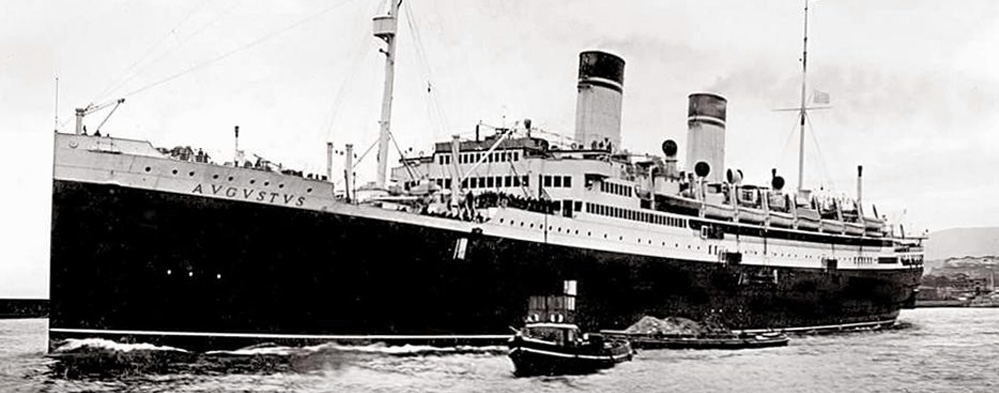
MS Augustus
Navigazione Generale Italiana / Italian Line · 1927 · Ship Guide
Overview
MS Augustus was a flagship-scale Italian motor ship built for Navigazione Generale Italiana (NGI) in the late 1920s, conceived as part of a paired program with her near-sister SS Roma. Where Roma is remembered as a turbine liner, Augustus is remembered as a major diesel-powered prestige ship—an interwar “statement vessel” that later straddled liner service, cruising, and (in wartime plans) aircraft-carrier conversion.
For collecting and cataloging, Augustus is a classic example of “one hull, multiple identities.” Passenger material will typically read Augustus (civil service), while naval/late-war narratives may reference the carrier conversion names Falco / Sparviero. Treat those as date-anchored statuses, not interchangeable names.
Key Facts
Some secondary summaries compress the route story (South America vs North Atlantic vs “world cruise” marketing) into a single sentence. When precision matters, prioritize dated company brochures, sailing lists, and contemporary press coverage for route and itinerary claims.
Design & Construction Context
Augustus sits at a useful hinge-point in ocean-liner technology and marketing. As a large diesel-powered passenger ship, she represents interwar confidence in motor propulsion at a prestige scale—paired with a public-facing image of modernity and comfort. In many narratives, her “motor ship” identity becomes a defining feature: a liner meant to be discussed as a technological achievement as much as a passenger environment.
The sister-ship pairing with SS Roma also creates a clean interpretive contrast for your guides: two outwardly similar ships, differentiated in machinery (diesel vs turbines) and—over time—operational emphasis (with Augustus often linked to South American service and later cruises in many summaries).
Service History (Summary)
1927–1932: Entered NGI service after her 1927 maiden voyage. Many summaries associate her with Italy’s longer-distance passenger market and South American routes.
1932–1940: Transferred into Italian Line (Italia Line) context following the 1932 consolidation of major Italian operators (commonly cited). Interwar brochures and cruise literature may reflect evolving class language and marketing emphasis after the consolidation.
1940–1944: Laid up and later taken into wartime conversion planning as an aircraft carrier (names Falco / Sparviero appear in many accounts), but the conversion did not reach operational combat service.
1944–1951: Scuttled as a blockship at Genoa in 1944 (commonly cited), raised after the war, and scrapped by 1951 in most summaries.
Interpretive Notes
Dating by name: Civil ephemera will almost always read Augustus. Wartime references to Falco / Sparviero should be treated as conversion-phase identifiers and dated accordingly.
“Motor ship” language matters: many period and later descriptions highlight diesel propulsion as a headline feature. In listings, that language can be accurate—but it can also be used as a vague “modern = better” signal. Curator practice: record the phrasing on the artifact, then add a separate note that explains what the term meant in context.
Sister-ship cross-referencing: brochures, postcard sets, and press pieces sometimes frame Augustus and Roma as a matched program. When you can, link them via “Related Liners” clusters and note whether an item is single-ship or paired marketing—because paired marketing can help narrow date ranges.
Evidence-first ship guideSources (Selected)