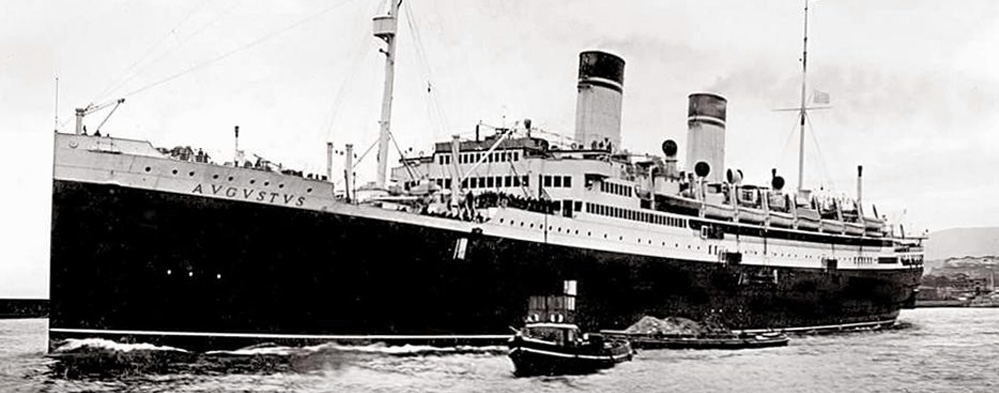
MS Augustus
Navigazione Generale Italiana · entered service 1927 · Ship Guide
Overview
MS Augustus was a major Italian motor liner built by Ansaldo at Genoa for Navigazione Generale Italiana (NGI). Launched on 13 December 1926 and placed in service in 1927, she was paired with the outwardly similar SS Roma but differed fundamentally in machinery: Augustus was diesel-powered, while Roma used steam turbines.
Her civilian career was centered first on South American service, with later North Atlantic and cruise work. During the Second World War the hull was requisitioned for conversion into an aircraft carrier, first under the name Falco and then Sparviero. The conversion was never completed.
Key Facts
A Prestige Motor Liner
At completion, Augustus represented the prestige potential of large diesel propulsion. Her four-engine, four-screw arrangement distinguished her from Roma and made the pair a useful comparison in interwar passenger-ship engineering. Period descriptions emphasized size, modernity, and economy as much as speed.
The ship's first regular emphasis was the Genoa–Naples–South America route. She also made North Atlantic voyages and, as economic conditions changed, undertook long cruises. This mixed employment is more accurate than classifying the ship as either a dedicated South American liner or a cruise ship for her entire civilian life.
Design and the Motor-Liner Statement
Augustus belonged to an interwar moment when diesel propulsion itself could be marketed as evidence of modernity. Her four-engine, four-screw machinery was not simply a technical distinction from Roma; it helped define the ship's public identity as a large prestige motor liner at a time when major passenger fleets were still divided between turbine and diesel solutions.
The sister pairing is especially useful historically because the two ships offered outwardly similar scale and purpose while embodying different machinery choices. Period brochures and later comparisons therefore deserve careful dating: “modern motor ship” language can describe a genuine engineering distinction, but it can also function as promotional shorthand rather than a neutral performance judgment.
Italian Line Era
NGI was absorbed into the state-directed consolidation that created the new Italian national shipping structure in 1932. Augustus thereafter operated under Italian Line identity. Material from before and after that reorganization should not be treated as interchangeable: operator imprint and voyage date help place brochures, passenger documents, and postcards in the correct corporate phase.
Falco and Sparviero
With Italy at war, Augustus was laid up and later requisitioned for conversion into an aircraft carrier. The Italian Navy first used the name Falco and then Sparviero. Official Italian naval history describes the project as an incomplete conversion of the passenger liner for escort-carrier duties.
Work proceeded slowly. Fondazione Ansaldo records that by the 1943 armistice the ship had been stripped down substantially but was far from an operational carrier. German forces later took control of the incomplete hull, which was sunk as a blockship at Genoa in 1944. It never served in combat as an aircraft carrier.
Postwar Disposal
Accounts agree that the wreck was recovered after the war and demolished, though secondary chronologies vary on the exact sequence between recovery, sale, and final dismantling. Fondazione Ansaldo records a sale in July 1947 and dismantling beginning the following month, while some summaries compress the disposal into a later “scrapped by 1951” date. The difference is best understood as a distinction between the start and completion of disposal rather than a separate postwar service career.
Evidence-first ship guide