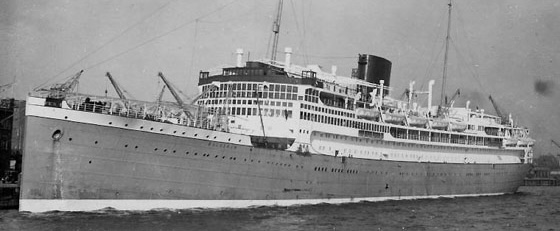
MS Baloeran (1930)
Rotterdamsche Lloyd · entered service 1930 · Ship Guide
Overview
MS Baloeran was a Dutch motor passenger and mail liner of Rotterdamsche Lloyd, completed in 1930 for the company's route between Rotterdam and the Dutch East Indies. With her near-sister Dempo, she was among the line's prominent modern interwar vessels.
Her wartime history is unusually complicated. Trapped in Rotterdam by the German invasion of 1940, she was subsequently taken over and renamed Strassburg for hospital-ship service. A mine strike and later British attacks destroyed the vessel off the Netherlands in September 1943.
Key Facts
Construction and an Interwar Flagship
Built at Fijenoord with outfitting at De Schelde in Vlissingen, Baloeran was launched on 29 August 1929. She was delivered on 9 April 1930 and sailed from Rotterdam on her inaugural passage to Batavia a week later.
The ship's diesel machinery and interior architecture expressed the modernization of Dutch passenger shipping. Accounts of her early public rooms emphasize the Art Deco work of architect H. P. Mutters. Contemporary photographs, deck plans, and images of her interiors provide useful evidence of how the line presented travel to the Netherlands Indies.
The Rotterdam–Dutch East Indies Service
The route connected Rotterdam to Batavia (today Jakarta), Surabaya, and intermediate ports by way of the Mediterranean and Suez Canal. It served travelers and commerce within a Dutch colonial transport network; that historical context is integral to understanding the ship, rather than simply treating her as a luxury floating hotel.
Passenger accommodation was divided among several classes. Published figures vary slightly between records, while later rearrangements may complicate comparisons of plans and advertisements. The vessel's passenger-cargo capacity also made freight a central element of her commercial purpose.
Peacetime Incidents and Refitting
A 1931 collision with the British motor vessel Silverbeech near Surabaya is recorded in maritime historical databases. The incident caused damage but did not end Baloeran's service.
A 1937 refurbishment of passenger accommodation is documented by the ship's pictorial record. This is a useful dividing line when dating interiors, brochures, and passenger photographs: images from the maiden-voyage era need not represent the later arrangement.
War and the Name Strassburg
At the time of Germany's invasion of the Netherlands in May 1940, Baloeran was in Rotterdam and could not escape. German authorities initially used her substantial electrical plant as a source of electricity before formally requisitioning the ship in May 1941.
Refitted as the hospital ship Strassburg, she entered that service in July 1941 and continued until May 1943. The wreck heritage account notes an unusual combination of visible Red Cross hospital markings and camouflage, which became central to how British forces assessed her wartime status. That issue should be described as an interpretation of the contemporary military circumstances rather than simplified into a legal conclusion.
Mined and Destroyed off IJmuiden
On 1 September 1943, while sailing toward Hamburg, Strassburg struck a British acoustic mine near IJmuiden. Her crew beached the damaged ship to prevent immediate sinking.
The stranded vessel subsequently came under British attack. Heritage accounts date a motor torpedo boat attack to 19 September and final destruction by aircraft to 20 September, while some archival summaries compress the sequence. The mine strike, torpedo attack, and later bombing were distinct events, not three names for one sinking. Remains of the wreck survive offshore.
Interpretive Notes
One hull, two service identities: the Dutch Baloeran and German Strassburg refer to the same vessel, in different political and operating circumstances.
Colonial context: the Netherlands East Indies route was a colonial-era transport system, with social and economic relationships reflected in class divisions and passenger records.
Loss chronology: distinguish the mine strike on 1 September from later attacks on the stranded ship.
Evidence hierarchy: maritime registry and Dutch underwater cultural heritage records are preferable to unqualified retellings for technical dates and wreck provenance.
Evidence-first ship guideRelated Guides
Compare sister MS Dempo (1931), which remained in Allied service and was sunk in 1944. For other Dutch passenger liners, explore the Ship Archive.
Sources (Selected)
- Ocean Liner Curator — Sources
- Maritiem Historische Databank — Baloeran, registry and service events
- Cultural Heritage Agency of the Netherlands — Baloeran wreck heritage record
- Lloydatelier — Baloeran photographic and historical collection
- Indische Buurten — Baloeran and Dutch East Indies service context