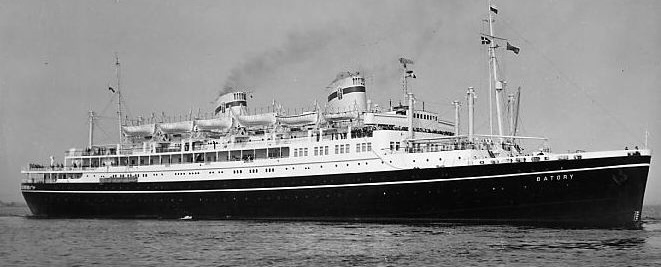
MS Batory (1936)
Gdynia-America Line · entered service 1936 · Ship Guide
Overview
MS Batory was one of two modern motor liners built in Italy for Gdynia-America Line as Poland sought to modernize its transatlantic passenger service in the 1930s. Named for King Stefan Batory, she entered service in 1936 and quickly became one of the best-known ships of the Polish merchant marine.
Her career ultimately stretched far beyond her original Gdynia–Copenhagen–New York role. During the Second World War she served as an Allied troop transport and participated in operations ranging from Norway to North Africa. After the war she returned to passenger service, later shifted to India and Middle East routes, and finally resumed transatlantic crossings to Canada before retirement in 1969.
Key Facts
A Modern Polish Transatlantic Liner
Batory and sister Piłsudski were ordered as part of Poland's effort to replace older emigrant-era tonnage with modern passenger ships capable of attracting both immigrant and tourist traffic. The ships were built at Monfalcone and represented a conspicuous statement of Poland's growing maritime ambitions through the new port of Gdynia.
The North Atlantic route linked Gdynia and Copenhagen with New York, and at times Halifax. Winter cruises extended the ship's commercial role beyond line voyages, reflecting the broader interwar trend toward dual-purpose liners.
Passenger Life and National Identity
Batory carried a distinctly Polish cultural identity. Interior decoration, artwork, furnishing, and service helped make the ship a floating representation of modern Poland rather than simply a generic transatlantic liner. Surviving photographs and archival collections preserve unusually rich evidence of these spaces.
That national symbolism later became one reason the ship occupied such a prominent place in Polish public memory. The vessel functioned simultaneously as transportation infrastructure, national showcase, and a recurring point of connection between Poland and overseas communities.
War Service
The outbreak of war ended Batory's normal commercial schedule. The ship came under Allied control and was converted for military transport. Polish government material documents her participation in the Norwegian campaign in 1940 alongside other Polish ships, while later wartime service included troop movements, evacuations, and amphibious operations.
Her best-known military work included transport connected with North Africa during Operation Torch. Contemporary military history records Batory landing troops near Oran and later carrying further contingents to Algeria. She survived repeated exposure to wartime hazards and acquired the enduring nickname “Lucky Ship.”
Popular accounts attribute a very long list of dramatic episodes to the ship. Where precise voyage claims matter, they should be checked against convoy, military, or ship records rather than repeated solely because they appear in later retellings.
Children, Troops, and Civilian Evacuation
One of the most human dimensions of Batory's wartime history was the transport of evacuees as well as military personnel. In August 1940 she carried hundreds of British children to Australia under the Children's Overseas Reception Board program, part of the wider effort to move children away from expected bombing in Britain.
That voyage reminds us that a wartime transport ship did not carry only soldiers. The same large passenger hull could move troops, evacuees, officials, and civilians depending on strategic need.
Postwar Return
After the war Batory returned to civilian service and resumed transatlantic operation. But the political circumstances surrounding Poland had changed completely. The ship now operated under a communist government and increasingly became entangled in Cold War politics as well as ordinary passenger transport.
In the early 1950s her route shifted away from New York. Polish Ocean Lines later employed her on services toward India and the Middle East before a 1957 refit prepared her for renewed North Atlantic work, this time with Montreal as a principal western terminus.
Cold War Passenger Service
Batory's postwar career is historically valuable precisely because it continued through a period when international passenger shipping was being reshaped by politics as much as technology. She carried emigrants, visitors, families, officials, and tourists between a Soviet-bloc Poland and destinations abroad.
The ship's existence therefore complicates any simple narrative in which the classic ocean liner disappears immediately after 1945. Batory remained commercially and culturally important for decades after the war, even while air travel steadily reduced the role of long-distance sea transport.
Retirement and Afterlife
Batory left regular service in 1969 after more than three decades. She was briefly used as a floating hotel at Gdynia, but the experiment did not prove economically sustainable. The ship was subsequently sold for demolition and broken up in Hong Kong in the early 1970s.
Her name and public role were effectively continued by the later Stefan Batory, but the two ships should be kept clearly distinct in historical and collecting descriptions.
Why Batory Matters
Batory fills several important gaps in ocean-liner history. She represents interwar Polish maritime ambition, the Baltic-to-America passenger trade, Allied wartime transport, postwar migration, and Cold War liner service. Few ships connect those themes so directly.
Her longevity also makes her useful for understanding the transition from the classic emigrant liner to the postwar passenger-and-cruise market. The ship that entered service in 1936 belonged to a very different political, commercial, and technological world from the one in which she retired in 1969.
Collecting Profile
Surviving material includes Gdynia-America Line and Polish Ocean Lines brochures, passenger lists, menus, tickets, luggage labels, postcards, interior photographs, wartime documentation, and later cruise material. Polish archives also preserve photographs and administrative records connected with the ship.
Because Batory served under different ownership and management structures across war and peace, provenance should distinguish carefully between prewar Gdynia-America Line material, wartime Allied service, and post-1951 Polish Ocean Lines material.
Interpretive Notes
The first voyage can mean two different things: Batory made an inaugural Mediterranean cruise in April 1936 before her first scheduled transatlantic sailing on 18 May.
Wartime claims should be voyage-specific: the ship participated in major Allied operations, but later popular accounts sometimes compress several years of service into a single heroic narrative.
The “Lucky Ship” label is historical memory, not a technical category: it reflects her survival through an unusually hazardous wartime career rather than immunity from danger.
Evidence-first ship guideSources (Selected)
- Ocean Liner Curator — Sources (master bibliography)
- Polish Ocean Lines — Batory fleet record
- Maritime Legend of Gdynia — Batory career history
- Archiwum Akt Nowych — archival materials relating to MS Batory
- Institute of National Remembrance — scholarly article on Batory's 1936 inauguration and career