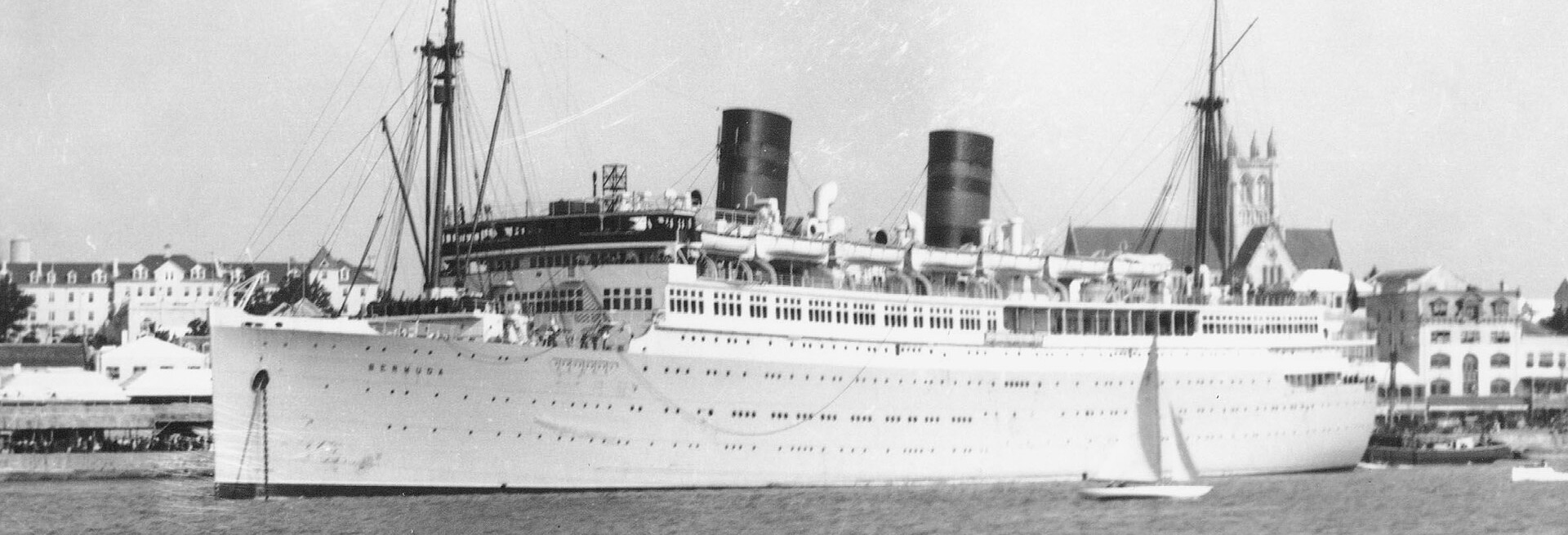
MS Bermuda
Furness Bermuda Line · 1928 · Ship Guide
Overview
MS Bermuda was a Furness Bermuda Line motor liner built specifically for the New York–Hamilton tourist trade. Completed by Workman, Clark & Co. at Belfast in December 1927 and placed in service in January 1928, she was a technically ambitious four-screw diesel ship whose short career was dominated by two serious fires in 1931.
The previous guide overstated several particulars. Published register-based summaries give a length of about 525.9 ft, a beam of 74.1 ft, and a service speed of roughly 17 knots rather than 550 ft, 76 ft, and 19 knots. Her 691-passenger complement was also not entirely first class: commonly cited figures divide it into 616 first-class and 75 second-class passengers.
Key Facts
A Destination Liner
Bermuda was designed for a market built around the destination rather than the crossing itself. The New York–Hamilton service sold Bermuda as a fashionable resort experience, so onboard comfort and schedule convenience mattered more than competing for Atlantic speed records. A roughly forty-hour passage allowed the ship to function as the maritime extension of the island holiday.
That route identity is essential when interpreting ephemera. Menus, brochures, luggage labels, passenger lists, and postcards belong to a tightly branded leisure system linking New York with Bermuda, not to the mass-migration economy associated with many contemporary Atlantic liners.
Diesel Propulsion and Modernity
Four diesel engines drove four propeller shafts, making Bermuda part of the expanding interwar motor-liner story. Diesel propulsion was still sufficiently novel in a large passenger vessel to carry marketing value, and the machinery helped distinguish her from steam-powered predecessors on the route.
The ship’s technical importance should nevertheless be kept proportional: she was not primarily an engineering demonstrator. Her machinery served a very specific commercial objective—reliable, frequent destination service between New York and Hamilton.
The 1931 Fires
Two fires in 1931 effectively destroyed Bermuda’s commercial future. The second and most destructive outbreak occurred at Hamilton on the night of 16–17 June. Multiple fires were discovered aboard, and crews, local firefighters, military personnel, Royal Navy personnel, tugs, and shore equipment were brought into the response.
To prevent the fire spreading into lower parts of the ship, Bermuda was partly sunk at the quay. Her upper works were badly burned, and although the hull was later raised on 24 December 1931, the damage was beyond economical repair for normal passenger service.
From Burned Hulk to Wreck
Workman, Clark acquired the damaged vessel, removed machinery and reusable fittings, and the stripped hulk was eventually sold for breaking at Rosyth. In April 1933 the tug Seaman began towing the hulk around northern Scotland.
On 30 April the tow parted near the Badcall Islands in Sutherland. Attempts to recover control failed and the hulk grounded where it could not be refloated. Much was salvaged in place, but portions of the wreck remained. Thus Bermuda did not simply proceed from fire damage to ordinary scrapping; her final chapter was itself a marine casualty.
Rebuilding the Route After Bermuda
The destruction of Bermuda did not end Furness Bermuda Line’s New York–Hamilton business. Her loss helped create the need for replacement tonnage, and the route soon became associated with later Furness ships whose names are much better known. This succession can cause postcards and promotional pieces to be casually assigned to the wrong vessel. A generic “Bermuda Line” imprint is therefore not enough: ship name, date, silhouette, and interior details all matter.
The route itself also explains why the ship’s career generated a different documentary record from a transatlantic migrant liner. Holiday brochures, resort advertising, shore-excursion material, fashion photography, and hotel partnerships can be as historically important as traditional passenger lists. The commercial product being sold was not merely transportation to an overseas port but a packaged destination experience.
Collecting and Attribution Notes
Pre-fire material is the most straightforward category because it documents the intact passenger liner during normal service. Fire photographs, salvage views, insurance material, and images of the partly submerged ship at Hamilton belong to a separate casualty phase. Items from the 1932–33 disposal period should be labeled with equal care: by then the vessel was no longer functioning as a passenger liner even though the hull still carried the same name.
The common “MV Bermuda” styling is widespread in later sources, but “MS Bermuda” better reflects the motor-ship prefix used in much period and specialist material. Either form may appear in collections; the important point is to avoid treating the prefix as evidence of a different vessel.
Why Bermuda Matters
Bermuda captures a distinct interwar liner niche: short international destination service, high-end tourism, and early large-scale diesel propulsion. Her brief life also demonstrates how a ship can generate several materially different evidence phases in only a few years—pre-fire passenger service, casualty documentation, salvage records, and wreck history.
For attribution, the safest anchors are date, route, operator imprint, and whether an item belongs to the intact passenger liner or the post-1931 casualty/disposal period.
Evidence-first ship guideSources (Selected)
- Ocean Liner Curator — Sources (master bibliography)
- MS / MV Bermuda — register-derived particulars, fire chronology, and wreck history with bibliography
- GG Archives — Furness Bermuda passenger-service and ephemera context
- David Burrell, Furness Withy 1891–1991 — company history
- R. M. Wilson, The Big Ships — contemporary-era liner reference