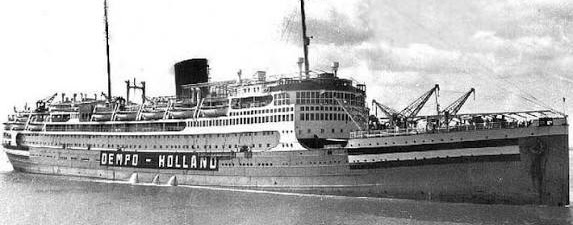
MS Dempo (1931)
Rotterdamsche Lloyd · entered service 1931 · Ship Guide
Overview
MS Dempo was a Dutch motor passenger and mail liner built for Rotterdamsche Lloyd's route between Rotterdam and the Netherlands East Indies. She entered service in 1931, following her near-sister Baloeran, and represented a major investment in the modernization of interwar Dutch overseas passenger shipping.
Unlike Baloeran, which was captured and used by Germany, Dempo remained available to the Allied war effort. Requisitioned for troop transport in 1941, she survived until March 1944, when she was sunk by German submarine U-371 in the Mediterranean.
Key Facts
Construction and Dutch Design
Dempo was laid down at De Schelde in Vlissingen in July 1929 and launched on 26 July 1930. Completed early in 1931, she was part of an ambitious two-ship program intended to modernize Rotterdamsche Lloyd's long route to the Dutch East Indies.
Period accounts describe attention to passenger interiors, furnished in the modern style by Dutch designers and manufacturers. Contemporary Dutch newspaper reporting is especially useful here because it documents how the building program was understood during construction, rather than relying entirely on later retrospective histories.
Route to the Dutch East Indies
The ship was scheduled to depart Rotterdam on 18 March 1931 for Batavia (now Jakarta), traveling through Southampton, Lisbon, Tangier, Gibraltar, Marseille, Port Said, Suez, Colombo, Sabang, Belawan, and Singapore. Service connected European ports to a Dutch colonial trading and passenger network.
The commercial story involves passengers, cargo, and mail, as well as broader histories of colonial administration, mobility, and trade. Passenger class, fares, and interior arrangements require dated schedules and deck plans: configurations could change as shipping needs evolved.
Service in the Late 1930s
The vessel continued scheduled passenger work through the 1930s. Some records report changes to her passenger accommodation and gross tonnage after later work; a figure quoted from a 1944 loss report should not automatically be assigned to her original 1931 condition.
The wartime disruption of routes to the East Indies reshaped the company's shipping network. Dempo was reportedly laid up at Surabaya in 1939 and employed in alternative service before her transfer to Allied troop transport.
Troopship Conversion
In early 1941, Dempo was brought into the British Ministry of War Transport system and converted in Liverpool for troop-carrying duties. The change from a peacetime liner to an Allied transport was not merely a change in itinerary; alterations to berthing and operating arrangements reflected military requirements.
During the war, the ship moved troops in Allied waters, including Mediterranean operations. Shipping casualty registers provide especially precise information for the final voyage, while accounts of earlier military service should be interpreted using voyage-specific evidence.
The Loss of 17 March 1944
On 17 March 1944, Dempo was sailing from Naples to Oran as part of convoy SNF-17. German submarine U-371, commanded by Waldemar Mehl, fired torpedoes against the convoy north-northeast of Bougie (present-day Béjaïa), Algeria. Both Dempo and the American cargo ship Maiden Creek were hit.
A torpedo struck Dempo on her starboard side. Her master attempted to beach the vessel, but she settled and sank at approximately 10:55 that morning. The uboat.net merchant-shipping loss register lists 333 crew aboard and 333 survivors, with no deaths; this is a recorded crew complement for that voyage, not the ship's total passenger capacity or a general measure of troopship berthing.
Interpretive Notes
Two related Dutch liners, different wartime paths: Baloeran became the German hospital ship Strassburg, whereas Dempo served with the Allies as a troop transport.
Distinguish peacetime and wartime figures. Gross registered tonnage and accommodation statistics may reflect refits, registry changes, or different measurement conventions.
Loss dates are specific. Dempo was torpedoed and sank on 17 March 1944; unlike her sister's staged 1943 loss, this was one day's casualty sequence.
Sources for casualty numbers. The recorded 333 persons and 333 survivors refer to the people documented aboard at the time of loss. Additional claims about troops or passengers should be examined against the specific convoy records.
Evidence-first ship guideRelated Guides
Compare her sister MS Baloeran (1930), whose wartime career and fate were markedly different.