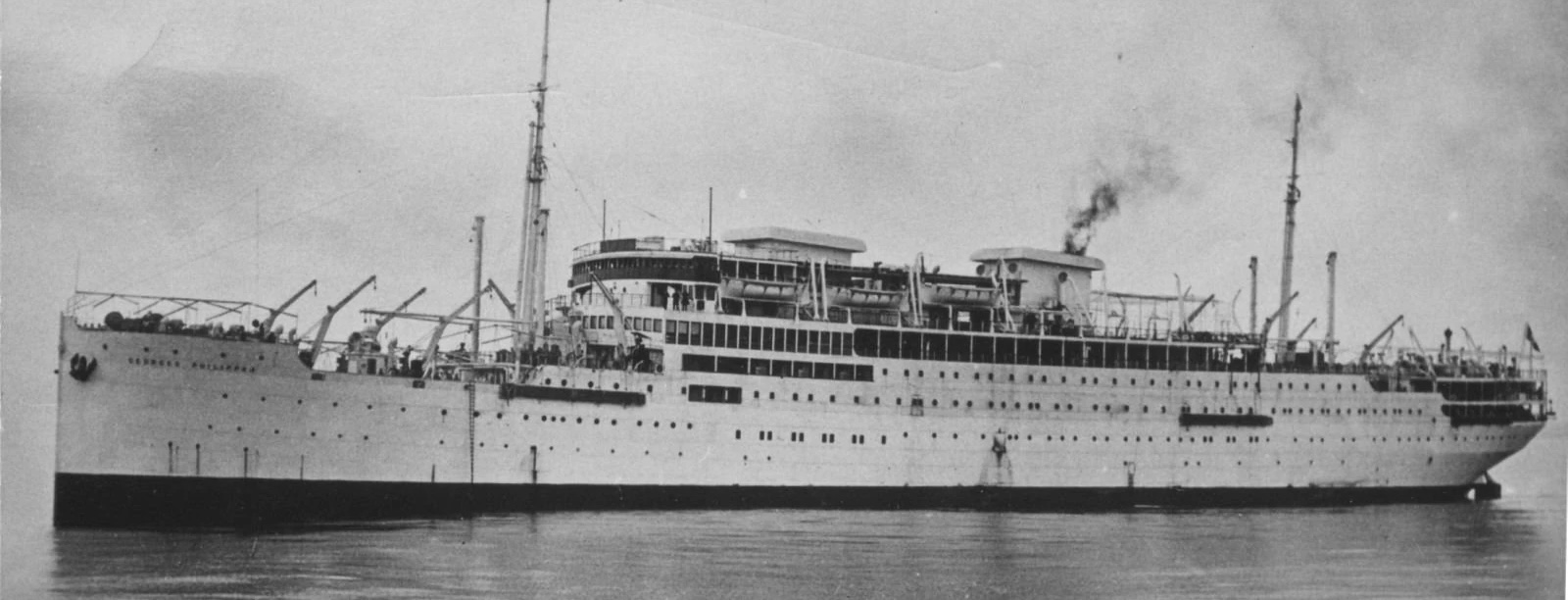
MS Georges Philippar (1932)
Messageries Maritimes · entered service 1932 · Ship Guide
Overview
MS Georges Philippar was a new French motor liner built for Messageries Maritimes' long Far East service. Launched at Saint-Nazaire in November 1930 and completed for service in early 1932, she was intended to represent a modern generation of diesel-powered passenger ships linking Marseille with ports across the Indian Ocean and Southeast Asia.
Her commercial career lasted only one round voyage. After sailing from Marseille on 26 February 1932, Georges Philippar reached the Far East and began the homeward passage. During the night of 15–16 May, while in the Gulf of Aden region, fire broke out in the passenger accommodation and spread with extraordinary speed. The ship was abandoned, continued burning for days, and ultimately sank. Fifty-two people were reported dead or missing.
Key Facts
A Modern Far East Liner
Georges Philippar belonged to Messageries Maritimes' effort to modernize its Far East passenger service with large diesel motor ships. Her two square funnels, extensive passenger accommodation, and long-range machinery gave her a distinctive appearance and a commercial role very different from the North Atlantic express liners of the same period.
She was named for Georges Philippar, then a leading figure in the company. The decision was unusual because company practice generally avoided naming a ship for a living serving president. The association became tragically uncomfortable after the loss, and the name was not reused on a replacement liner.
Construction Problems and Early Warning Signs
The ship's pre-service history contained documented warning signs. Messageries Maritimes records describe a fire in refrigerated spaces during fitting out in late 1930, attributed to an electrical short circuit. They also record delay surrounding an electrical switchboard that had been judged non-compliant during inspection.
Those facts matter because they establish that electrical and fire-safety concerns existed before the final voyage. They do not, by themselves, prove the cause of the May 1932 disaster. A responsible reconstruction has to keep the distinction between documented precursor problems and a demonstrated causal chain.
The First and Only Commercial Voyage
After an inaugural cruise from Saint-Nazaire to Marseille in January 1932, Georges Philippar left Marseille on 26 February for the Far East. Surviving photographs place her in the Suez Canal in early March and later at Asian ports including Saigon and Hong Kong.
The outward passage was completed, and the ship began her return voyage to France in May. She departed Colombo for Djibouti on 10 May. Five days later, the voyage entered the history of major interwar liner disasters.
The Fire, 15–16 May 1932
A survivor account by Louis Christophe places the first unmistakable signs of the fatal fire in a port-side luxury cabin on D Deck during the early hours of 16 May. A passenger reported the smell of burning rubber and crackling sounds; smoke was then observed moving through partitions. The alarm reached the bridge, the engines were stopped, and an SOS was transmitted.
The fire spread rapidly through the superstructure. Electrical lighting failed, smoke filled passages, and communication through parts of the ship became difficult or impossible. Some lifeboats were themselves affected by the flames, complicating evacuation.
The speed with which fire travelled through interior partitions and decorative materials became one of the central features of later discussion of the disaster. It is safer to describe that observed behavior directly than to assign a single cause where the surviving evidence does not justify certainty.
Rescue
The Soviet tanker Sovietskaia Neft was the principal rescue ship and took aboard hundreds of survivors. The British cargo ships Mahsud and Contractor also assisted. Survivors were later transferred as the rescue operation evolved, including to the Messageries Maritimes liner André Lebon, which had been diverted toward the scene.
Among those lost was the prominent French journalist Albert Londres. His death helped give the disaster a cultural prominence in France that extended well beyond maritime circles.
Burning Wreck and Sinking
After abandonment, the ship continued burning while drifting. Survivor and company accounts describe the wreck remaining aflame for roughly three days. It eventually sank during the night of 19–20 May, well after the evacuation itself had ended.
This chronology is worth preserving carefully: the ship was effectively lost to fire on 16 May, but the hull did not immediately disappear beneath the sea. Photographs of the burning and later heavily damaged wreck therefore document different stages of the same casualty.
What Caused the Fire?
The cause remains the part of the story most vulnerable to overstatement. An accidental electrical origin has often been considered plausible because of the ship's earlier electrical problems, reports of local electrical irregularities, and the position of electrical equipment near the area where the fatal fire was first observed.
Other theories circulated at the time, including deliberate destruction. Threats reportedly made before departure contributed to suspicion. But suspicion, coincidence, and prior defects are not the same thing as proof. The surviving record supports saying that an electrical short circuit is a strong historical explanation; it does not support presenting every later sabotage theory as established fact.
Evidence-first note: this guide intentionally distinguishes between documented pre-existing electrical problems, eyewitness observations during the fire, and retrospective theories about causation.
Why Georges Philippar Matters
Georges Philippar matters because her loss exposes the risks hidden inside the visual modernity of the interwar motor liner. Diesel propulsion, fashionable interiors, and contemporary electrical systems could coexist with construction materials and installation practices that made fire extraordinarily dangerous once established.
Her story also broadens French liner history beyond the French Line and the North Atlantic. Messageries Maritimes maintained a global passenger network linking Marseille with the Mediterranean, Indian Ocean, Southeast Asia, and East Asia. Georges Philippar was built for that world.
Collecting Profile
Because the ship's commercial career was so brief, genuine voyage-specific material is naturally constrained. Useful survivals include Messageries Maritimes postcards, company promotional pieces, photographs from the inaugural and Far East voyage, contemporary newspapers and illustrated magazines, passenger documentation, and material relating directly to the fire and rescue.
The brevity of the career increases the importance of precise dating. A company postcard depicting Georges Philippar is ship-specific; a generic Messageries Maritimes item from the early 1930s is not automatically evidence that it was carried or used aboard this ship.
Interpretive Notes
Maiden voyage terminology requires care: the ship made an inaugural positioning or promotional cruise in January 1932 before the February commercial Far East voyage. The May disaster occurred on the return leg of that first commercial round voyage.
Fire origin is not fully settled: electrical failure is strongly supported as a plausible explanation, but the surviving evidence does not justify converting probability into certainty.
Fatality totals vary in later retellings: this guide follows the Messageries Maritimes record of 52 dead or missing and labels that source basis rather than flattening all later figures into a false consensus.
Evidence-first ship guideSources (Selected)
- Ocean Liner Curator — Sources (master bibliography)
- Encyclopédie des Messageries Maritimes — Georges Philippar specifications and career
- Messageries Maritimes archive — Louis Christophe survivor account of the fire and evacuation
- Messageries Maritimes archive — deck plans and fire-location notes
- Saint-Nazaire maritime history — builder record for Georges Philippar