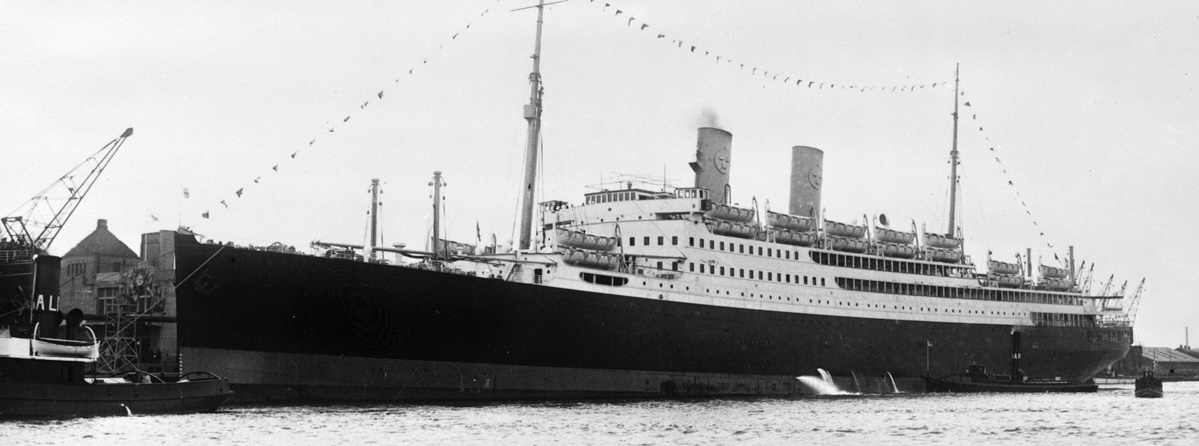
MS Gripsholm (1925)
Swedish American Line · entered service 1925 · Ship Guide
Overview
MS Gripsholm entered Swedish American Line service in November 1925 on the Gothenburg–New York run, notable as an early purpose-built diesel transatlantic passenger liner—part of a broader interwar shift toward efficiency, range, and dependable schedules rather than purely “record” speed. Her story is often told in two halves: a peacetime liner and cruise ship of the late 1920s–30s, and a wartime neutral-flag vessel chartered for exchange and repatriation voyages during World War II.
For collectors, Gripsholm is unusually “documentable” because many surviving artifacts are date-locked: passenger lists and menus with printed ship names, wartime exchange voyage material tied to specific ports, and press photography that is frequently captioned with clear context. That makes her a strong candidate for evidence-first cataloging—where the object itself can often carry the claim.
Evidence-first note: the ship is commonly referred to as MS (motor ship) or M/S. Contemporary documents sometimes vary. For labels, mirror the nomenclature on the artifact when possible.
Key Facts
Design & Construction (Context)
Gripsholm was ordered as a modern, efficient transatlantic liner at a moment when diesel propulsion was proving itself at sea. In a curator’s reading, she represents a different kind of “modernity” than the turbine speed queens: operational economy, range, and dependable service—qualities that shaped how lines marketed comfort and reliability in the 1920s.
Collecting implication: Swedish American Line’s branding is often crisp and consistent across shipboard and shore-side print. That’s helpful—but it also means many items are line-specific rather than ship-specific. The ship name printed in-period (or a date-locked voyage context) is the strongest attribution anchor.
Service History (Summary)
Delivered in November 1925, Gripsholm inaugurated a new era for Swedish American Line’s fleet and served the Gothenburg–New York route through the interwar years. Like many liners, she also participated in cruising as lines experimented with winter itineraries and leisure travel beyond traditional Atlantic schedules.
When describing an artifact: distinguish clearly between “shipboard-issued” (menus, stationery, passenger lists) and “agency/promotional” items printed ashore. Both are legitimate historical categories—just different evidentiary claims.
World War II: Exchange & Repatriation Voyages
During World War II, Sweden’s neutral status enabled certain Swedish-flag ships to operate under tightly controlled diplomatic arrangements. From 1942 to 1946, Gripsholm was chartered for exchange and repatriation voyages—carrying civilians, diplomats, internees, and other designated passengers between belligerent powers as part of negotiated swaps. Contemporary and later accounts often refer to her as a “Mercy Ship,” reflecting the humanitarian stakes (and the high visibility) of these sailings.
Curatorial note: wartime material tied to Gripsholm is frequently rich in documentation—official paperwork, port references, date lines, and published reporting. That makes it a strong area for evidence-first collecting, but it also invites exaggeration in listings. Require documentary anchors before accepting high-claim phrases like “exchange voyage artifact” or “carried on the Mercy Ship.”
Postwar Career & Renaming
After the war, Gripsholm returned to commercial service, but like many pre-war and interwar liners she faced an evolving passenger market. In 1954 she was sold to Germany and renamed Berlin for service under Norddeutscher Lloyd, continuing her working life into the 1960s before being scrapped (a commonly cited scrapping year is 1966).
Attribution tip: post-1954 items labeled “Berlin (ex-Gripsholm)” can be authentic to the hull’s later career, but they are not Swedish American Line material. Keep eras and operators cleanly separated in descriptions.
Collecting Profile (What Tends to Survive)
The most common—and most useful—survivals include: (1) passenger lists, menus, and onboard stationery with the ship name printed in the design, (2) postcards and brochures for Swedish American Line (ship-specific examples exist, but confirm), (3) photographs and press clippings (especially around wartime exchange voyages), and (4) later-career material under the name Berlin.
Practical method: prioritize artifacts that self-identify the ship (printed “Gripsholm”), or that can be date-locked by postmark, sailing date, or port context. If an item is “right line, right decade” but not ship-specific, label it conservatively: “Swedish American Line (period), ship attribution unverified.”
Motor-liner transition: Gripsholm belonged to the generation that demonstrated large passenger ships no longer had to be defined by steam-turbine propulsion. Her diesel machinery mattered commercially because fuel economy, range, and operating cost were becoming as important as prestige speed in the interwar passenger market.
That makes the ship valuable beyond Swedish-American Line history alone. She sits within a broader technological transition in which motor liners became credible long-distance passenger ships rather than experimental exceptions. Route material, machinery descriptions, and later service records should therefore be read together rather than treating propulsion as a detached technical fact.
Her long career also shows how quickly diesel propulsion moved from novelty into accepted mainstream liner practice across multiple operators and routes.
Interpretive Notes
Nomenclature varies in contemporary material: MS and M/S are both encountered. When cataloging an artifact, preserving the form printed on the object is preferable to silently standardizing it.
Wartime exchange voyages were a distinct operating phase: neutral-flag repatriation service should not be conflated with the ship’s normal peacetime liner and cruise work.
Evidence-first ship guide