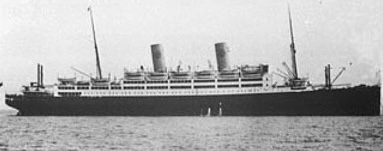
MS Kungsholm (1928)
Swedish American Line · launched 1928 · Ship Guide
Overview
MS Kungsholm was Swedish American Line's large interwar motor liner and one of the ships that helped make cruising a planned component of liner economics rather than merely an occasional sideline. Blohm & Voss launched her at Hamburg on 17 March 1928; she was delivered in October and departed Gothenburg for New York on her maiden voyage on 24 November.
She combined regular transatlantic service with winter cruising, and her interiors were deliberately arranged with that dual role in mind. Swedish American Line reduced the number of passengers carried on cruises so that space and service could be marketed as part of the leisure experience.
Her later identities are just as important as her Swedish career. The United States acquired the ship during the Second World War and renamed her John Ericsson; after the war she became Home Lines' Italia, and finally the floating hotel Imperial Bahama.
Key Facts
Passenger-capacity figures differ substantially between sources because liner-service and cruise configurations were not the same. Contemporary and archival descriptions should be dated before capacities are compared.
Diesel and the Swedish Atlantic
Kungsholm followed Swedish American Line's pioneering diesel liner Gripsholm. The line had already demonstrated that large motor ships could sustain regular transatlantic schedules, and Kungsholm expanded the formula with greater emphasis on cruise suitability.
The technology mattered commercially. Diesel machinery promised lower fuel consumption and operating costs than many contemporary steam plants, while the ship's moderate speed was adequate for a service marketed around comfort, Scandinavian modernity, and a dependable Gothenburg–New York connection.
Cruising as Part of the Design
Swedish American Line entered the cruise market before Kungsholm was completed, and the ship's interiors reflected that strategy. During cruise operation her passenger load was reduced substantially from liner-service capacity, allowing public rooms, deck space, and service to become part of a more spacious leisure product.
This matters for artifact interpretation. A Swedish American Line passenger list for a Gothenburg–New York crossing and a winter cruise brochure can both belong to the same period yet describe different passenger experiences, capacities, and itineraries.
Wartime: John Ericsson
In December 1941 Kungsholm was in New York as the United States entered the war. After negotiations, Swedish American Line sold her to the U.S. War Shipping Administration for wartime use. Renamed John Ericsson, she was operated under government contract and used principally for troop transportation.
The name change marks a complete documentary break: Swedish commercial ephemera gives way to U.S. government and military transport records. The same hull therefore belongs to two very different archival systems before and during the war.
Italia and Imperial Bahama
After the war the ship briefly returned to Swedish ownership but did not resume her old Swedish American Line passenger career. Home Lines acquired her and placed her in service as Italia from 1948. She subsequently appeared on several Atlantic, Canadian, Caribbean, and cruise itineraries.
In 1964 she was sold for conversion into a floating hotel at Freeport in the Bahamas and renamed Imperial Bahama. The hotel experiment was short-lived; the vessel was sent to Bilbao for demolition in 1965.
Interpretive Notes
MS, not SS: Kungsholm was a motor ship. Period captions sometimes use “SS” generically, but propulsion and official ship type should be recorded accurately.
One hull, four identities: Kungsholm, John Ericsson, Italia, and Imperial Bahama belong to different owners, routes, and historical contexts. Date and issuer should take precedence over hull identity alone.
Cruise capacity is not liner capacity: reduced cruise loads were intentional. Conflicting passenger totals may therefore describe different operating modes rather than factual mistakes.
Evidence-first ship guideSources (Selected)
- Ocean Liner Curator — Sources (master bibliography)
- GG Archives — MS Kungsholm archival collection and timeline
- Fondazione Ansaldo archive — Kungsholm / John Ericsson / Italia
- Swedish American Line history, with cited company and maritime sources
- Wikipedia — MS Kungsholm (1928), with Lloyd's Register references