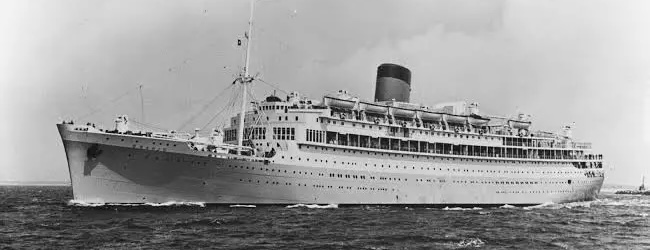
MS Oranje (1939)
Netherland Line · entered service 1939 · Ship Guide
Overview
MS Oranje was the pre-war flagship of Stoomvaart Maatschappij Nederland, generally known in English as the Netherland Line. Built at Amsterdam for the long passenger route between the Netherlands and the Dutch East Indies, she represented a mature form of the large diesel motor liner: fast, long-ranged, and designed for a service world very different from the North Atlantic express race.
Her timing could hardly have been more consequential. Oranje left Amsterdam on her maiden voyage on 4 September 1939, immediately after the outbreak of the Second World War in Europe. The conflict disrupted the service for which she had been built, and by 1941 she had been converted for Allied hospital-ship work. After the war she returned to civilian service, carrying passengers, repatriates, migrants, and later tourists before being sold in 1964 and renamed Angelina Lauro.
Key Facts
A Dutch East Indies Flagship
Oranje was launched by Queen Wilhelmina in September 1938 and was conceived as a flagship for one of the Netherlands' most important long-distance passenger routes. Unlike the great British, French, German, and Italian ships associated with North Atlantic competition, her commercial geography ran through the Mediterranean and Suez toward Southeast Asia.
The ship's three diesel engines and triple-screw arrangement gave her both substantial power and unusually high speed for a colonial-route liner. Her trial performance of roughly 26.5 knots was considerably above her normal service requirement. The distinction matters: trial speed is a measured performance under test conditions, not the same thing as sustained commercial service speed.
Measurement note: surviving references give different overall lengths and later tonnage figures because they do not always use the same measurement convention or the same stage of the ship's career. The figures above use the original Dutch registry record where possible and identify later-refit figures separately.
A Maiden Voyage in Wartime
Oranje departed Amsterdam for Batavia on 4 September 1939. Germany had invaded Poland three days earlier, and Britain and France had declared war on Germany on 3 September. The ship therefore entered service into a geopolitical crisis that immediately undermined the stable passenger schedule for which she had been designed.
She reached the Dutch East Indies but spent an extended period laid up at Surabaya as normal passenger operations became increasingly impractical. The German occupation of the Netherlands in May 1940 further separated the ship from her home country and transformed her strategic value.
Hospital Ship, 1941–1946
In 1941 the Dutch government-in-exile made Oranje available for Allied medical service. Conversion began in the Netherlands East Indies and was completed in Sydney. Her speed made her especially useful for moving wounded personnel over long distances, and she operated with Dutch shipboard personnel alongside Allied medical staffs.
The Australian War Memorial describes Oranje as the fastest hospital ship then in service. Dutch maritime records credit her with transporting tens of thousands of wounded servicemen over the course of the war. Exact totals vary according to how voyages and categories of patients are counted, so such figures are best tied to the source that reports them rather than presented as universally fixed.
Her wartime career is central to understanding the ship. Oranje was not merely a peacetime liner temporarily painted white; years of hospital service displaced the commercial career that her owners had expected when she was completed in 1939.
Return to Passenger Service
Oranje returned to Amsterdam in July 1946 and resumed civilian operation in a world substantially changed from the one for which she had been designed. Postwar voyages included repatriation traffic connected with the Dutch East Indies as well as regular passenger service between Europe and Southeast Asia.
The political transformation of Indonesia, changing migration patterns, competition from aircraft, and the broader decline of traditional long-distance liner travel gradually altered her role. Cruising became more important, and a major 1959 refit reorganized her accommodation into first and tourist classes with a total capacity substantially higher than in her original four-class arrangement.
The 1953 Collision with Willem Ruys
One of Oranje's best-known postwar incidents came in January 1953 when she collided with the Rotterdam Lloyd liner Willem Ruys in the Red Sea. Both ships were damaged but survived. The episode is particularly notable because the two Dutch liners were prominent contemporaries serving overlapping Europe–Southeast Asia passenger networks.
For curatorial purposes, contemporary photographs and reports of the collision should be treated as event-specific material rather than generalized evidence of either ship's normal appearance or operating condition.
Angelina Lauro
In September 1964, twenty-five years after the beginning of her maiden voyage, Oranje passed to Achille Lauro's Italian interests and was renamed Angelina Lauro. Her interiors and passenger spaces were substantially altered for a new commercial life increasingly centered on cruising.
The renamed ship remained in service into the late 1970s. A major fire in the Caribbean in 1979 left her badly damaged. She was later refloated for disposal but sank on 24 September 1979 while under tow toward Taiwan, bringing the forty-year career of the former Oranje to an end.
Why Oranje Matters
Oranje broadens the history of the ocean liner beyond the familiar North Atlantic narrative. She was a major national flagship built for a Netherlands–Southeast Asia route, and her story connects interwar colonial passenger shipping, wartime medical evacuation, postwar repatriation, decolonization, migration, cruising, and the reuse of older liners under new owners.
She is also a particularly clear example of historical contingency. The ship completed in 1939 had been designed for a stable commercial service that barely had time to begin. War redirected her almost immediately, and the postwar political order then changed the underlying route itself.
Collecting Profile
Useful surviving material includes Netherland Line brochures, passenger lists, menus, postcards, photographs, luggage labels, and voyage documents; wartime photographs and hospital-ship documentation; and postwar material tied to repatriation, migration, and cruise service.
Items from the Angelina Lauro period belong to the same physical hull but to a distinct ownership, identity, and service phase. Descriptions should preserve that distinction rather than treating all surviving material simply as “MS Oranje memorabilia.”
Interpretive Notes
Route context matters: Oranje was not a North Atlantic express liner. Her design and commercial significance are best understood within the Netherlands–Dutch East Indies passenger network.
Specifications changed: tonnage, passenger capacity, and some published dimensions differ across sources because of refits and measurement conventions. Original-build and later-career figures should not be mixed without labeling them.
Hospital-ship claims should be source-anchored: patient totals, voyage counts, administrative arrangements, and flag descriptions can differ in surviving summaries. High-specificity claims should identify the record on which they depend.
Evidence-first ship guide