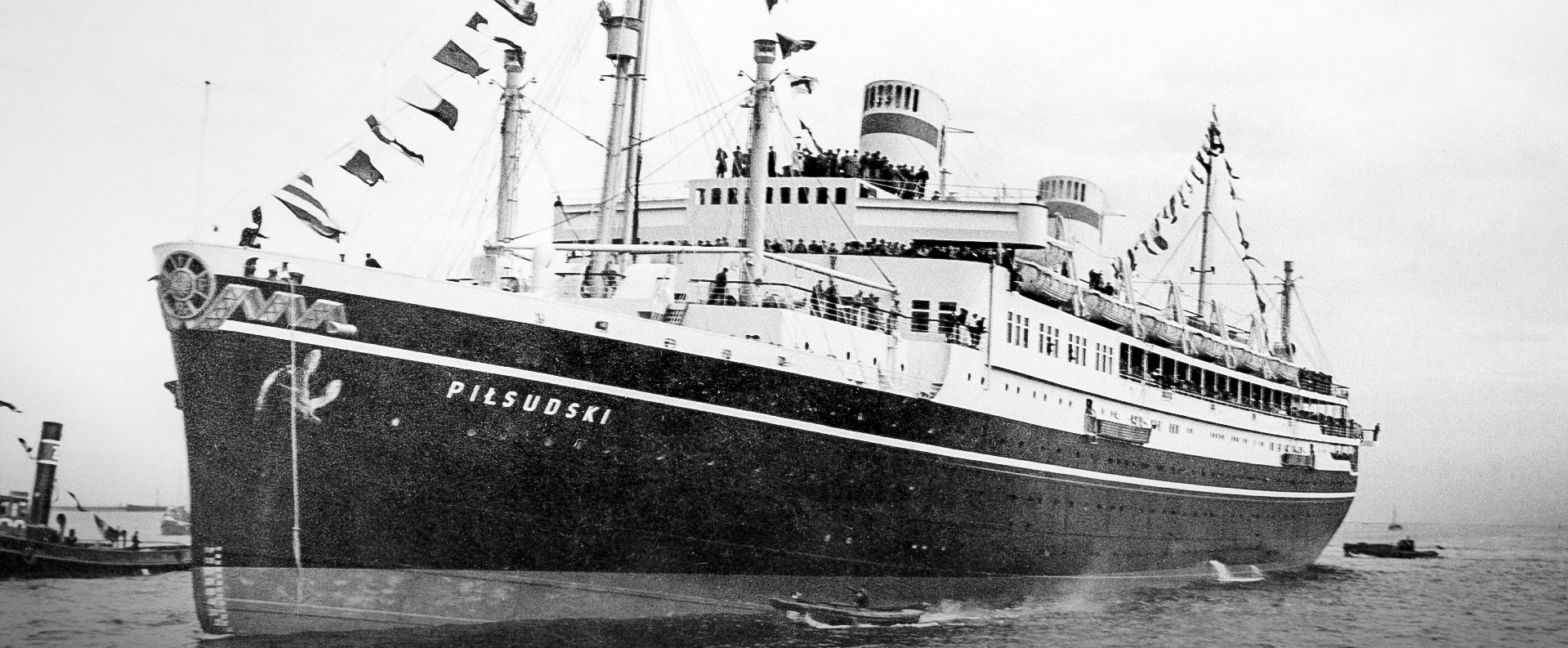
MS Piłsudski (1935)
Gdynia-America Line · entered service 1935 · Ship Guide
Overview
MS Piłsudski was the first of two modern motor liners built in Italy for Gdynia-America Line as Poland transformed its North Atlantic passenger service during the 1930s. Named for Józef Piłsudski, she entered service in September 1935 and became an immediate national symbol: a modern Polish ship, sailing from the new port of Gdynia, carrying passengers directly to New York.
Her commercial career lasted only four years. After the outbreak of the Second World War she remained outside occupied Poland and was prepared for Allied wartime service. On 26 November 1939, while sailing from the British east coast, she was struck by an underwater explosion and sank. A mine remains the leading explanation, but the precise cause has never been established beyond doubt.
Key Facts
Poland Builds a Modern Atlantic Pair
Piłsudski and Batory were ordered from the Monfalcone shipyard as a coordinated modernization of Poland's transatlantic fleet. The purchase was tied to a Polish-Italian trade arrangement involving coal deliveries, an arrangement that turned industrial exchange into two of the most visible symbols of the young Polish maritime state.
The ships replaced older emigrant-era tonnage with faster, more comfortable motor liners suited to a changing passenger market. Their home port, Gdynia, mattered almost as much as the ships themselves: Poland had built a modern port and now possessed modern liners capable of connecting it directly with North America.
Arrival in New York
After a Mediterranean positioning cruise from Venice, Piłsudski reached Gdynia on 11 September 1935 and sailed four days later on her first scheduled Atlantic voyage. She arrived at New York on 24 September to an unusually enthusiastic reception from the Polish-American community.
The welcoming spectacle—harbour craft, aircraft, crowds, press attention, and organized Polish-American participation—made the maiden arrival more than a routine commercial event. It marked the appearance of a modern Polish national liner in one of the world's great immigrant ports.
Passenger Spaces and Polish Design
Although built in Italy, the ship's interiors were deliberately Polish in character. Polish architects, artists, and designers contributed furnishings, decorative art, and public-room treatments intended to present a modern national identity rather than an imported Italian one.
The ship also contained an indoor swimming pool, one of the features repeatedly highlighted in contemporary and later descriptions. More broadly, her public spaces represented the same ambition found aboard Batory: the liner was not simply transportation but a curated expression of Poland abroad.
Early Stability Problems
The early career was not entirely smooth. During an Atlantic storm on a subsequent voyage, Piłsudski suffered significant weather damage and revealed handling and stability concerns that led to repairs and alterations. This episode belongs to the engineering history of the ship and should not be confused with the circumstances of her later loss.
As with other interwar liners modified after early service, photographs from different dates may reflect changes introduced during these corrective works. Dating images and promotional material therefore matters when reconstructing her original appearance.
Four Years on the North Atlantic
From 1935 to 1939 Piłsudski served the route linking Gdynia and Copenhagen with New York, with Halifax appearing in the wider North Atlantic schedule. The ship carried tourists, emigrants, returning residents, families, officials, and members of overseas Polish communities.
The relatively short career means that surviving passenger lists, menus, brochures, and photographs can often be dated within a narrow four-year commercial window. That makes Piłsudski unusually attractive for provenance-focused collecting.
War Changes Everything
When war began in September 1939, Piłsudski was outside Poland and did not return to Gdynia. The ship reached Britain and was placed at Allied disposal. Plans to employ her as an armed merchant cruiser were considered and then abandoned; she was instead prepared for troop transport work.
That transition was abrupt. A ship created as a symbol of civilian Polish modernity had, within weeks, become part of the Allied wartime transport system.
The Loss, 26 November 1939
On 26 November 1939, during the ship's first wartime movement from the British east coast, Piłsudski was rocked by underwater explosions and began sinking. The crew abandoned ship in difficult conditions.
Captain Mamert Stankiewicz survived the initial sinking but died after rescue from exposure and exhaustion. His death became inseparable from the memory of the ship and helped shape later Polish narratives of duty and command.
The wreck lies in the North Sea off the Yorkshire coast and has been visited and documented by divers. Those investigations have not produced a definitive answer to the cause of the loss.
Mine, Torpedo, or Something Else?
A mine is the leading historical explanation for the sinking. Some contemporary and later accounts proposed torpedo attack, while other theories developed around sabotage or unusual wartime circumstances. The surviving evidence has not resolved the question conclusively.
Evidence-first note: this guide treats a mine strike as the strongest explanation, not as a proven fact. The National Maritime Museum in Gdańsk has explicitly described the circumstances of the sinking as unresolved.
Piłsudski and Batory
The sisters became historical opposites. Piłsudski, the first completed, had barely four years of service before being lost at the opening of the war. Batory survived the conflict and continued sailing until 1969, becoming one of the longest-lived and best-known Polish passenger ships.
Viewed together, they provide a compact history of Polish ocean travel across the middle twentieth century: one ship represents the optimism and vulnerability of the interwar project, while the other carried that project through war, postwar reconstruction, and the Cold War.
Why Piłsudski Matters
Piłsudski matters because she joined maritime technology, migration, design, and national identity in a single ship. Her 1935 arrival in New York demonstrated that Poland could field a modern liner under its own flag and from its own newly developed port.
Her short life also gives the ship a very different documentary character from Batory. Nearly every surviving commercial object belongs to a tightly bounded prewar period, while the wreck and unresolved loss preserve a second, sharply distinct historical layer.
Collecting Profile
Surviving material includes Gdynia-America Line brochures, passenger lists, menus, postcards, luggage labels, photographs, inaugural-voyage souvenirs, stamps, and Polish-American commemorative material. Because her career was brief, voyage-specific attribution is often possible with comparatively small date ranges.
Objects naming Piłsudski are preferable to generic GAL material when making ship-specific claims. Items associated with the 1935 inaugural voyage or New York reception have especially strong contextual value when their date and provenance are documented.
Interpretive Notes
Maiden-voyage language varies: an August–September Mediterranean cruise preceded the first scheduled Gdynia–New York sailing on 15 September 1935.
The sinking remains unresolved: a mine is the strongest explanation, but this guide does not present it as certainty.
Passenger totals differ slightly among references: surviving institutional sources give totals in the high 700s, depending on class arrangement and date.
Evidence-first ship guideSources (Selected)
- Ocean Liner Curator — Sources (master bibliography)
- Gdynia Maritime University — 90th anniversary history of the 1935 inaugural voyage
- National Maritime Museum in Gdańsk — history of Piłsudski and the unresolved 1939 sinking
- Piłsudski Institute of America — MS Piłsudski exhibit and ephemera
- Polish Press Agency — interwar Polish transatlantic liners and passenger configuration