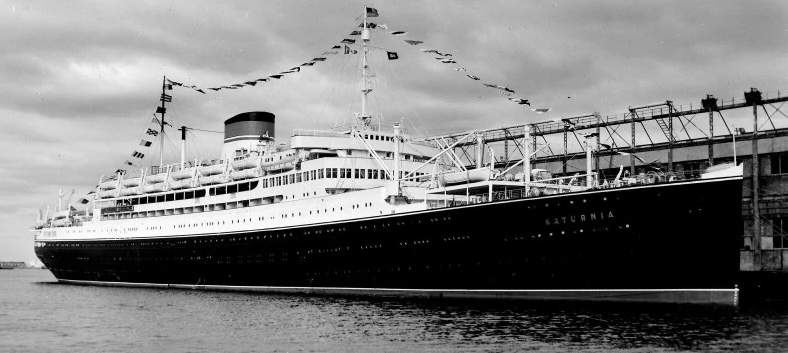
MS Saturnia
Cosulich Line / Italian Line · 1927 · Ship Guide
Overview
MS Saturnia was an Italian motor ship built at Monfalcone (Trieste region) for Cosulich Società Triestina di Navigazione, launched in late 1925 and placed into service in 1927. With her sister Vulcania, she represented a modern Italian approach to long-distance liner travel: diesel propulsion, a distinctive profile, and interiors that evolved dramatically over time.
After interwar passenger service to South America and North America, Saturnia was taken into U.S. control during World War II, serving as a troop ship and (briefly) as a U.S. Army hospital ship under the name USAHS Frances Y. Slanger. Returned to Italy in 1946, she became closely associated with postwar migration—especially sailings to Halifax and New York—before retirement in 1965.
Key Facts
Some figures (dimensions, exact capacities, and port sequences) vary across references because Saturnia was altered, re-engined, and repeatedly reconfigured. For evidence-first cataloging, tie technical claims to a dated company brochure, sailing list, or register entry.
Design & Construction Context
Saturnia and Vulcania were often discussed as “modern” Italian motorships: efficient propulsion, long-range comfort, and a design language that balanced traditional liner form with interwar taste. A major 1935 modernization is frequently noted as a turning point, with interiors refreshed toward a more contemporary aesthetic and machinery upgraded.
Service History (Summary)
1927–early 1930s: Entered service on long-distance routes, including South America (River Plate) and later North Atlantic sailings to New York. Period accounts often frame her as flexible—shifted between routes as traffic required.
Mid-1930s: A major refit and re-engining (commonly cited as 1935) modernized machinery and passenger spaces, with marketing increasingly aimed at the U.S. public.
World War II: After the Italian armistice, she passed into Allied/U.S. control and served in troop and transport roles; she also served briefly as USAHS Frances Y. Slanger (U.S. Army hospital ship) before later U.S. Army transport employment under the name Saturnia.
1946–1965: Returned to Italian service and became closely associated with postwar migration and family travel—frequently connected with arrivals at Halifax and New York. Withdrawn in 1965 and scrapped.
Interpretive Notes
Where Saturnia appears in collections: immigrant-travel ephemera is especially common—passenger lists, luggage labels, brochures, menus, and postcards from 1947–1965 service. Halifax references are a strong, practical anchor for postwar pieces.
Interiors as a collecting “hook”: Saturnia is often remembered through her public rooms (and their redesign). Curator practice: treat statements like “original Art Deco” vs “post-1935 modernization” as date-dependent—verify by brochure year, printer line, or photographic evidence.
Name caution: “Saturnia” can also appear in non-Italian contexts (including other ships with the same name). For this guide, the identifiers are: Cosulich / Italian Line branding, Italian ports (Trieste, Genoa, Naples), and the sister relationship to Vulcania.
Evidence-first ship guideSources (Selected)
- Ocean Liner Curator — Sources (master bibliography)
- Italian Liners Historical Society — Saturnia (timeline & context)
- MS Saturnia (summary; cross-check recommended)
- GG Archives — Saturnia (selected specs & service notes; cross-check recommended)
- Maritime Timetable Images — Saturnia interiors (brochure scans)
- Gente di Mare — Saturnia passenger-list index (research aid)