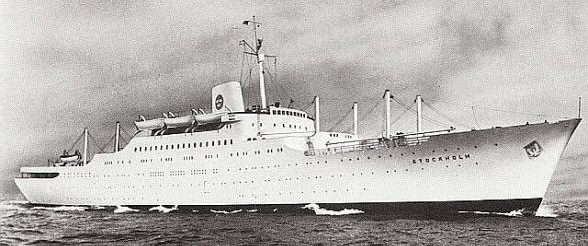
MS Stockholm (1948)
Swedish America Line · entered service 1948 · Ship Guide
Overview
MS Stockholm (launched 1946; entered transatlantic service 1948) was the Swedish America Line’s postwar North Atlantic liner: compact by superliner standards, diesel-powered, and built for dependable service between Göteborg (Gothenburg) and New York. If the 1930s “greyhounds” were about national spectacle, Stockholm belongs to a different era—one shaped by postwar economics, modernization, and a passenger market increasingly split between practical travel and emerging leisure cruising.
In public memory she is inseparable from one night: 25 July 1956, when she collided with the Italian liner Andrea Doria in fog off Nantucket, driving her reinforced bow into Andrea Doria’s starboard side. Yet for collectors and researchers, her longer life is equally instructive: a Cold War reinvention as the East German cruise ship Völkerfreundschaft (1960–1985), followed by a long sequence of later cruise identities that culminated in her final name, Astoria (2016–2025), and scrapping in Belgium in July 2025.
Evidence-first note: “Stockholm” is a naming tangle (multiple SAL ships carried the name, and later owners/registries sometimes prefer different prefixes). When attributing an artifact, anchor to operator + date (and ideally a sailing, route, or onboard department mark), not the name alone.
Key Facts
Design & Construction (Context)
Designed as a postwar liner rather than a prewar trophy ship, Stockholm is best understood as an “economy of reliability” vessel: a smaller North Atlantic passenger ship that could be operated efficiently with diesel machinery while still offering a credible liner experience. In collecting terms, this is a ship whose printed ephemera often emphasizes regularity (timetables, dependable sailings, practical tourist-class travel) rather than superlatives of size or speed.
She is also a reminder that “what a ship is” can change without changing the hull. When you interpret artifacts, treat each ownership era as a new documentary ecosystem—new company marks, new languages, new fare structures, and different onboard “promises.”
Service History (Summary)
1946–1948: From launch to service. Launched 9 September 1946 at Götaverken, she entered Swedish America Line service with a commonly cited maiden voyage date of 21 February 1948.
1948–1960: Swedish America Line North Atlantic workhorse. In SAL service she represented modern Swedish liner practice: modest scale, professional operation, and a route identity centered on Göteborg–New York.
25 July 1956: Collision with Andrea Doria (event summary). In fog off Nantucket, Stockholm’s bow struck Andrea Doria’s starboard side. Andrea Doria later sank (26 July 1956). Multiple ships responded, and the rescue became one of the most documented peacetime North Atlantic evacuations.
1960–1985: East German cruise ship Völkerfreundschaft. In January 1960 she transferred to East German control and was renamed Völkerfreundschaft, becoming (in effect) a state-linked “holiday ship” for organized travel—an unusually rich era for ephemera in German, with different institutional structures behind passenger documentation.
1985–2025: A long chain of cruise identities. Sold out of East German service in 1985, she passed through multiple owners and names over decades, eventually sailing in the 21st century as Azores and then Astoria (widely cited as 2016–2025).
July 2025: Final voyage under tow. After lay-up and sale for recycling, she was towed to Ghent, Belgium for dismantling, with reports noting departure under tow on 3 July 2025 and arrival the next day.
Interpretive Notes
Stockholm is an attribution stress test because she exists in distinct documentary regimes. An SAL-era menu, lettercard, baggage label, or sailing list typically lives in a Swedish/English commercial passenger world; a Völkerfreundschaft brochure or onboard paper belongs to a Cold War institutional travel system; later cruise-ship material may be tied to modern operators with entirely different branding, typography, and passenger expectations.
Practical collector rule: don’t treat “Stockholm” as a sufficient label. Require at least two anchors: (1) operator/branding mark and (2) date/route/sailing evidence. A third anchor (cabin class, ship’s crest variant, printer’s line, port agent stamp, or onboard department heading) turns a plausible attribution into a publishable one.
Evidence-first ship guideSources (Selected)
Use these as a starting index. For publish-ready specs (tonnage, dimensions, capacities), corroborate with dated registers and contemporaneous company material.
- Ocean Liner Curator — Sources (master bibliography)
- Wikipedia — MS Stockholm (1946) (launch date, basic specs, name chronology; corroborate)
- SS Maritime — “MS Stockholm” (narrative reference; cross-check details)
- P&O Line / Bob’s page — Stockholm (maiden voyage date and summary outline; corroborate)
- DDR Museum — MS Völkerfreundschaft (context for GDR-era service)
- Ships Monthly — Astoria goes for scrapping (July 2025 tow and recycling context)
- Cruise Critic — industry note on Astoria towed to Ghent for recycling (July 2025)