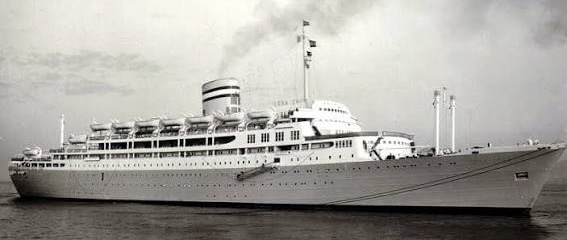
MS Vera Cruz (1952)
Companhia Colonial de Navegação · entered service 1952 · Ship Guide
Overview
MS Vera Cruz was one of the defining postwar passenger liners of Portugal's merchant marine. Built in Belgium for Companhia Colonial de Navegação (CCN), she entered service in 1952 as part of the state-backed fleet-renewal program known as Despacho 100.
Her early career centered on the South Atlantic, carrying large numbers of passengers between Portugal and Brazil, Uruguay, and Argentina. In 1960 she was reassigned to the Angola route, where she served both passenger and military transport needs during the final phase of Portuguese colonial rule.
Key Facts
Despacho 100 and Fleet Renewal
Vera Cruz emerged from Portugal's postwar merchant-fleet modernization program, commonly known as Despacho 100. The policy supported construction of dozens of new merchant ships intended to replace aging prewar tonnage and strengthen Portugal's maritime links with overseas markets and territories.
For CCN, Vera Cruz was a major step upward in scale and ambition. Earlier company passenger ships were generally smaller or mixed passenger-cargo vessels; the new liner was conceived as a large, modern passenger ship in her own right.
Design and Passenger Facilities
The ship was built by John Cockerill at Hoboken, Belgium, and incorporated the modern equipment expected of a major early-1950s liner. Contemporary descriptions emphasized radar, gyrocompass, automatic steering, extensive electrical systems, and large public spaces.
Passenger facilities included a cinema, winter garden, swimming pool, hospital, lounges, dining rooms, and accommodation divided among three classes. The emphasis was not on North Atlantic speed records but on capacity, comfort, and regular long-distance service.
Maiden Voyage to South America
Vera Cruz departed on her maiden voyage on 20 March 1952, bound for Buenos Aires with calls that included Rio de Janeiro, Santos, and Montevideo. The voyage was treated in Portugal as a national maritime event and was accompanied by considerable press attention.
Contemporary reporting suggests that passenger demand developed quickly. A Portuguese railway journal reported that the ship carried roughly 1,300 passengers from Brazil on her second voyage, a striking illustration of the scale of the South Atlantic market the new liner was intended to serve.
The South America Trade
During the 1950s, Vera Cruz was closely associated with Portugal's routes to Brazil, Uruguay, and Argentina. These voyages combined ordinary tourism and commercial travel with migration and family movement between Portugal and established Portuguese communities in South America.
The route also carried symbolic weight. Portuguese-language press accounts from the period repeatedly described enthusiastic receptions among expatriate communities in Brazilian and Argentine ports, presenting the ship as both transportation infrastructure and a visible expression of national maritime renewal.
Santa Maria and a Two-Ship Strategy
CCN followed Vera Cruz with the closely related Santa Maria in 1953. Together the two ships gave the company a modern pair of large passenger liners and substantially expanded its ability to compete for long-distance Atlantic traffic.
Their careers later diverged. Santa Maria became closely associated with the Caribbean and Venezuela trade, while Vera Cruz was reassigned in 1960 to Portugal's African routes.
Transfer to the Angola Route
In 1960, after roughly eight years on South American service, Vera Cruz shifted to the Lisbon–Angola route. That reassignment reflected changing commercial and political priorities within Portugal's shipping system.
After armed conflict began in Angola in 1961, the liner's role expanded beyond civilian passenger service. She was also used to move troops and other personnel, making her later career part of the maritime infrastructure of Portugal's colonial wars.
Passenger Liner and Military Transport
The dual use of Vera Cruz during the 1960s is important to interpreting the ship accurately. She remained a passenger liner, but her employment increasingly overlapped with the logistical requirements of the Portuguese state and military.
This period should not be treated as a simple continuation of her South America service. The geography, passenger mix, and political setting had changed substantially, even though the same ship and operator remained in service.
Retirement and Demolition
By the early 1970s, maintaining large steam-powered passenger liners was increasingly difficult. Air travel had transformed long-distance transport, while Portugal's overseas shipping system was approaching a period of political and institutional upheaval.
Vera Cruz was withdrawn in 1973 and sold for demolition at Kaohsiung, Taiwan. Her near-sister Santa Maria was also scrapped there in the same year, bringing a notable chapter of Portuguese postwar passenger shipping to an end.
Why Vera Cruz Matters
Vera Cruz matters because she was more than a successful passenger ship. She embodied Portugal's attempt to rebuild a modern merchant marine after the Second World War and became one of the clearest maritime products of the Despacho 100 program.
Her career also spans two very different Atlantic systems: first, migration and passenger exchange with South America; later, transport between Portugal and colonial Africa. That transition makes her especially valuable for understanding how political and economic change reshaped liner employment in the 1950s and 1960s.
Collecting Profile
Surviving material includes CCN brochures, deck plans, menus, sailing schedules, postcards, passenger lists, tickets, luggage labels, and photographs. Ephemera from the Brazil–River Plate service is particularly useful for reconstructing her original commercial role.
Later Angola-route material should be distinguished chronologically from the South America period. Military transport documentation may overlap with ordinary passenger-service records, and provenance is especially important when interpreting items from the 1960s.
Interpretive Notes
Sources differ slightly on tonnage and passenger totals: figures can reflect different measurement systems, dates, or accommodation configurations. Rounded values are used here where precision is not secure across sources.
Vera Cruz and Santa Maria were closely related rather than necessarily identical: contemporary and later sources commonly describe them as sisters, but details of arrangement and capacity differ.
The Angola service had both civilian and military dimensions: from 1961 onward, the ship's employment should be understood in the context of the Portuguese Colonial War as well as normal passenger transportation.
Evidence-first ship guideSources (Selected)
- Ocean Liner Curator — Sources (master bibliography)
- Museu da Presidência da República — photographic record of the Vera Cruz model and construction context
- Gazeta dos Caminhos de Ferro, 1952 — contemporary account of early Vera Cruz voyages
- Gazeta dos Caminhos de Ferro, 1952 — contemporary discussion of the South America service
- Gjenvick-Gjønvik Archives — Companhia Colonial de Navegação fleet list
- Novo Milênio — historical profile of Vera Cruz and the Brazil route