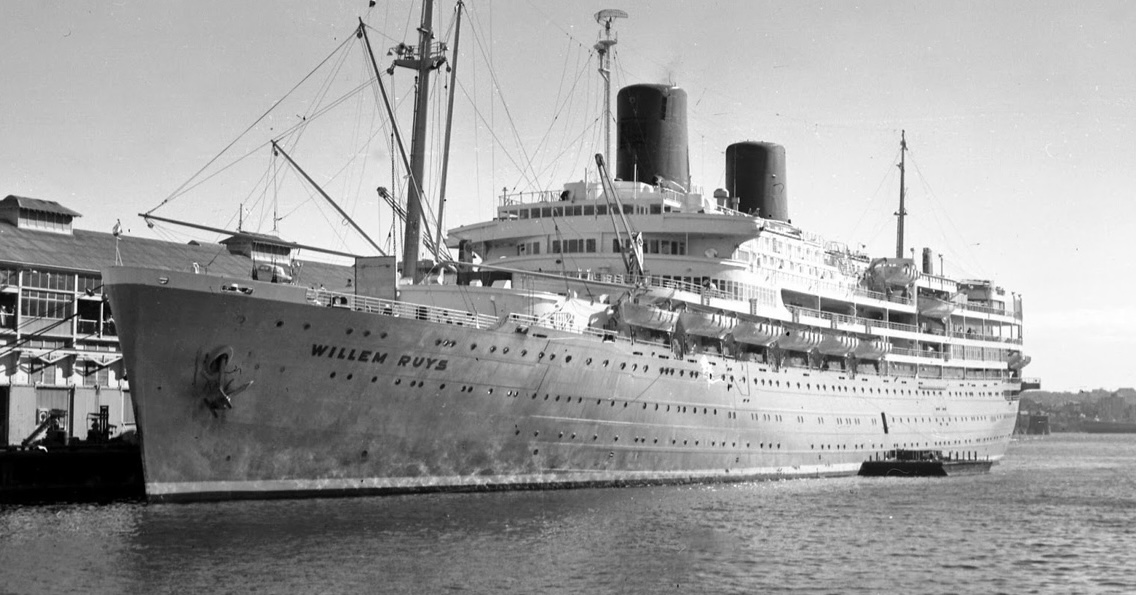
MS Willem Ruys (1947)
Royal Rotterdam Lloyd · Netherlands–Indonesia Service · Ship Guide
Overview
MS Willem Ruys was the postwar flagship of the Royal Rotterdam Lloyd and one of the most important Dutch passenger liners of the mid-twentieth century. Ordered before the Second World War, laid down at Vlissingen in 1939, and delayed for years by occupation and wartime conditions, she did not enter service until late 1947.
Her career reflected the rapid geopolitical transformation of the era. Built for the Netherlands–Dutch East Indies trade, she entered service just as Indonesian independence was reshaping that traffic. She later carried repatriates and emigrants, collided with her great rival Oranje, was rebuilt for round-the-world service, and was eventually sold to Lauro Line, becoming the cruise ship Achille Lauro.
Key Facts
A Ship Delayed by War
Willem Ruys had one of the most unusual construction timelines of any major postwar liner. Her keel was laid at De Schelde in January 1939 as yard number 214, but the German occupation of the Netherlands and the wider war halted normal completion. The hull remained on the building berth through the occupation, with work proceeding only where circumstances allowed.
She was finally launched on 1 July 1946 and named for Willem Ruys, the Rotterdam Lloyd director who had been executed during the war. Completion continued into 1947, and the ship was delivered in November of that year—nearly nine years after the keel was laid.
Design and Machinery
Although conceived before the war, Willem Ruys emerged with a distinctly modern postwar appearance. Her long, low superstructure and two streamlined funnels gave her a clean profile that contrasted sharply with many prewar passenger ships still in service.
Her machinery was unusual and ambitious. Eight diesel engines—six built by De Schelde and two by Sulzer—transmitted power through gearing to twin screws. Total power was about 32,000 bhp, sufficient for a service speed of roughly 22 knots. She was not as fast as Oranje, but she offered greater passenger and cargo capacity.
Netherlands–Indonesia Service
Willem Ruys entered service in December 1947 on the long route linking the Netherlands with the East Indies. By then, however, the political context had changed radically. Indonesian independence undermined the colonial passenger trade for which the ship had originally been designed.
Even so, she remained heavily used. During the late 1940s and 1950s she carried passengers in both directions, including Dutch repatriates returning from Indonesia and emigrants traveling onward toward Australia and New Zealand. Royal Rotterdam Lloyd records credit her with 64 round voyages between the Netherlands and Indonesia before withdrawal from the regular route in 1958.
Rivalry with Oranje
Willem Ruys is frequently discussed alongside the Netherland Line's Oranje. The two ships were near-contemporaries, direct competitors, and eventually operational partners. Their rivalry became literal in the Red Sea during the night of 5–6 January 1953, when the two liners collided while passing one another at close range.
The collision caused damage to both ships but no loss of life. Later accounts emphasize that close ceremonial passing had become customary between the vessels and that communication failures contributed to the accident. The episode remains one of the better-known operational incidents in postwar Dutch passenger-shipping history.
From Liner to Round-the-World Ship
By 1958 the collapse of the traditional Indonesia passenger route forced Royal Rotterdam Lloyd to find a new role for its flagship. Willem Ruys was withdrawn from the regular service, used briefly for cruises and Canada sailings, and then extensively rebuilt for round-the-world operation.
The refit altered both her accommodation and exterior profile. Her funnels were lengthened and the stern superstructure was enlarged. In 1959 she entered a globe-circling service linking Europe with the Mediterranean, Asia, Australia, New Zealand, South America, the Panama Canal, North America, and the Atlantic return to Europe.
Sale and Transformation into Achille Lauro
Royal Rotterdam Lloyd sold the ship in 1964 to the Italian Lauro Line, with transfer completed in 1965. The new owners carried out an extensive reconstruction and renamed her Achille Lauro.
That later identity became far more widely known than Willem Ruys. As Achille Lauro, the ship served as a cruise liner for decades, survived multiple fires and collisions, became internationally notorious after the 1985 hijacking, and finally sank in December 1994 following a major engine-room fire.
Why Willem Ruys Matters
Willem Ruys is unusually valuable for understanding the transition from traditional colonial liner service to postwar global cruising. She was designed for one world, completed in another, and repeatedly adapted as economics and politics overtook the assumptions behind her original construction.
She also gives important context to Oranje. The two ships were rivals, running mates, collision partners, and eventually participants in similar round-the-world strategies. Their careers help explain how Dutch passenger lines responded when the old Europe–Indonesia route ceased to support the fleets built around it.
Interpretive Notes
Maiden-voyage dates vary slightly: some sources give 2 December 1947 and others 5 December. The difference appears to reflect whether departure from the company's terminal, formal sailing, or route commencement is being counted.
Passenger capacity changed: published figures range roughly from 840 to 870 in early service and changed again after later rebuilding. Capacity figures should always be tied to a date and configuration.
The ship had two distinct historical identities: Willem Ruys and Achille Lauro belong to the same physical vessel, but their service contexts were so different that evidence from one period should not automatically be applied to the other.
Evidence-first ship guide