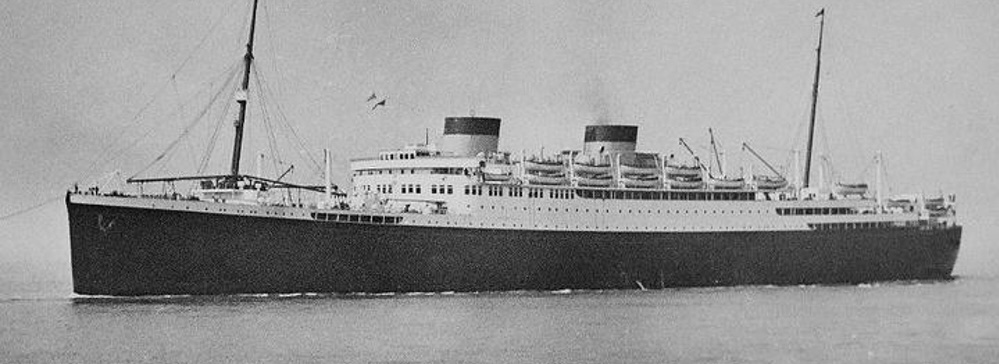
MV Georgic
White Star Line · entered service 1932 · Ship Guide
Overview
MV Georgic was the last ship built for the White Star Line. Harland & Wolff completed her at Belfast as yard no. 896, launching her on 12 November 1931 and delivering her on 10 June 1932. She began her maiden Liverpool–New York voyage on 25 June.
She was the younger sister and running mate of MV Britannic. Both ships embodied White Star's late turn toward diesel-powered motor liners: economical, modern passenger ships intended to sustain scheduled Atlantic service without competing for speed records.
Georgic's importance extends well beyond that commercial role. Bombed and largely gutted at Port Tewfik in 1941, she was refloated, reconstructed, and returned to wartime transport service. Her postwar career then shifted again toward troop and assisted-emigration work before final withdrawal in 1956.
Key Facts
Published tonnage differs by source and measurement date. Builder records and later liner summaries should not be forced into a single number without context.
White Star's Final Newbuild
Georgic and Britannic were products of a difficult commercial moment. White Star needed ships that could maintain a credible Atlantic passenger service while lowering operating costs during the Depression. Diesel propulsion, moderate speed, and a modern passenger product were therefore strategic choices rather than signs of diminished ambition.
At her launch, Georgic was among the largest British motor ships. Her status as White Star's final newbuild also gives later artifacts unusual interpretive weight: they belong to the company's last generation of purpose-built passenger liners before the Cunard–White Star merger of 1934.
Interwar Service
1932–1934: she operated Liverpool–New York with seasonal cruise work, broadly complementing Britannic.
1934 onward: following the Cunard–White Star merger, Georgic remained in service under the combined company. White Star identity persisted visually even as corporate control changed.
Her peacetime role emphasized reliability and economy, not record-breaking passages. That makes her especially useful for understanding the commercial realities of the 1930s Atlantic rather than the prestige competition of the prewar express era.
Port Tewfik: Destruction and Salvage
Requisitioned for wartime transport, Georgic reached Port Tewfik in the Gulf of Suez in July 1941. On 14 July German aircraft attacked the anchorage. Bomb hits ignited fuel and ammunition aboard the ship, causing major fires and explosions. She was beached two days later, badly burned and partly submerged.
The ship was nevertheless judged salvageable. Work began in the autumn of 1941; she was raised, patched, and towed first to Port Sudan, then onward for extensive reconstruction. The rebuild materially changed her interior and appearance. Post-1941 photographs and plans should therefore not be treated as straightforward evidence for her original White Star configuration.
Postwar Career
After returning to useful service, Georgic continued in government transport and later civilian work. Her postwar career included large-scale migration voyages to Australia and New Zealand as well as periods of transatlantic operation.
Ownership and operation in this period can be confusing: government bodies owned the ship while Cunard-White Star and later Cunard handled operation under varying arrangements. A printed Cunard association therefore does not necessarily mean ordinary peacetime private ownership.
She was finally withdrawn in 1956 and sent to Faslane for breaking.
Interpretive Notes
Pre- and post-bombing Georgic are materially different: the 1941 damage and reconstruction make date essential when interpreting interiors, deck plans, and photographs.
Do not confuse the two White Star Georgics: the 1895 cargo ship and this 1931 motor liner are separate vessels. Date, propulsion terminology, and silhouette resolve most ambiguity.
Corporate identity changed while visual identity lingered: White Star, Cunard-White Star, Cunard, and government contexts can all appear in legitimate material from the same hull.
Evidence-first ship guide