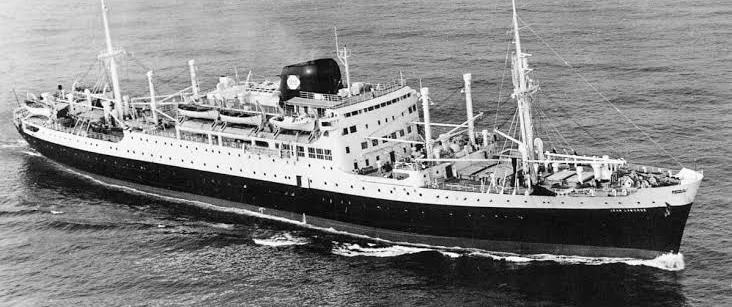
MV Jean Laborde (1931)
Messageries Maritimes · entered service 1931 · Ship Guide
Overview
Jean Laborde was a diesel-powered Messageries Maritimes passenger and mail liner built at La Ciotat for the Indian Ocean service. Launched in 1929 and entering regular service in 1931, she belonged to the company’s interwar generation of “nautonaphtes”—large motor liners that marked a deliberate shift away from traditional steam propulsion.
Her career divides sharply into two parts. During the 1930s she served Madagascar and the Indian Ocean, was substantially lengthened and re-powered in 1936, and also worked the Indochina route. After the fall of France in 1940, however, she was immobilized, disarmed, used as a training ship, and never returned to commercial service.
Key Facts
The Nautonaphte Generation
Messageries Maritimes adopted the term nautonaphte for a new generation of large diesel-powered liners beginning in the late 1920s. Jean Laborde belonged to that program alongside ships such as Félix Roussel, Georges Philippar, Aramis, Maréchal Joffre, and later Président Doumer.
The shift to diesel propulsion promised better fuel economy and long-range operating efficiency on routes extending from the Mediterranean deep into the Indian Ocean and Far East. For Messageries Maritimes, these ships were part of a broad effort to modernize both machinery and passenger accommodation.
Sister to Maréchal Joffre
Jean Laborde and Maréchal Joffre were built at La Ciotat to essentially the same design and are explicitly described in contemporary and specialist sources as identical sister ships. Président Doumer belonged to the same Indian Ocean family but differed in details such as funnel and boat arrangement.
The comparison is especially valuable because their wartime careers diverged dramatically. Maréchal Joffre eventually entered Allied service as USS Rochambeau, while Jean Laborde remained tied to Vichy-controlled territory and never returned to commercial operation after 1940.
Indian Ocean Service
Jean Laborde made her first departure from Marseille on 20 March 1931 and was initially assigned to the Indian Ocean route. Her service connected France with East Africa, Madagascar, and Réunion through the Suez Canal, carrying passengers, mail, officials, commercial traffic, and large numbers of subsidized or contract passengers.
From 1933 she also operated alternating voyages toward Indochina. That flexibility reflected the way Messageries Maritimes used its larger motor liners across overlapping colonial and commercial networks rather than keeping every ship permanently tied to a single itinerary.
The 1936 Reconstruction
In 1936 Jean Laborde underwent a major transformation. Her bow was rebuilt with a raked profile, the hull was lengthened by roughly seven metres, and her diesel engines were modified and supercharged. Power rose from about 6,400 to roughly 9,800 horsepower, while service speed increased from around 15 to 19 knots.
The reconstruction was substantial enough to change both her appearance and operating capability. It allowed an early-1930s ship to remain competitive with the faster Far East liners that Messageries Maritimes had introduced elsewhere in the fleet.
War and the 1940 Armistice
At the beginning of 1940, Jean Laborde was in the Far East. In January she repatriated roughly 800 people from Tientsin to Saigon. She later attempted to return toward Europe by way of the Cape.
The French armistice overtook the ship at Pointe-Noire on 25 June 1940. When political control in French Equatorial Africa began shifting toward Free France, the ship’s officers remained loyal to Vichy and escaped from Pointe-Noire during the night, eventually reaching Dakar.
Dakar and Return to Marseille
Jean Laborde was at Dakar in September 1940 during the Allied and Free French attempt to take the port. She survived the action without reported damage.
She reached Marseille in October and was then disarmed. Rather than return to the Indian Ocean or Far East, she was used as a training ship. This effectively ended her commercial career less than a decade after entering service.
Destruction in 1944
In 1943 the inactive liner was moved to the Étang de Berre. On 19 August 1944, during the retreat from southern France, German forces set her on fire at the Caronte quay.
The damage proved terminal. An attempt was made after the war to tow or recover the ship, but she was judged uneconomic to repair. Jean Laborde was ultimately broken up for scrap in 1948.
Why Jean Laborde Matters
Jean Laborde gives the archive an important missing counterpart to Maréchal Joffre. Together they show how two effectively identical sister ships could be pushed into completely different wartime histories by geography, politics, and circumstance.
She also helps complete the broader Messageries Maritimes “nautonaphte” story. Her 1936 reconstruction demonstrates how aggressively the company updated its early diesel liners, while her short post-1936 commercial career shows how completely the Second World War interrupted that modernization program.
Related Liners
Sources
- Messageries-Maritimes.org, Le Jean Laborde (I).
- Messageries-Maritimes.org, Le Maréchal Joffre.
- Messageries-Maritimes.org, Série des Nautonaphtes.
- Contemporary technical reporting on the Société Provençale de Constructions Navales and the 1936 reconstruction of Jean Laborde.