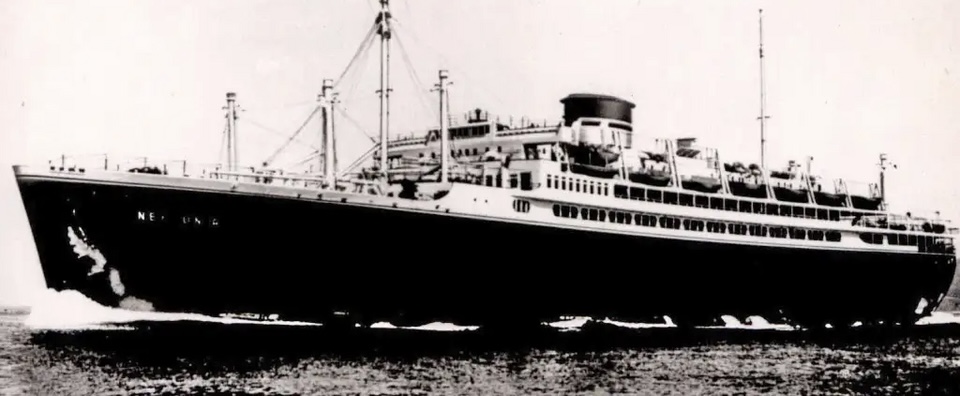
Neptunia
Cosulich Line / Italian Line · 1932 · Ship Guide
Overview
Neptunia was a large Italian motor liner of the interwar period, built for the Cosulich Line and later absorbed into the Italian Line. She belonged to the modern diesel-powered generation that projected Italian passenger-shipping ambition into long-distance commercial service beyond the familiar North Atlantic focus. Her peacetime career moved through more than one geographic setting, and her later wartime use as a troopship ended in torpedo loss in 1941.
In collecting and interpretation, Neptunia is best divided into three main phases: South America service, eastern-route service, and wartime troopship service. Material from those phases should be distinguished carefully rather than treated as a single undifferentiated ship identity.
Key Facts
Published dimensions, speed, and passenger-capacity figures vary somewhat across technical summaries and commercial descriptions. For cataloging purposes, preserve the exact wording used by the original source or artifact when possible, especially when distinguishing South American, eastern-route, and wartime material.
Design & Construction Context
Neptunia belonged to the interwar generation of modern Italian motor liners that emphasized diesel propulsion, long-range efficiency, and a more contemporary passenger presentation than many earlier coal- and steam-era ships. She was not a conventional North Atlantic record-seeker; instead, her significance lies in representing Italian maritime ambition across wider international routes.
In design and fleet terms, she belonged to a period when Italian liners were being used to project both commercial reach and national prestige. That makes her useful not just as an individual ship, but as part of a broader interwar modernization story in Italian passenger shipping.
Service History (Summary)
1931–1932: Built at Monfalcone by Cantiere Navale Triestino, Neptunia was launched in December 1931 and entered service in 1932. Her maiden voyage departed Trieste for Buenos Aires in October 1932.
Early South America service: In her initial peacetime role she served the South American route. This is the correct interpretive setting for passenger lists, menus, brochures, deck plans, and publicity material tied to her first commercial identity.
Mid-1930s eastern-route service: By 1935 she had begun operating on the Bombay–Shanghai route, broadening her service world well beyond the South Atlantic. In curatorial terms, this means route-specific ephemera should be dated and attributed carefully, since the ship’s operating geography changed significantly within a relatively short span.
1937 company change: When the Cosulich Line was absorbed into the Italian Line, Neptunia passed into that reorganized corporate framework. Material from the later 1930s may therefore reflect both route changes and branding changes.
1940 wartime conversion: During the Second World War, she was withdrawn from passenger service and used as a troopship. From that point onward, references to the vessel increasingly belong to a military transport framework rather than a civilian passenger one.
August 1941 convoy service: She participated in fast convoy troop movements to North Africa, operating in the dangerous Mediterranean war zone alongside other Italian liners converted for military use.
18 September 1941: While in convoy on another troop movement, Neptunia was torpedoed by the British submarine Upholder. The ship was lost during the attack sequence that also fatally affected her sister Oceania.
South America to the Eastern Routes
Neptunia's peacetime career did not remain tied to one route. After entering South American service, she was later employed on eastern services that included Bombay and Shanghai, reflecting the flexibility expected of large Italian motor liners during the 1930s.
Troopship Conversion
In 1940–1941 the passenger liner was drawn into Italian military transport work. Along with sister ship Oceania, she carried troops and matériel toward Libya as part of the North African war.
18 September 1941
On 18 September 1941, while in a heavily escorted convoy bound for Tripoli, Neptunia was torpedoed and sunk by the British submarine HMS Upholder. Her sister Oceania was attacked and lost in the same convoy action.
Because both sister ships were lost on the same date and in the same operation, casualty and rescue figures must be attributed carefully. Combined survivor totals appear frequently in secondary accounts and should not automatically be assigned to either ship individually.
Interpretive Notes
This is not a single-route liner: Neptunia had a more geographically varied commercial life than many liners, so route context matters greatly when interpreting surviving material.
South America and eastern-route artifacts should not be collapsed together: even though the same ship is involved, the commercial identity, itinerary language, and passenger context may differ substantially.
Peacetime and wartime material belong to different interpretive worlds: passenger-service ephemera reflects civilian travel culture, while troopship records belong to a military-logistical and wartime-loss framework.
Diesel-era Italian modernity matters: Neptunia helps illustrate the shift toward modern motor-liner technology in interwar Italian passenger shipping.
Corporate identity changes matter for dating artifacts: the transition from Cosulich Line to Italian Line can help place brochures, luggage labels, and other printed matter more precisely within the ship’s career.
Evidence-first ship guideSources (Selected)
- Ocean Liner Curator — Sources (master bibliography)
- MS Neptunia — overview chronology, dimensions, routes, and wartime service
- Italian Liners — broader interwar Italian liner context
- Derby Sulzers — machinery and wartime convoy context
- Technical summary reference preserving commonly cited particulars
- Regia Marina Italiana — 18 September 1941 convoy chronology for Neptunia and Oceania