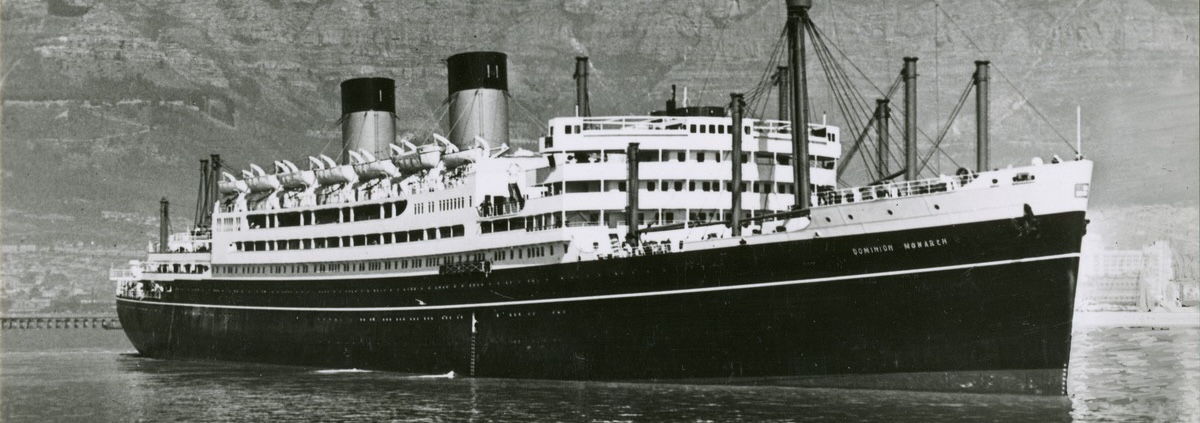
QSMV Dominion Monarch
Shaw, Savill & Albion Line · 1939 · Ship Guide
Overview
QSMV Dominion Monarch was one of the great late British motor liners of the Britain–Australia–New Zealand trade, combining substantial refrigerated cargo capacity with all-first-class passenger accommodation. She belonged to the long-haul imperial-route world rather than the North Atlantic express-liner tradition, and her significance lies in that service pattern linking Britain with Australasia by way of South Africa and Australia. She also became a major wartime troopship, a phase that dramatically altered both her function and the way surviving material should be interpreted.
In collecting and interpretation, Dominion Monarch is best divided into three main phases: prewar and postwar civilian Shaw, Savill & Albion service, Second World War troopship service, and final end-of-career use before scrapping. Material from those phases should be distinguished carefully rather than treated as a single undifferentiated ship identity.
Key Facts
Published accommodation and tonnage summaries can vary slightly depending on whether sources emphasize the prewar civilian ship, wartime troopship conversion, or postwar refitted service. For cataloging purposes, it is best to preserve the exact wording used by the source or artifact being cited.
Design & Construction Context
Dominion Monarch was conceived as a very large motor passenger-and-cargo liner for the Australasian trade, with an unusual combination of all-first-class accommodation and large refrigerated cargo capacity. She should be understood not through Atlantic prestige comparisons but through the Britain–Australia–New Zealand liner-and-produce route world, where refrigerated cargo, schedule reliability, and long-haul endurance mattered enormously.
When new, she was promoted as the world’s most powerful motor liner and set several route records. In curatorial terms, she represents the late prewar peak of the British Dominion-route cargo-passenger liner before wartime conversion transformed her into something very different.
Service History (Summary)
1937–1939 construction and entry into service: Built by Swan Hunter and Wigham Richardson at Wallsend, Dominion Monarch was laid down in July 1937, launched in July 1938, completed in January 1939, and sailed on her maiden voyage on 17 February 1939.
Prewar civilian service: In her original role she served between Britain, South Africa, Australia, and New Zealand. This is the correct interpretive frame for passenger lists, route brochures, luggage labels, deck plans, and publicity photography tied to her civilian identity.
1939 records and significance: Her early voyages established several distinctions, including fastest passage from Britain to Australia via the Cape route, and she was promoted as the largest merchant ship to serve both Australia and New Zealand.
Early wartime civilian service: War interrupted her normal career almost immediately. She initially continued in modified civilian service, blacked out and lightly armed, before being fully requisitioned.
1940 requisition as troopship: In August 1940 the Admiralty requisitioned the ship and converted her for troop transport. From that point onward, references to her increasingly belong to a military transport framework rather than a civilian passenger-and-cargo one.
Second World War troopship service: She carried troops on very long routes via South Africa, the Indian Ocean, the Pacific, and occasionally via Panama. Her wartime life included major convoy service, multiple world-circling deployments, and the carriage of tens of thousands of military personnel.
End of hostilities and repatriation: By the end of the war she had carried more than 90,000 military personnel and very large cargoes, including refrigerated foodstuffs from Australasia to Britain. She also helped repatriate troops, including New Zealand servicemen after the war.
Postwar return to civilian service: Released from government service in 1947, she returned to civilian operation and resumed the Australasian route in 1948, later adopting an expanded round-the-world style service pattern.
1962 end of career: After a final period out of service, she was sold in 1962, spent part of that year in Seattle as a floating hotel during the Century 21 Exposition, and was then scrapped in Japan.
Passenger Liner and Refrigerated Cargo Ship
Dominion Monarch combined two businesses that were both essential to the Britain–Australasia trade: premium passenger accommodation and large-scale refrigerated cargo capacity. Her all-first-class passenger arrangement was unusual, but the ship's economics depended just as much on moving produce and other cargo over very long distances.
That mixed role helps explain why she does not fit neatly into a North Atlantic luxury-liner model. The ship was part of a trade system built around distance, mail, passengers, and refrigerated exports rather than short-cycle express crossings.
Wartime Troop Transport
The Second World War transformed Dominion Monarch into a troop transport operating on long-distance routes far removed from her peacetime schedule. Accommodation and passenger spaces were adapted for military carrying capacity, creating a wartime configuration that should not be treated as representative of civilian Shaw, Savill & Albion service.
After the war she returned to commercial operation, making her a useful case study in how a large liner could move from highly specialized peacetime service into mass transport and then back again.
Postwar Route Expansion
Her later service extended beyond the traditional outward passage to New Zealand, with schedules that could continue across the Pacific, through the Panama Canal, and back toward Europe. This gave the ship a near-round-the-world operational character during the postwar period.
Interpretive Notes
This is an Australasian produce-and-passenger liner first: Dominion Monarch should be understood chiefly within the Britain–Australia–New Zealand route system, not through North Atlantic assumptions.
The all-first-class arrangement matters: this was a striking part of her civilian identity and helps explain the tone of surviving publicity and passenger material.
Civilian and troopship material belong to very different interpretive worlds: prewar and postwar route ephemera reflects luxury long-haul passenger service, while wartime records concern convoy logistics and mass troop transport.
She is both a liner and a refrigerated cargo ship: any serious interpretation should preserve that dual identity, since frozen produce carriage was central to the economics of her route.
This ship represents a late imperial-route peak: Dominion Monarch stands near the high point of the British Australasian passenger-and-refrigerated-cargo liner before the wartime and postwar transformation of global passenger shipping.
Evidence-first ship guideSources (Selected)
- Ocean Liner Curator — Sources (master bibliography)
- QSMV Dominion Monarch — overview chronology, technical particulars, service, and wartime record
- Maritime Radio — concise technical and service summary
- SS Maritime — illustrated service history and route context