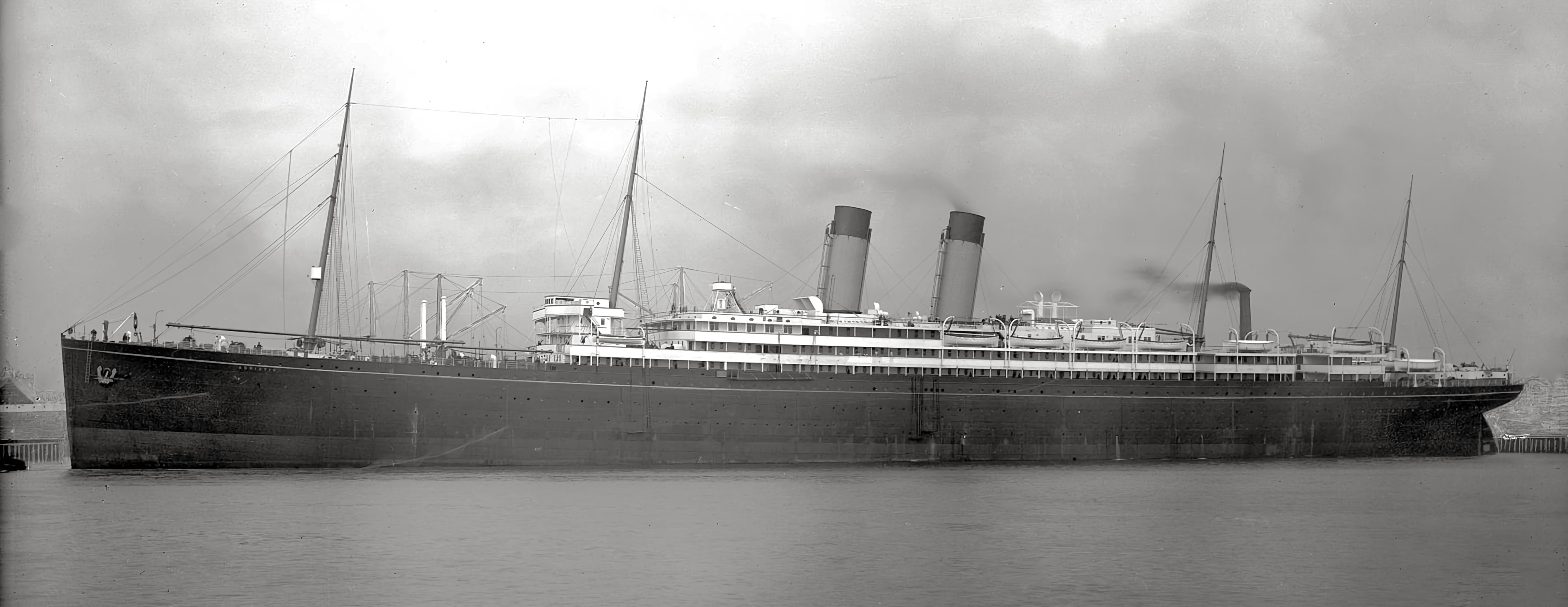
RMS Adriatic (1907)
White Star Line · entered service 1907 · Ship Guide
Overview
RMS Adriatic was the fourth, last and largest of White Star Line's “Big Four.” Built by Harland & Wolff at Belfast as yard no. 358, she retained the group's moderate-speed, high-capacity commercial philosophy while introducing passenger facilities that pointed directly toward the much larger Olympic class.
Her importance therefore sits at a transition point. Adriatic belonged structurally and economically to the Big Four, yet features such as an electric passenger lift, gymnasium, Turkish baths and a saltwater plunge bath showed how White Star's ideas about shipboard comfort were changing.
Key Facts
The Final Big Four
Although Adriatic shared the Big Four's basic twin-screw reciprocating arrangement, Harland & Wolff gave her greater power and speed than her predecessors. More important for passenger history were the interiors. Titanic Belfast's Harland & Wolff records identify an electric lift, separate First Class dining tables, a gymnasium, Turkish baths and a saltwater plunge bath among features that anticipated the Olympic-class passenger experience.
The ship was not simply “an early Olympic.” Her scale, machinery and route economics still belonged to the older White Star formula. What makes her revealing is the overlap between those two generations.
Early Service
Adriatic departed Liverpool on 8 May 1907 under Captain Edward J. Smith. Soon afterward White Star placed her on its developing Southampton–Cherbourg–New York service. In 1911, after Olympic entered service, Adriatic returned to the Liverpool route alongside the other Big Four ships.
After the Titanic disaster in 1912, several survivors and White Star personnel returned to Britain aboard Adriatic, including J. Bruce Ismay and surviving officers. That association is documented, but it should not overshadow the ship's own much longer commercial history.
First World War
Unlike many liners requisitioned immediately in 1914, Adriatic continued transatlantic work during the early war years while carrying useful cargo. From 12 April 1917 until 28 February 1919 she served formally under the Liner Requisition Scheme, transporting troops and war material across the Atlantic.
On 26 January 1918 a fire broke out while the ship was at Pier 60 in New York after oil barrels on deck ignited. The fire was controlled and did not end her service. She survived the war and was refurbished for commercial use afterward.
Postwar Service and Cruising
After 1919 Adriatic returned to White Star service with changing passenger arrangements and increasingly important cruise work. By the early 1930s cruising had become a major part of her employment, illustrating the broader interwar shift from scheduled immigrant-heavy crossings toward leisure travel.
She passed briefly into the Cunard-White Star fleet when the companies merged in 1934, but the combined fleet had surplus tonnage. Sold at the end of that year, Adriatic was dismantled in Japan in 1935.
Evidence-first ship guide