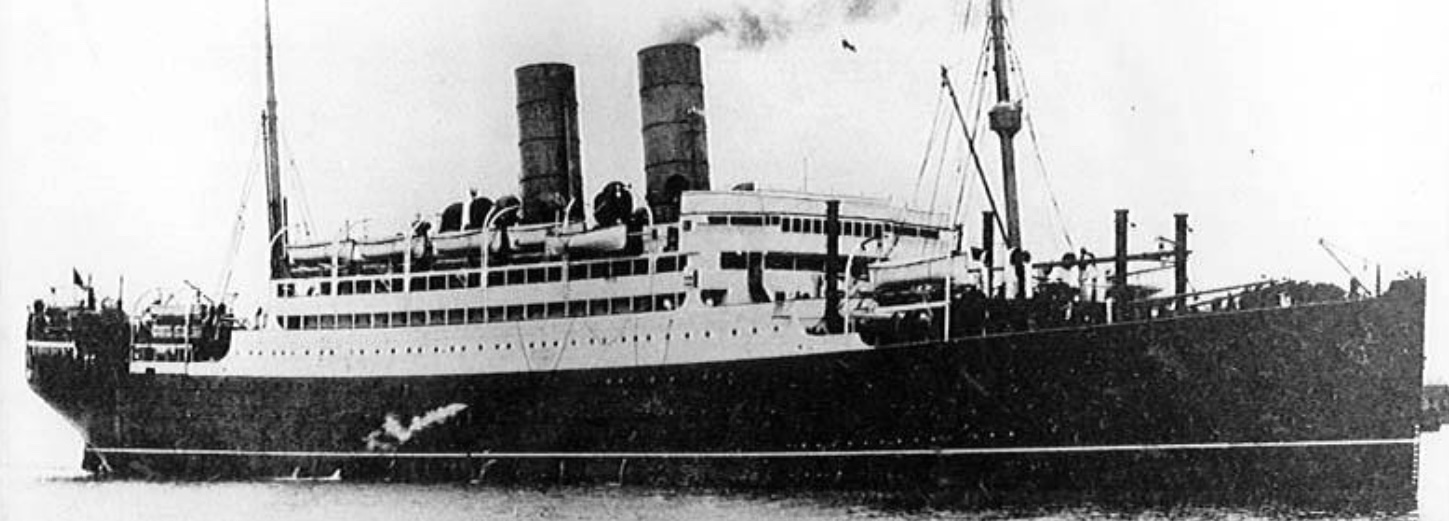
RMS Alaunia (1913)
Cunard Line · entered service 1913 · Ship Guide
Overview
RMS Alaunia was a Cunard passenger-cargo liner built for practical North Atlantic service rather than the prestige express trade. Launched by Scotts Shipbuilding & Engineering at Greenock on 9 June 1913 and entering service later that year, she belonged to the less glamorous but historically essential working fleet that connected Britain with Boston and other North Atlantic destinations.
Her career was very short. War transformed her from a commercial passenger-cargo liner into a government transport, and she was lost in 1916 after striking a mine. That compressed life makes it especially important to separate prewar civilian material from wartime transport records.
Key Facts
A Practical Cunard Liner
Alaunia belonged to the part of Cunard's fleet that carried the bulk of ordinary Atlantic traffic. Her large third-class accommodation is more revealing than any claim to luxury: the ship was built around migration, affordable passage, cargo, and steady service.
That practical identity helps correct a common distortion in liner history. The most famous ships often dominate public attention, but medium-sized vessels like Alaunia formed much of the actual transport infrastructure linking Britain, North America, and the wider world.
Design and Passenger Market
The ship's cabin-and-third-class arrangement reflected a commercial model centered on volume travel. Third class was not merely an afterthought beneath more prestigious accommodation; it was central to the economics of the service and to the social history represented by the ship.
For collectors, this means passenger lists, immigration documents, baggage material, tickets, and ordinary shipboard paper may be more historically representative than luxury-focused objects.
Prewar Service
Alaunia's maiden service linked Liverpool and Queenstown with Portland and Boston. Her civilian career was brief, but it established the route context for commercial photographs, passenger lists, company advertising, and ordinary onboard material from 1913–14.
Later wartime summaries also record altered route patterns, including voyages involving New York and London. Those should not be projected backward onto the original service without a specific date.
War Changes the Ship's Identity
After the outbreak of war, Alaunia entered transport work connected with British military operations. References to India, Persia, and the Dardanelles belong to this wartime phase rather than to ordinary Cunard passenger service.
The administrative context changed with the role. Troop movements, cargo priorities, military orders, and wartime censorship all shaped the documentation generated by the ship. A transport reference and a peacetime passenger list therefore need different interpretive framing even when they concern the same hull.
19 October 1916
On 19 October 1916, while on a voyage from New York to London carrying cargo, Alaunia struck a mine off Eastbourne. uboat.net identifies the mine as one laid by UC-16 under Egon von Werner. The specific submarine attribution is worth preserving because a generic “wartime mine loss” description loses useful historical precision.
The sinking ended a career of barely three years. That short lifespan helps explain why original material is comparatively scarcer than for longer-lived Cunard liners and is one reason weakly identified artifacts should be attributed cautiously.
Route Geography and Ordinary Travel
The Liverpool–Queenstown–Portland–Boston pattern placed Alaunia within a route system designed around practical access rather than prestige. Portland could serve as a seasonal or operational alternative within the broader New England and Canadian traffic network, while Queenstown remained an important embarkation point for Irish passengers.
That geography shaped the social world aboard. Large numbers of third-class passengers were not simply “steerage traffic” in the abstract; they were people moving through specific port chains, often connecting onward by rail or joining established migrant communities. A dated passenger list can therefore illuminate both shipboard history and wider migration networks.
Material Culture of a Short-Lived Ship
Because Alaunia served for such a short period, surviving commercial material may be proportionally scarcer and more easily confused with similarly named Cunard vessels. Menus, postcards, deck plans, tickets, and photographs become more valuable when tied to a precise date or voyage.
The short career also means visual changes can be compressed into a narrow chronology. Prewar passenger configuration, wartime alterations, and final transport appearance belong to only a few years, so even modest differences in fittings or paint can help date an image.
Interpretive Notes
Alaunia should be understood as a working Cunard liner, not a failed attempt at prestige. Boston service, third-class traffic, and wartime adaptation are the central themes. Civilian and military material should be kept distinct, and route claims should be tied to dates wherever possible.
Because the service life was so brief, the exact chronology carries unusual weight. An artifact dated even one or two years differently may belong to a completely different phase of the ship's career.
Evidence-first ship guide