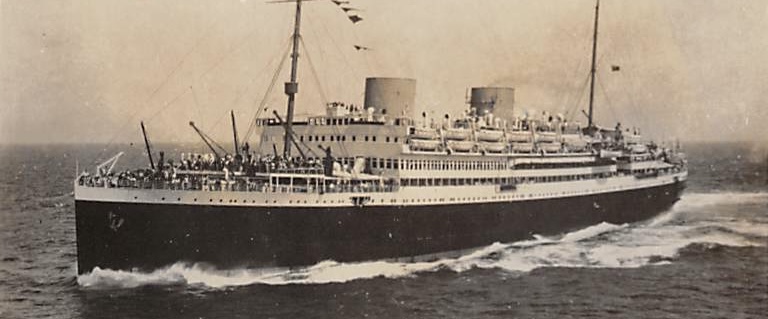
RMS Alcantara
Royal Mail Lines · launched 1926 · Ship Guide
Overview
RMS Alcantara was one of Royal Mail’s major interwar South America liners, built by Harland & Wolff at Belfast as yard no. 586. Launched on 23 September 1926 and completed on 18 February 1927, she was designed for the Southampton–South America route and formed a closely related pair with Asturias.
The ship is especially valuable as a study in technological change because her machinery did not remain static. The previous version of this guide described her as turbine-powered from the outset; in fact, Alcantara was built as a twin-screw motor liner with two Burmeister & Wain diesel engines. In 1934 those diesels were removed and replaced by steam turbines, increasing her power and raising service speed from roughly 16.5 to about 19 knots.
Her career then crossed sharply different identities: interwar mail liner, Royal Navy armed merchant cruiser, troop transport, and finally a refurbished postwar passenger liner. She returned to civilian service in 1948 and remained in operation until 1958.
This guide concerns the 1926 ship. Royal Mail’s earlier Alcantara, launched in 1913, served as an armed merchant cruiser in the First World War and was sunk in 1916.
Key Facts
South America Service
Alcantara belonged to the Royal Mail tradition of long-distance passenger, mail, and cargo service between Britain and the east coast of South America. Her route identity is therefore more closely tied to Brazil, Uruguay, Argentina, and the River Plate than to the North Atlantic express trade. Route ephemera—sailing lists, port calls, passenger documents, menus, and agency material—can be as important for attribution as the ship’s silhouette.
The 1934 machinery replacement is a striking example of how aggressively major liners could be modernized in mid-career. Replacing the original diesels with steam turbines was not a cosmetic refit: it substantially altered the ship’s engineering character and performance. Technical descriptions of Alcantara therefore need a date attached to them.
Second World War
1939: the Royal Navy requisitioned Alcantara and converted her into an armed merchant cruiser, HMS Alcantara. Her civilian spaces and route identity gave way to patrol work at a time when the Navy urgently needed ships for ocean surveillance and trade protection.
28 July 1940: while patrolling the South Atlantic, Alcantara fought the German auxiliary cruiser Thor. Both ships were damaged. The action is one of the most significant episodes of her career and illustrates both the usefulness and the vulnerability of converted passenger liners employed as warships.
1943–1948: as the threat from surface raiders changed, Alcantara was converted to troopship work. She continued in government transport service through the war and immediate postwar period.
Postwar Return
After a major refit, Alcantara returned to civilian Royal Mail service in 1948. That second passenger career lasted another decade, placing her among the liners that successfully bridged prewar prestige service and the increasingly difficult economics of the 1950s. She was finally withdrawn and sold for breaking in 1958.
Interpretive Notes
Date the machinery: “diesel-powered” and “turbine-powered” can both be correct descriptions of Alcantara, but not for the same period. The 1934 conversion is essential context.
Do not flatten the wartime role: she was first an armed merchant cruiser and later a troopship. Calling her simply a “WWII troop ship” omits the combat phase that included the encounter with Thor.
Name reuse: artifacts naming only Alcantara require dating and visual or documentary corroboration because the 1913 and 1926 ships had separate careers and separate wartime identities.
Evidence-first ship guide