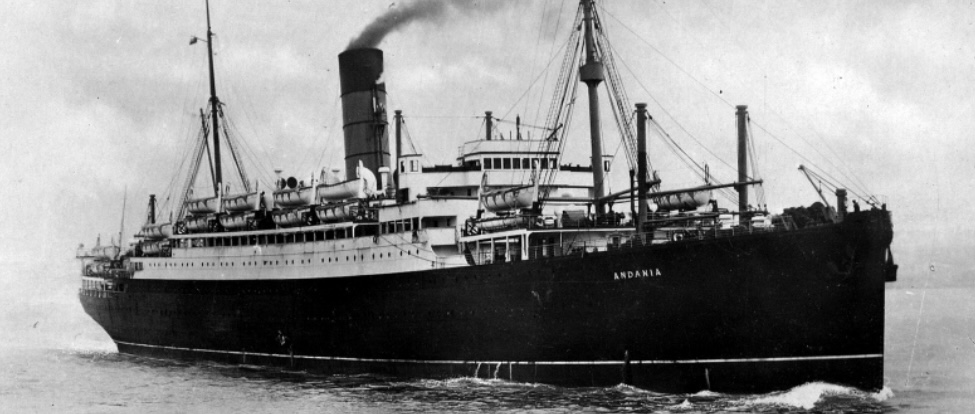
RMS Andania
Cunard Line · 1922 · Ship Guide
Overview
RMS Andania was one of Cunard’s early-1920s “A-class” cabin liners, a group of medium-sized postwar ships designed to rebuild dependable North Atlantic passenger service after the disruption of the First World War. She belonged to the practical world of cabin-class and third-class travel rather than the grand-express tradition of Mauretania or Berengaria, and her importance lies in that more workmanlike but historically significant role. In peacetime she served Cunard’s Canadian and later joint North Atlantic routes; in wartime she was converted into an armed merchant cruiser and became the only member of her immediate sister group to be lost during the Second World War.
In collecting and interpretation, Andania is best divided into three distinct contexts: postwar civilian Cunard passenger service, late-1930s refitted cabin-liner service, and wartime naval service as HMS Andania. Menus, passenger lists, tourist material, naval records, and loss accounts should not be merged casually, because they reflect sharply different uses of the same ship across two decades.
Key Facts
Published summaries differ slightly on a few particulars, especially gross tonnage, power figures, route shorthand, and whether the ship is indexed as 1921 or 1922. For cataloging purposes, it is often best to keep the launch year, entry-into-service year, and exact source wording explicit rather than forcing a single simplified formula.
Design & Construction Context
Andania was part of Cunard’s postwar rebuilding program: not a giant prestige liner, but a modern, efficient cabin liner meant to restore dependable commercial service on routes where mixed passenger traffic still mattered. Ships of this type occupied an important middle ground in the 1920s, serving tourists, family travelers, migrants, and business passengers who did not require the line’s most famous express vessels.
That makes Andania historically valuable precisely because she was typical of a major shipping line’s working fleet in the interwar years. She helps document how Cunard adapted to a changed passenger market after 1918: less Edwardian grandeur, more standardized and commercially flexible cabin-liner service.
Service History (Summary)
1921–1922 construction and entry into service: Built by Hawthorn Leslie at Hebburn, Andania was launched on 1 November 1921 and began her maiden voyage on 1 June 1922. Her first service connected London and Southampton with Quebec and Montreal, placing her clearly in Cunard’s Canadian service world rather than the express Atlantic tradition.
1920s civilian passenger service: In her peacetime years, Andania worked as a practical cabin liner within Cunard’s transatlantic network. Passenger lists and commercial ephemera show her presence in routine but important service rather than in the flagship mythology that dominates popular ocean-liner memory.
Later interwar route adjustments: Like several Cunard liners of her class, she was shifted as route needs changed and later served in joint service arrangements. This part of her career is important for interpreting surviving paper material, because a single ship can appear under more than one route context across the decade.
Late-1930s refit and reduced-class service: By the end of the 1930s, changing passenger markets led to refitting and class simplification across this group. Andania therefore belongs not only to the early postwar migration-and-cabin-liner world, but also to the late interwar transition away from older prewar class structures.
1939 wartime requisition: With the outbreak of the Second World War, Andania was requisitioned and commissioned as the armed merchant cruiser HMS Andania. At that point, her documentary identity changed sharply from civilian liner to naval auxiliary, and records connected with her become military rather than commercial in character.
1940 attack and loss: On 15 June 1940, while serving on Northern Patrol duties south of Iceland, she was torpedoed by the German submarine UA. She remained afloat for several hours but sank early on 16 June 1940. Contemporary summaries agree that those aboard were rescued, an important distinction when interpreting wartime loss references.
Identity Boundary: The Second Andania
The A-class Andania was a different ship from the 1913 Cunarder of the same name. Launched in 1921 and entering service in 1922, she belonged to Cunard's postwar rebuilding program and survived through the interwar period into the Second World War.
Cataloging should therefore treat “Andania” as a name requiring a date check, not as a unique vessel identifier. Builder, launch year, machinery, and wartime fate make the two ships straightforward to separate once chronology is established.
A-Class Service and Cabin-Liner Economics
Andania was designed for the broad middle of the North Atlantic passenger market rather than prestige express traffic. Her cabin-class and third-class accommodations matched the postwar shift toward more flexible fare structures and practical immigrant and family travel.
This makes surviving passenger lists and route ephemera particularly valuable: they document the ordinary commercial traffic on which Cunard depended between the wars, beyond the better-known flagship narrative.
HMS Andania and Final Loss
Requisitioned at the outbreak of the Second World War, the liner was converted into an armed merchant cruiser as HMS Andania. She was torpedoed by U-46 in June 1940 and sank after the attack.
That fate creates an unusual echo with the earlier ship of the same name, which had also been lost to a German submarine. The parallel is real, but the two losses occurred in different wars and involved entirely different hulls.
Interpretive Notes
This is an interwar working Cunard liner first: Andania should be approached initially as part of Cunard’s practical post-1918 rebuilding fleet, not as a lesser version of the line’s prestige ships.
The Canadian and cabin-liner context matters: her historical meaning lies in middle-tier transatlantic service, where cabin and third-class traffic remained commercially central. That is the right framework for most passenger ephemera tied to the ship.
Civilian and wartime material belong to different documentary worlds: a 1920s passenger list, a joint-service brochure, and an Admiralty loss summary should not be treated as if they describe the same operational identity.
The ship’s date label needs care: some references index her as 1921 from the launch date, while others effectively place her in 1922 from completion and entry into service. Being explicit about which convention is being used avoids catalog confusion.
The 1940 loss should be documented precisely: because wartime sinkings are often compressed into short summaries, it is worth preserving attacker, location context, rescue outcome, and the ship’s naval status as carefully as possible.
Evidence-first ship guideSources (Selected)
- Ocean Liner Curator — Sources (master bibliography)
- RMS Andania (1921/1922) — overview chronology, class context, technical particulars, and wartime loss summary
- Norway Heritage — Cunard fleet context, route use, and published technical summary
- Cabin Liners — Cunard A-class liners context and service comparison
- Great Ships — concise service history and wartime requisition summary