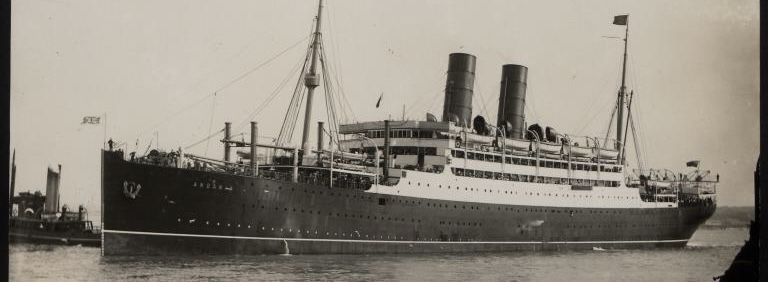
RMS Andania
Cunard Line · 1913 · Ship Guide
Overview
RMS Andania was a Cunard passenger-cargo liner built for the Canadian and St. Lawrence trade, part of the company’s early-1910s effort to provide modern second- and third-class accommodation on North Atlantic routes outside the premier express service. She belonged to the same broad world as other medium-sized Cunard liners built for practical emigrant and general passenger work rather than record-breaking speed. Although not a flagship in the Lusitania or Aquitania sense, she was a substantial and purpose-built transatlantic ship whose career linked civilian migration routes, imperial wartime transport, and eventual U-boat loss.
In collecting and interpretation, Andania is best understood in three overlapping but distinct contexts: prewar Cunard Canadian service, wartime transport and troopship service, and final-loss material connected to her torpedoing in January 1918. Those categories should be separated carefully, since brochures, passenger ephemera, troop records, and wreck references belong to different documentary worlds.
Key Facts
Published summaries of Andania sometimes emphasize slightly different route patterns depending on whether they are tracing civilian passenger service, wartime transport work, or final-voyage loss records. For cataloging purposes, it is best to preserve the precise route or service wording used by the original source or artifact.
Design & Construction Context
Andania was one of a small group of Cunard liners designed for the Canadian trade rather than the famous Liverpool–New York express route. In practical terms, that meant a ship oriented toward large-scale second- and third-class traffic, cargo carrying, and seasonal service to Quebec and Montreal via the St. Lawrence rather than toward a lavish first-class profile.
She is therefore best understood as part of Cunard’s important but less glamorous middle tier: substantial, modern liners built for regular North Atlantic work and migration traffic. Her significance lies not in exceptional size or speed, but in how clearly she represents the service structure that supported mass transatlantic travel immediately before the First World War.
Service History (Summary)
1913 entry into service: Built at Greenock by Scotts Shipbuilding & Engineering, Andania was launched on 22 March 1913, completed on 13 July, and began her maiden voyage on 14 July 1913 from Liverpool via Southampton to Quebec and Montreal.
Prewar Cunard Canadian service: Her early career belongs to Cunard’s Canadian and St. Lawrence service world. This is the correct interpretive frame for passenger lists, route brochures, commercial photography, and any prewar ephemera tied to Quebec and Montreal crossings.
1914 requisition and troop work: With the outbreak of war, Andania was requisitioned as a troopship in August 1914 and carried Canadian troops during the autumn of that year. She was also used to accommodate German prisoners of war in the Thames between late October 1914 and February 1915.
Gallipoli and Mediterranean service: From February 1915 onward she served in connection with the Gallipoli campaign, including transport work associated with the Royal Inniskilling Fusiliers and Royal Dublin Fusiliers, and later carried the Barnsley Pals to Port Said in late 1915. Her support work for the Mediterranean Expeditionary Force ended in March 1916.
Return to transatlantic service: After further troop-carrying duties, Andania returned to passenger service in 1917, operating on the Liverpool–New York run. This later civilian phase is important because it shows the ship’s reversion from wartime utility back to a recognizable Cunard liner identity, even if under wartime conditions.
Final voyage and loss: Leaving Liverpool on 26 January 1918 with passengers, crew, and general cargo, she sailed in convoy toward New York. On 27 January 1918 she was torpedoed amidships by the German submarine U-46, commanded by Leo Hillebrand, about two miles north-northeast of Rathlin Island. Attempts to save and tow the ship failed; all passengers were saved, but seven crew members were lost.
Identity Boundary: The 1913 Andania
This ship was the first Cunard liner to carry the name Andania. Built by Scotts of Greenock and entering service in July 1913, she belongs to the prewar Canadian-service generation and should not be confused with the later Cunard A-class Andania launched in 1921.
The distinction is especially important in passenger lists and casualty references. A document dated 1913–1918 concerns this earlier ship; material from the 1920s and 1930s belongs to the second Andania.
War Service and the 1918 Loss
The First World War transformed Andania from a Canadian-route passenger liner into a transport vessel. She continued to operate under wartime conditions until 27 January 1918, when the German submarine U-46 torpedoed her off the Irish coast.
The ship remained afloat long enough for evacuation before sinking. Her loss ended a career of less than five years and makes wartime records a disproportionately large part of her surviving documentary history.
Why This Andania Matters
Andania is a useful example of Cunard's practical Canadian-service fleet immediately before the war: substantial enough for mass passenger and cargo traffic, but far removed from the glamour of the express liners. Her short career also shows how quickly wartime demand could erase a newly built commercial ship from service.
Interpretive Notes
This is a Canadian-service Cunard liner first: Andania should be placed primarily within the Canadian and St. Lawrence branch of Cunard operations, not judged against the prestige profile of the line’s most famous express liners.
Her two-class emphasis matters: the ship’s accommodation profile helps explain the kind of material collectors are most likely to encounter: emigrant-oriented documentation, second- and third-class material, route ephemera, and practical rather than elite luxury references.
Wartime records alter the ship’s identity: once requisitioned, Andania moves from commercial liner history into military transport history. Troopship references, POW accommodation records, and campaign-linked service should not be casually blended with prewar passenger promotion.
The Gallipoli connection is significant but often underemphasized: compared with the better-known story of her sinking, Andania’s Mediterranean transport work can be overlooked, yet it places her directly within one of the major imperial campaigns of the war.
The final loss should be documented precisely: because wartime sinkings invite compressed retellings, it is important to keep route, date, attacker, casualty count, and survivor context accurate and separate from later wreck-diving summaries.
Evidence-first ship guideSources (Selected)
- Ocean Liner Curator — Sources (master bibliography)
- RMS Andania (1913) — overview chronology, technical particulars, and wartime service summary
- Norway Heritage — route chronology and basic vessel particulars
- Cunard Shipwrecks — fleet context, torpedoing, and wreck summary
- uboat.net — attack record for Andania on 27 January 1918