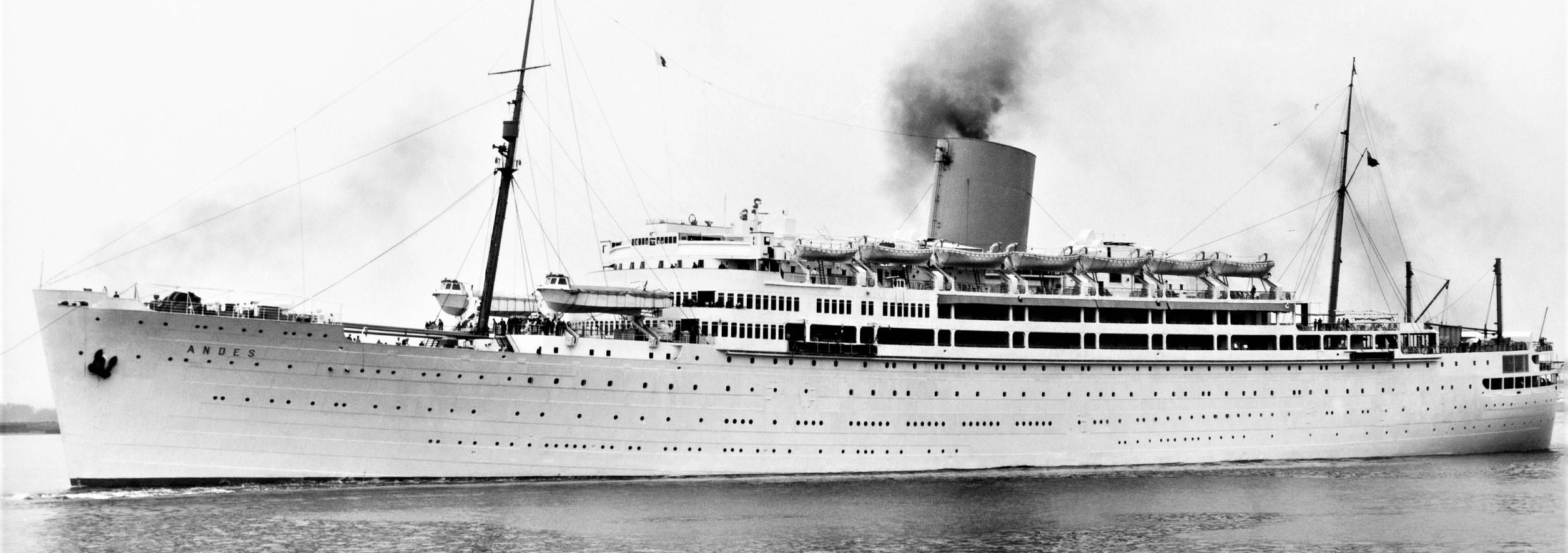
RMS Andes
Royal Mail Lines · completed 1939 · Ship Guide
Overview
RMS Andes (launched 1939) was built for Royal Mail Lines as a modern, fast passenger liner designed for the long South America run. Her intended peacetime role was the company’s premier service between Southampton and the River Plate—typically routing via Rio de Janeiro to Buenos Aires. The timing of her completion, however, placed her immediately into wartime government service.
From late 1939 through 1947, Andes is most consistently described in sources as an Admiralty-controlled troop ship. After the war she returned to Royal Mail, was refitted, and entered civilian liner service in 1948 on the South America route. In the late 1950s she transitioned toward cruising, and in the 1960s she became closely associated with cruise voyages rather than scheduled liner work.
Evidence-first note: “Andes” is a repeated ship name in British merchant shipping. This guide is for the Royal Mail Lines turbine ship launched 7 March 1939 (often indexed as “RMS Andes (1939)”). When cataloging memorabilia, record the year and operator to prevent name-based misattribution.
Key Facts
Service Context
Andes belongs to a late “dual-purpose” design moment: built with a scheduled South America route in mind, but sized and powered in a way that made her adaptable to long-distance troop lift and, later, to cruising. After her postwar return, Royal Mail Lines positioned her on the prestige South America run—where refrigerated cargo capability and long-endurance planning mattered alongside passenger accommodation.
Curatorial cue: for South America liners, printed material often foregrounds the route (“Southampton–Rio–Buenos Aires”) and the company brand. The ship name may appear in smaller type. Don’t assume a “Royal Mail Lines” piece is automatically Andes-specific without ship naming.
Wartime Troopship Career
Wartime conversion compresses the collecting footprint. Passenger-facing ephemera largely disappears; the ship’s paper trail shifts toward movement records, photo captions, and postwar summaries. For Andes, the safest “ship-specific” collecting targets are items that explicitly name her (troopship menus, dated photographs with clear provenance, official souvenirs, or documents that include hull name and date).
Interpretive restraint: troopship claims, passenger/troop capacities, and anecdotal “fastest crossing” stories can be repeated and embellished. Treat these as leads unless you can tie them to a dated primary record.
Postwar Liner Work & Cruising
From 1948, Andes re-enters the “classic” collecting zone: sailing lists, brochures, tickets, luggage labels, onboard stationery, menus, deck plans, and route advertising for South America. In 1959–60 her identity shifts again as she is increasingly presented as a cruise ship—often visually marked by a lighter (commonly white) hull presentation in later imagery and brochures.
Collecting Notes
Practical, evidence-first ways to catalog RMS Andes (1939) material:
- Lock the identifier: “RMS Andes (1939), Royal Mail Lines, Harland & Wolff” in your item record prevents Andes-name drift.
- Separate eras: 1939–47 troopship context vs. 1948–59 South America liner service vs. 1960s cruising.
- Prefer named ship artifacts: menus, stationery, deck plans, passenger lists, and cruise brochures that clearly print Andes.
- Route corroboration: South America ports (Rio, Santos, Montevideo, Buenos Aires, etc.) often reinforce correct attribution when ship name is faint.
- Watch “Royal Mail” general material: company pieces can be beautiful, but file them as “line ephemera” unless the ship is named.
Built for one market, introduced to another: Andes was intended for Royal Mail’s South American passenger trade, but war intervened before she could establish the civilian career for which she had been designed. Her early history therefore belongs to wartime service, while the South Atlantic passenger role came only after demobilization and refit.
That delayed commercial beginning matters when dating photographs and printed material: an early image of the completed ship is not automatically evidence of peacetime passenger operation. The postwar career represents the point at which the original route concept finally became reality.
Evidence-first ship guide