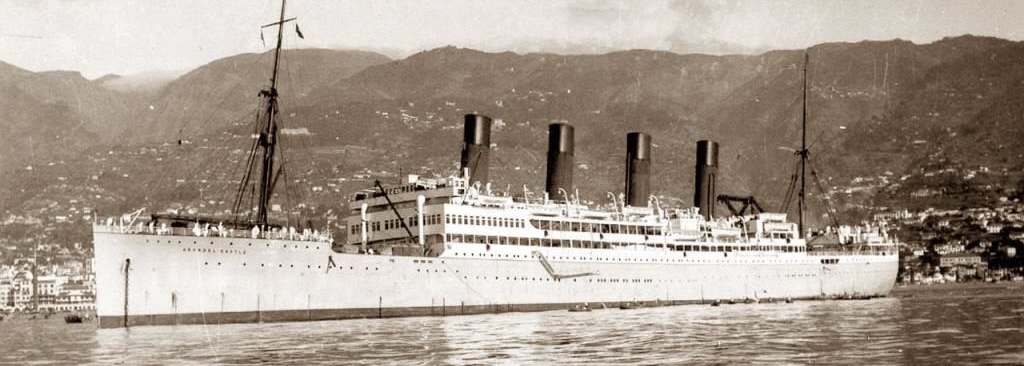
RMS Arundel Castle (1921)
Union-Castle Line · entered service 1921 · Ship Guide
Overview
RMS Arundel Castle was one of Union-Castle Line’s most recognizable “Cape Mail” liners—built for the Southampton–Cape Town run and famous for her four-funnel silhouette on a route that prized reliability and comfort over Atlantic speed records. Ordered before the First World War and completed in 1921 after long wartime delay, she became (for a time) the largest ship on the South Africa service and a highly visible symbol of Union-Castle’s interwar modernization.
A key feature of her story—useful for both historians and collectors—is that she had two distinct “visual lives”: the original four-funnel appearance of the 1920s–mid-1930s and a dramatic 1937 modernization that reduced her to two funnels, altered her bow, lengthened her hull, and improved performance. That rebuild creates clear era markers in photographs and printed material.
Evidence-first note: many listings lean on “four funnels” as proof. Treat silhouette as supporting context only. The strongest attribution is still an internal anchor—printed ship name, date, route, and operator branding.
Key Facts
Design & Construction (Context)
Union-Castle’s South Africa route demanded ships that could keep a tight schedule across a wide range of climates. That shaped Arundel Castle’s design priorities: sustained service speed, large endurance, and passenger comfort on a long-haul mail service. Her original four-funnel profile—striking in photographs—was part practical and part prestige; contemporary commentary often notes that at least one funnel was “dummy” (visual balance more than exhaust demand), reinforcing how brand image mattered even off the Atlantic express stage.
The 1937 modernization matters for interpretation because it effectively created a “second ship” in appearance and performance. For collectors, that provides a built-in dating tool: pre-1937 imagery usually shows the classic four funnels; post-1937 items (photographs, postcards, brochures) often show the two-funnel, more modernized silhouette and altered bow line.
Service History (Summary)
1921–1937: Cape Mail flagship era. Entering service in April 1921, Arundel Castle ran the Southampton–Cape Town service and quickly became one of the route’s showpieces. This is the core “Union-Castle collectible” era: passenger lists, menus, onboard stationery, postcards (often Cape Town views), and sailing/agency ephemera with route language that can anchor attribution.
1937–1939: Rebuilt and modernized. The 1937 refit dramatically altered her outward appearance (two funnels) and is commonly credited with a speed uplift. For cataloging, the rebuild is a clean dividing line—note it explicitly when describing photographs or printed materials.
1939–1945: Admiralty requisition. At the outbreak of the Second World War she was requisitioned and operated as a troop transport. Wartime material exists, but it is also where seller narratives can outpace object evidence. Prefer items that self-document (dated letters, official headers, voyage paperwork, or photographs with reliable captions).
1946–1958: Postwar passenger/emigrant service and final years. After release from government service she returned to civilian work, including postwar passenger and emigrant traffic to South Africa, before resuming a more standard Union-Castle mail-service rhythm. Her final voyage concluded in December 1958, and she was sold for scrap soon after.
Interpretive Notes
Arundel Castle is extremely rewarding for evidence-first collecting because Union-Castle material often prints identity clearly, and because the 1937 rebuild gives you a powerful visual “date bracket.” The main pitfalls are not fakes so much as era drift (1920s vs post-1937 vs postwar) and route drift (generic “South Africa liner” items presented as ship-specific).
Practical checks:
1) Printed route line: “Southampton–Cape Town” language is a strong anchor for Union-Castle mail material.
2) Photo silhouette: four funnels generally indicates pre-1937; two funnels generally indicates post-1937 (supporting evidence only).
3) Dates & ports beat romance: a dated menu/passenger list is stronger than any “famous four-funnel” sales copy.
4) Postwar vs interwar tone: typography and class language often shift—catalog what the item says, not what it “feels like.”
Cape Mail context: Arundel Castle belonged to a service in which schedule discipline mattered as much as prestige. Union-Castle’s mail contract tied the liner to regular South African connections, so sailing dates, intermediate ports, and seasonal traffic patterns are historically meaningful rather than incidental details.
The 1930s modernization also creates a strong visual breakpoint. Her original four-funnel appearance and later streamlined profile belong to different photographic and collecting eras; undated images should therefore be checked against funnel count, bridge form, and superstructure details before being assigned to a specific period.
The modernization therefore matters twice: as an engineering and passenger-service update, and as a practical dating tool for visual evidence. A collector who ignores that breakpoint can easily place a later photograph into the ship’s original 1920s appearance.
That makes the refit a core part of the ship’s evidentiary timeline, not merely a cosmetic footnote.
It also helps separate original-condition postcards from later promotional material produced after the ship’s appearance had been substantially updated.
Evidence-first ship guide