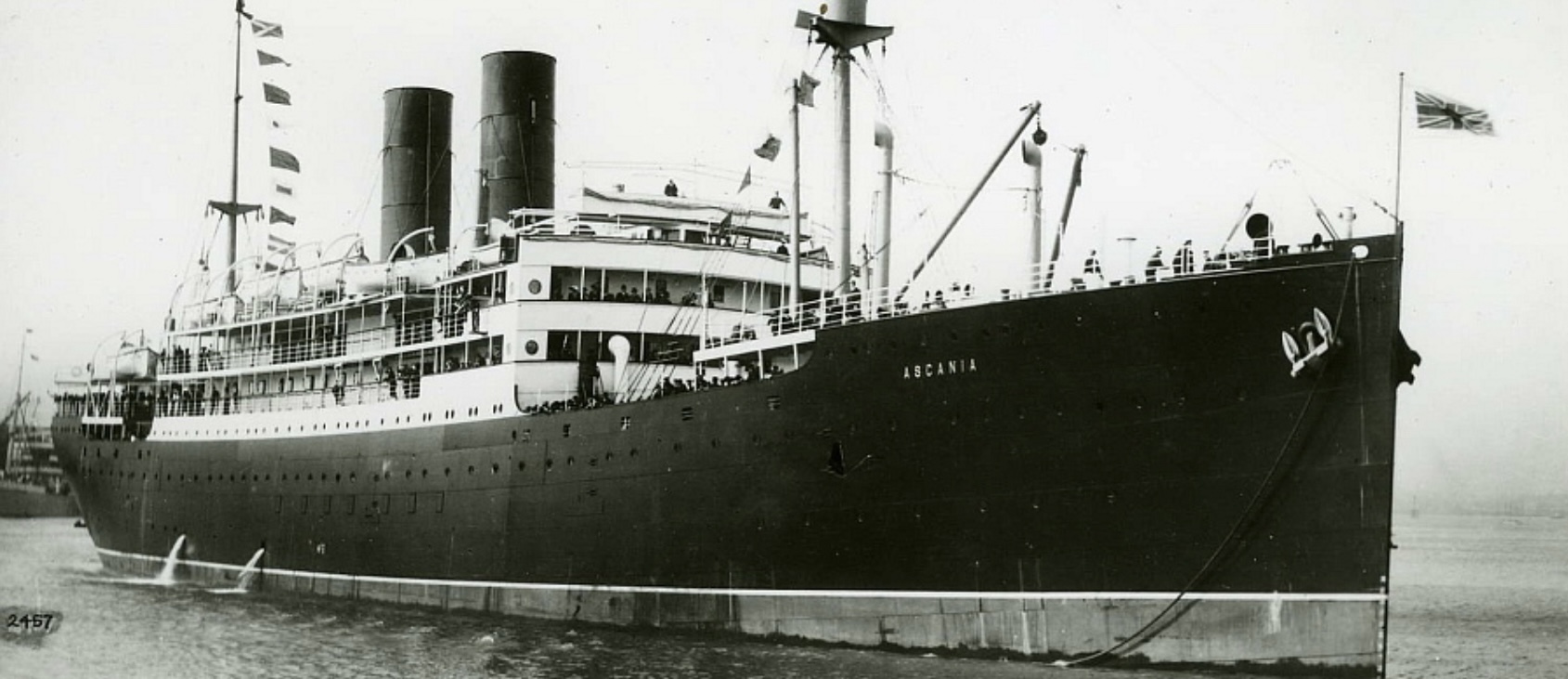
RMS Ascania
Cunard Line · 1923 · Ship Guide
Overview
RMS Ascania was one of Cunard’s interwar “A-class” cabin liners, built for practical North Atlantic service rather than the elite express-liner trade. She belonged to the London–Southampton–Quebec–Montreal route system, with seasonal winter service to Halifax and New York, and represented the sturdy middle range of Cunard’s passenger fleet in the 1920s and 1930s. Although often identified by her 1923 launch year, she was not completed until 1925, and that distinction matters when dating sources and artifacts.
In collecting and interpretation, Ascania is best separated into three broad phases: interwar Cunard passenger service, wartime government and military service, and postwar return to civilian operation. Menus, passenger lists, military transport material, and postwar tourist-class ephemera belong to different documentary settings and should not be merged casually.
Key Facts
Sources differ in whether they headline this ship as Ascania (1923) or effectively treat her as a 1925 liner because of her completion and maiden-voyage dates. For cataloging purposes, the safest practice is to preserve both the launch year and the 1925 entry-into-service chronology.
Design & Construction Context
Ascania was not intended as an Atlantic speed queen. She belonged instead to Cunard’s solid commercial core: ships designed for dependable Canadian and North Atlantic service, carrying a mix of cabin and emigrant or tourist traffic with cargo revenue as part of the operating logic. In that sense, she represents the durable interwar cabin-liner world more clearly than Cunard’s more famous prestige vessels.
Her delayed completion also matters. Launched in late 1923 but not finished until May 1925 because of cost overruns, she sits slightly awkwardly in fleet chronology. That makes exact dating especially important when dealing with advertisements, builder information, and route ephemera.
Service History (Summary)
1923–1925 construction and entry into service: Built by Armstrong Whitworth at Newcastle-upon-Tyne, Ascania was launched on 20 December 1923 and completed on 2 May 1925. She began her maiden voyage on 22 May 1925, sailing from London and Southampton to Quebec and Montreal.
Interwar Canadian service: Her peacetime identity belongs to Cunard’s Canadian and St. Lawrence trade, with seasonal winter operation to Halifax and New York. This is the correct interpretive setting for passenger lists, cabin-class material, route brochures, and most prewar commercial photography.
Interwar adjustments and incidents: In July 1927 her accommodations were revised to cabin, tourist, and third class, reflecting broader interwar changes in passenger marketing. In December 1934 she rescued the crew of the sinking cargo ship Unsworth, and in July 1938 she ran aground near Bic Island in the St. Lawrence before being refloated and repaired.
Second World War service: Requisitioned in 1939, Ascania served in several wartime roles, including troop transport and later naval support work. In 1940 she was involved in the Norwegian campaign, and later she served as a depot and accommodation ship under naval control, illustrating how far her wartime identity diverged from her original civilian role.
Postwar return: After refit, Ascania returned to Cunard service in 1950. She then belongs to a distinct postwar passenger world, shaped less by pre-1939 migration patterns and more by the changed economics of North Atlantic travel.
Retirement and scrapping: She remained in service until December 1956 and was scrapped at Newport in January 1957. Her long overall career makes her documentation richer than that of many short-lived liners, but it also means artifacts must be dated carefully to the correct service phase.
The A-Class Canadian Service
Ascania belonged to Cunard's postwar A-class program, ships intended for practical Canadian and North Atlantic service rather than the express route. Her regular pattern linked Southampton with Québec and Montréal, shifting toward Halifax and New York when winter closed the St. Lawrence.
That seasonal geography matters when identifying passenger material: a winter New York sailing does not represent a different ship role, but the operational response to the Canadian route's ice season.
Grounding and Rescue Before the War
In December 1934 Ascania rescued the crew of the sinking cargo ship Unsworth. Four years later, on 2 July 1938, she grounded near Bic Island in the St. Lawrence; her passengers were transferred off while the crew remained aboard for the salvage effort.
These incidents add useful texture to an otherwise routine liner career and also help date newspaper photographs and passenger correspondence from the 1930s.
War Service and Civilian Return
During the Second World War Ascania served in several government and military roles before eventually returning to passenger operation in 1950. That return required refitting the vessel back toward civilian use after years spent outside normal liner service.
The ship's 1920s cabin-liner identity, wartime configuration, and 1950s passenger service therefore represent three materially different phases of the same hull.
Interpretive Notes
This is an interwar cabin liner first: Ascania should be read primarily within the practical commercial world of Cunard’s Canadian and secondary North Atlantic services, not through the mythology of express-liner grandeur.
1923 and 1925 are both important dates: the launch year explains why some sources identify her as a 1923 ship, while 1925 marks her true service debut. Both dates can be correct in different contexts, but they should not be confused.
Her wartime identity is separate from her civilian one: troopship, depot-ship, and naval-service references belong to a different interpretive framework from passenger ephemera and Cunard promotional material.
Postwar material should not be treated as prewar by default: because Ascania returned to service after 1950, later menus, brochures, and photographs may reflect a very different shipboard culture from her original interwar phase.
This is a strong documentation ship: compared with some more obscure liners, Ascania has a relatively long and varied paper trail. That makes precise phase identification even more important, because the name spans interwar, wartime, and postwar contexts.
Evidence-first ship guideSources (Selected)
- Ocean Liner Curator — Sources (master bibliography)
- RMS Ascania (1923) — overview chronology, technical particulars, route history, wartime roles, and retirement
- GG Archives — summary particulars, accommodation, and route/service outline
- Royal Museums Greenwich — collection search for surviving photographs and related material
- Clydeships / shipbuilding reference context for comparable Cunard motor and turbine liners