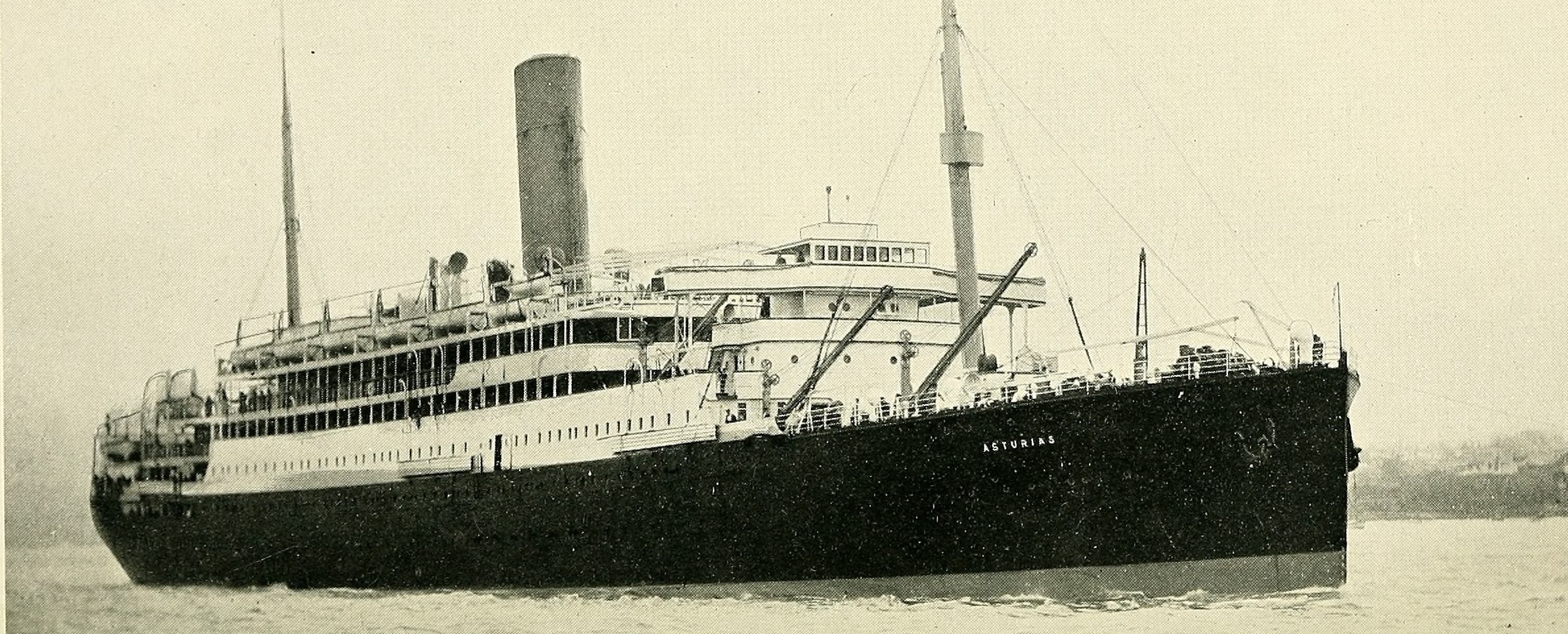
RMS Asturias (1908)
Royal Mail Steam Packet Co. · 1908 · Ship Guide
Overview
RMS Asturias was a Royal Mail Steam Packet Company (“Royal Mail Line”) passenger liner built by Harland & Wolff at Belfast and delivered in January 1908. She was part of the company’s “A-series” South America service, associated particularly with the Southampton–Buenos Aires route and the prewar expansion of reliable, comfortable long-haul liner travel to the River Plate.
Her career arc is unusually multi-layered: a peacetime liner, then a First World War hospital ship (HMHS Asturias), torpedoed and beached off South Devon in March 1917, followed by salvage and a period as an ammunition hulk, and finally a postwar “second life” as the cruise ship Arcadian after a major refit in the early 1920s.
Evidence-first note: There was also a later Asturias (Royal Mail Line) launched in the mid-1920s. This page covers the 1907/1908-built Asturias that became HMHS Asturias and later Arcadian.
Key Facts
Design & Construction (Context)
Asturias was built for steady long-distance passenger service rather than headline speed contests. In the Royal Mail Line model, that meant dependable schedules, cargo capacity, and a passenger experience suited to multi-week voyages to South American ports. In collecting terms, that usually yields a distinctive paper trail: company-branded passenger lists, menus, deck plans, luggage labels, and route-specific brochures and agency notices emphasizing the River Plate trade.
Technically she sits in a transitional sweet spot: a substantial steel liner of the prewar expansion era, powered by large quadruple-expansion engines at a time when turbines were rising but not universal. The visual identity many collectors recognize—Royal Mail Line branding and the “A-series” family resemblance—can be helpful for context but is not sufficient for ship-specific attribution without printed anchors.
Service History (Summary)
1908–1914: South America liner service. Delivered in January 1908, Asturias entered the Royal Mail Steam Packet Company’s South America services, commonly associated with Southampton–Buenos Aires voyages. Material from this period often prints ship name and route clearly, which is ideal for evidence-first cataloging.
1914–1917: HMHS Asturias. In August 1914 she was converted to a hospital ship and operated in the marked white-and-green hospital-ship scheme. This era can produce compelling artifacts—official stationery, medical staff documents, postcards, and photographs—yet it is also an area where attributions drift. Prefer items with unit/ship identifiers and dates rather than generic “WWI hospital ship” souvenirs.
20 March 1917: Torpedoing and beaching. While returning along the English coast, HMHS Asturias was torpedoed by UC-66 and was subsequently beached off South Devon. The incident is well documented; however, casualty numbers and micro-timelines vary by account—cite carefully if you publish specifics.
1917–1922: Salvage and hulk years. After salvage she was used as an ammunition hulk for a period, reflecting how damaged tonnage could be repurposed during and after the war.
1923–1930: Rebuilt as Arcadian. In the early 1920s she underwent a major rebuild/refit and returned to service as the cruise ship Arcadian, operating cruises (Mediterranean and West Indies are commonly cited). This generates a different paper trail—more “cruise” branding, itinerary booklets, and shore-excursion materials.
1930–1933: Laid up and scrapped. Laid up in 1930, she was sold for scrap and broken up in 1933.
Interpretive Notes
RMS Asturias is a classic case where a single hull supports multiple collecting categories. The biggest risk is “name and role collapse”: listing anything connected to Arcadian as “RMS Asturias,” or labeling generic Royal Mail Line ephemera as ship-specific. Your catalog should keep the identity ladder explicit: RMS Asturias (1908) → HMHS Asturias (1914–1917) → Arcadian (1923–1933).
Practical checks:
1) Printed name on the item: “Asturias” vs “Arcadian” should be preserved—do not “upgrade” names for romance.
2) Route language: Southampton / Buenos Aires / River Plate wording supports prewar liner-era attribution.
3) WWI hospital ship claims: look for HMHS identifiers, dates, and institutional headers.
4) Beware the later Asturias (1920s): if an item references later-era design language or post-1925 context, confirm which ship it belongs to.
Sources (Selected)
Use these as a starting index; corroborate technical particulars against registers/yard data and WWI incident details via institutional summaries.
- Ocean Liner Curator — Sources (master bibliography)
- Wikipedia — HMHS Asturias (starting index; cross-check)
- TheYard.info (Harland & Wolff) — Yard no. 388 build data
- Maritime Archaeology Trust (PDF) — HMHS Asturias summary (torpedoing/beaching context)
- GG Archives — RMS Asturias archival index (compiled; cross-check)
- ShipIndex — bibliographic index (use to chase books, registers, and archival references)