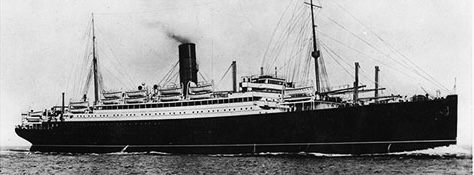
RMS Aurania (1916)
Cunard Line · completed 1917 · Ship Guide
Overview
RMS Aurania is unusual among Cunard liners because the peacetime career for which she was designed never truly happened. Ordered before the First World War as part of Cunard's Canada–Europe planning, she was delayed by wartime priorities, launched on 16 July 1916, completed in March 1917, and placed directly into government transport service.
Her historical identity therefore belongs primarily to wartime transport rather than to civilian passenger service. The commercial ship existed first as design intent and company planning; the operating ship that actually sailed was a troop and supply carrier.
Key Facts
Designed for Peace, Completed for War
Aurania was conceived as part of Cunard's practical Canadian-service fleet. In that sense she belongs structurally with liners such as Alaunia and Andania, ships intended for migration, cargo, and general passenger work rather than for express prestige.
War broke the expected sequence. Instead of entering a normal commercial timetable and generating years of passenger lists, menus, and route brochures, the ship emerged from construction into a military transport system. That distinction between intended role and actual career is the key to interpreting her history accurately.
Construction Delay
Ordered before the war, Aurania was not launched until July 1916 and was completed in March 1917. The delay itself is part of the story because wartime shipbuilding priorities changed labor, materials, and completion schedules across the industry.
This also explains why secondary references sometimes date the ship differently, emphasizing order year, construction year, launch year, or completion year. For curatorial work, launch and completion dates should be stated explicitly rather than relying on an ambiguous parenthetical year.
Troopship Career
Aurania's first voyage took her from the Tyne to New York on 28 March 1917. She remained on British Government hire and spent the rest of her active life moving troops and supplies across the North Atlantic.
By early 1918 she had completed several crossings, but she had never accumulated a normal civilian passenger identity. This is why supposed “passenger-service” material associated with the ship deserves extra scrutiny: publicity about the planned liner and records of the operating wartime vessel belong to different evidentiary categories.
Final Voyage and Torpedoing
In February 1918 Aurania sailed westbound in ballast. On 4 February she was torpedoed by the German submarine UB-67. The explosion flooded machinery spaces and left the ship badly damaged.
A tow was established, but the vessel later stranded near Tobermory on the Isle of Mull and was broken up by heavy weather. The loss was therefore a sequence rather than a single instant: torpedo damage disabled the ship, towing failed to save her, and grounding completed the destruction.
The Missing Civilian Career
One of the most important facts about Aurania is negative: there was no long sequence of peacetime crossings in which the ship gradually developed a public identity. Company planning, construction publicity, and specifications describe what Cunard intended, but they should not be mistaken for evidence of a mature civilian service that never occurred.
This makes the ship especially interesting for provenance work. A brochure produced before completion might advertise projected accommodation or routes, while a wartime photograph shows a vessel operating under completely different priorities. Both are authentic, but they answer different historical questions.
Life as a Wartime Transport
Troopship service placed different demands on the vessel from those anticipated by her designers. Passenger comfort, decorative presentation, and commercial timetable logic gave way to capacity, military scheduling, convoy or routing instructions, and the practical movement of men and supplies.
The documentary record therefore leans toward government correspondence, transport schedules, naval intelligence, casualty reports, and ship movements. That profile helps explain why Aurania can feel less visible in popular liner history despite being structurally comparable to better-known Cunard ships.
Wreck and Afterlife
The final loss near Tobermory created another category of evidence: wreck reports, salvage references, and later local memory. Because the ship did not sink immediately after the torpedo attack, accounts that compress the event to “torpedoed and sunk” lose the important sequence of damage, towing, grounding, and destruction by weather.
For interpretation, that sequence also separates cause from final mechanism. UB-67 inflicted the disabling damage; the later stranding and heavy seas completed the loss. Preserving both stages gives a more accurate account than assigning everything to a single moment.
Interpretive Notes
Aurania should not be described as though she enjoyed a normal Cunard passenger career. The original Canada–Europe role belongs to design intent; the actual service record belongs overwhelmingly to wartime transport.
Structurally she can be compared with her related Cunard ships, but operationally she is different. Collectors should expect shipbuilding references, fleet planning material, transport records, military documentation, and loss reports to be more representative than ordinary peacetime passenger ephemera.
That unusual documentary profile is not a deficiency. It is precisely what makes Aurania historically interesting: a commercial liner whose intended civilian identity was overtaken completely by war.
Evidence-first ship guide