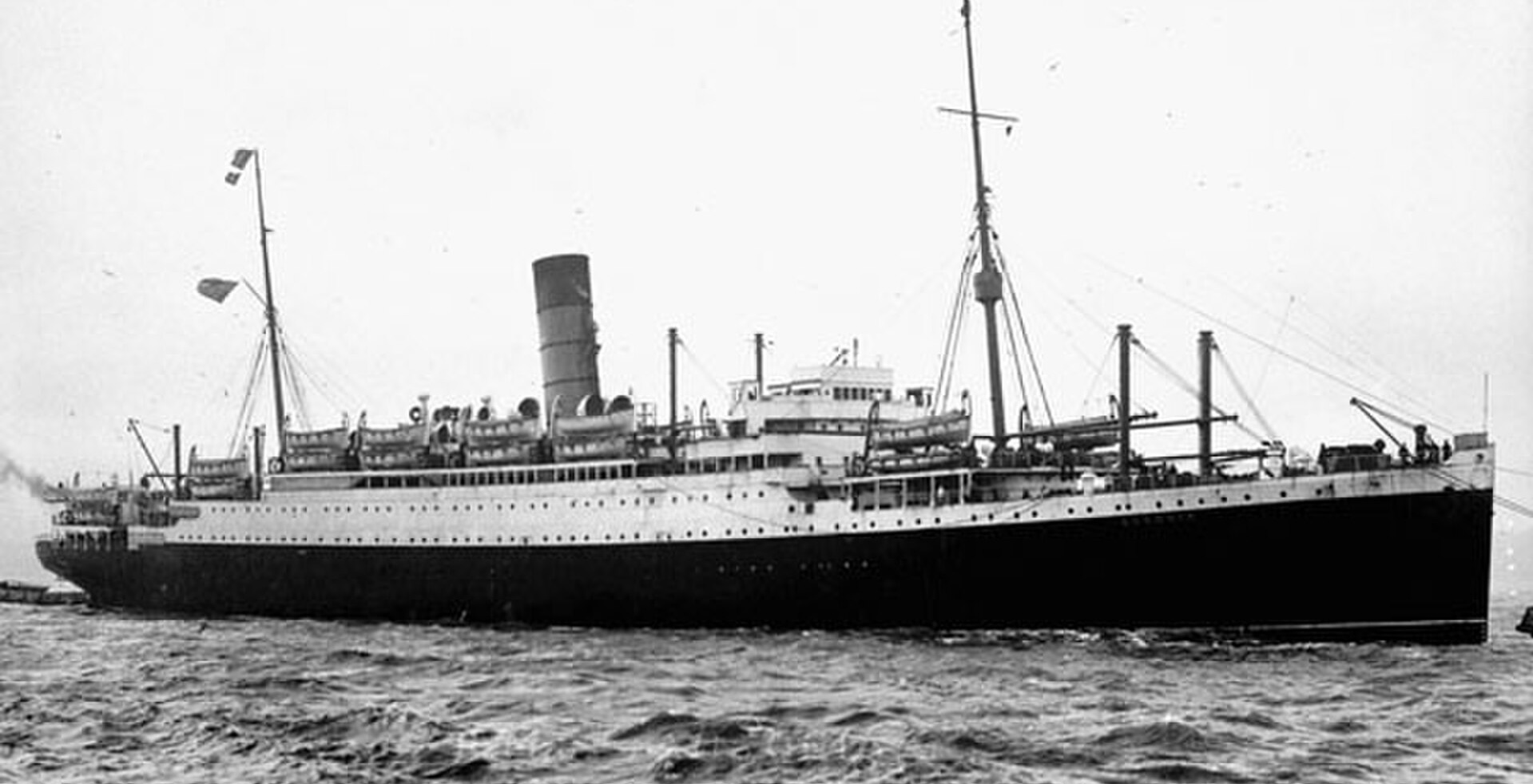
RMS Ausonia (1922)
Cunard Line · entered service 1922 · Ship Guide
Overview
RMS Ausonia was one of Cunard's original three 1922 A-class intermediate liners, built for Canadian passenger, emigrant, mail, and refrigerated-cargo service after the First World War. Alongside Andania and Antonia, she formed the first trio in a broader six-ship A-class rebuilding program.
Built by Armstrong, Whitworth at High Walker on the Tyne, Ausonia was launched on 22 March 1921 and entered passenger service in 1922. Her maiden voyage on 31 August took her from Liverpool to Quebec and Montreal; from the following season she was closely associated with the London–Southampton–Quebec–Montreal service.
Her wartime and postwar career made her the longest-lived of the class. Requisitioned in September 1939 as an armed merchant cruiser, she escorted and patrolled in the Atlantic before being converted into a fleet repair ship. She later served in the Eastern Fleet and, after years in reserve, returned to active service at Malta in 1958 as a repair and depot ship for the Mediterranean Fleet.
When finally sold in 1965, Ausonia had accumulated roughly forty-four years of service across commercial and naval roles. That longevity makes her unusually valuable for tracing how an interwar passenger liner could be transformed repeatedly without losing the continuity of the underlying hull.
Evidence-first note: sources differ by a day on the launch date and disagree in older summaries on the maiden-voyage date. Contemporary-style and specialist histories commonly give 22 March 1921 for launch and 31 August 1922 for the Liverpool–Quebec–Montreal maiden voyage; those dates are used here while the discrepancy is preserved rather than hidden.
Key Facts
The Original 1922 A-Class Trio
Ausonia, Andania, and Antonia formed the first three-ship batch of Cunard's postwar A-class program. Approximately 14,000 gross tons each, the ships were designed as passenger-refrigerated-cargo liners for the Canadian trade, combining cabin-class accommodation with very large third-class capacity.
A second trio—Aurania, Alaunia, and Ascania—followed in the mid-1920s. Keeping the two trios distinct is useful because the broader "A-class" label can otherwise obscure differences in build date, builder, and wartime history.
Canadian Passenger Service
After her 1922 maiden voyage, Ausonia worked the Canadian trade that had shaped her design. Published fleet histories place her on London and Southampton services to Quebec and Montreal through much of the interwar period, with Halifax serving as the practical winter alternative when the St. Lawrence was inaccessible.
Her passenger arrangement shows the market Cunard expected to serve. The ship offered several hundred cabin-class berths but more than a thousand third-class places, along with significant refrigerated cargo space. This was a transportation system built around migration, family travel, food cargoes, and regular scheduled movement rather than flagship spectacle.
Armed Merchant Cruiser
With the outbreak of the Second World War, Ausonia was requisitioned in September 1939 and converted into an armed merchant cruiser. Her armament included eight 6-inch guns and two 3-inch guns, transforming the passenger liner into a naval auxiliary suitable for ocean patrol and escort work.
She served with Atlantic escort forces, including work associated with Halifax and patrols in the North Atlantic. During a Belfast refit in 1941 she and the dockyard were exposed to German bombing, another example of how the ship's operational world had shifted completely from commercial passenger service.
Conversion to Fleet Repair Ship
By 1942 the Royal Navy's need for mobile repair capacity had become more pressing than the requirement for additional armed merchant cruisers. Approval was given to convert Ausonia into a heavy fleet repair ship, and the Admiralty acquired her outright.
Her former passenger spaces were transformed into workshops, technical stores, and specialized support areas. Additional electrical generating plant and repair facilities allowed the ship to function as a mobile dockyard for naval forces operating far from established bases. The conversion was completed in 1944, after which HMS Ausonia served with the Eastern Fleet.
Far East Service
HMS Ausonia deployed east in 1944 and supported Allied naval operations in the Indian and Pacific theaters. Specialist histories place her repair work at Aden and later Manus Island, where mobile technical support was essential to maintaining ships operating at great distance from British dockyards.
Repair ships rarely occupy the foreground of naval histories, but their role was fundamental. A damaged or mechanically compromised warship could remain in theater only if skilled workers, machine tools, spare parts, power, and workshop space were available nearby.
Postwar Reserve and Malta
After returning from the Far East, Ausonia spent years in reserve. Her career might easily have ended there, but she was recommissioned at Devonport on 16 September 1958 and sent to Malta to serve the Mediterranean Fleet.
At Malta she operated as a repair ship and gradually took on depot duties for submarines and minesweepers. This second naval career extended well into the 1960s, making her one of the last surviving operational links to Cunard's immediate post-First World War rebuilding program.
Final Years and Disposal
The gradual reduction of British forces in Malta finally made the elderly repair ship unnecessary. Ausonia left Malta for the last time on 7 August 1964 and returned to Portsmouth for disposal.
Sold to Spanish breakers in 1965, she departed Portsmouth under tow on 13 November for Castellón. Her roughly forty-four-year life encompassed eighteen years as a passenger liner, wartime service as an armed merchant cruiser, and more than two decades as a fleet repair ship.
Why Ausonia Matters
Ausonia demonstrates the extraordinary adaptability of a medium-sized liner hull. Designed around emigrant and cargo traffic to Canada, she later became first an armed patrol vessel and then a floating industrial base capable of supporting fleets across the Indian Ocean, Pacific, and Mediterranean.
She also completes the historical picture of the first A-class trio. Andania was lost in 1940; Antonia became HMS Wayland and was scrapped in 1948; Ausonia remained in naval service until the mid-1960s. Three nearly contemporary sisters thus developed strikingly different wartime and postwar fates.
Interpretive Notes
Ausonia belongs to the original 1922 trio: her immediate sisters were Andania and Antonia, distinct from the later Aurania–Alaunia–Ascania follow-on group.
Her naval career is longer than her passenger career: artifacts and photographs after 1939 should be interpreted primarily through her AMC and repair-ship identities rather than Cunard passenger service.
Launch and maiden-voyage dates require source awareness: minor discrepancies exist in published summaries; recording the source convention is preferable to hiding the conflict.
Her longevity is historically meaningful: the 1965 disposal date makes her the last survivor of Cunard's six A-class liners.
Evidence-first ship guideSources (Selected)
- Ocean Liner Curator — Sources (master bibliography)
- HMS Ausonia historical project — RMS/HMS Ausonia chronology and technical particulars
- Tyne Built Ships — Armstrong Whitworth construction record for Ausonia
- HMS Ausonia historical project — armed merchant cruiser service and armament
- HMS Ausonia historical project — postwar Malta service and disposal
- HMS Ausonia historical project — Cunard A-class fleet context
- RMS Ausonia — consolidated technical and service chronology