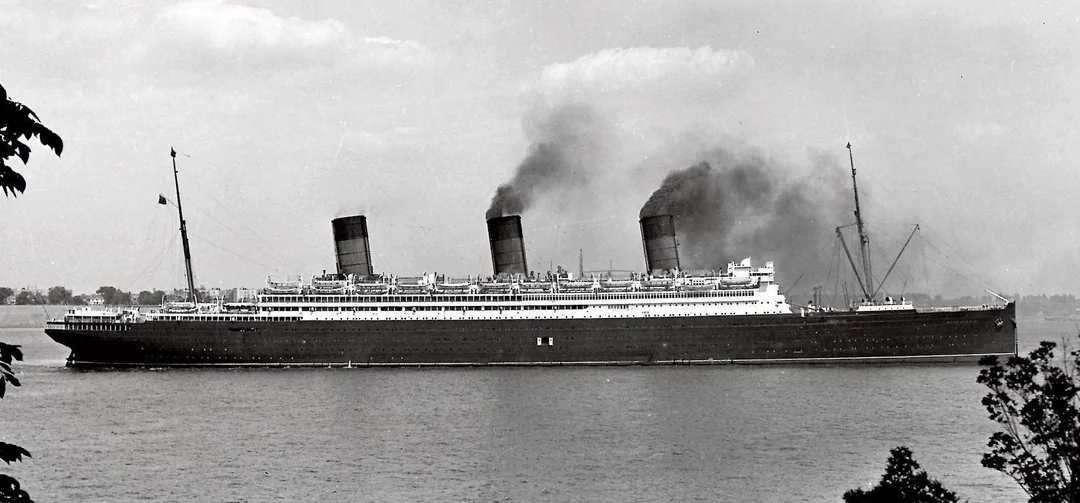
RMS Berengaria
Cunard Line · ex-Imperator · Ship Guide
Overview
RMS Berengaria began life as SS Imperator, the first of Hamburg America Line's trio of enormous prewar liners. Built by A.G. Vulcan at Hamburg, she was launched on 23 May 1912 and began her maiden voyage from Cuxhaven to New York via Southampton on 11 June 1913.
World War I interrupted the career she had been built for. In 1919 the ship was turned over for U.S. troop-repatriation work, then transferred to Britain as a war reparation. Cunard ultimately operated her as Berengaria, making her a flagship of the company's interwar express service.
Key Facts
German Design, British Career
Imperator was conceived as a German prestige liner and was briefly the largest ship in the world. Her transfer after World War I created one of the clearest examples of a liner acquiring a second national identity without losing the architectural DNA of the first.
Cunard refitted the ship extensively, including conversion to oil-fired boilers. In service she joined Aquitania and Mauretania, giving Cunard a formidable three-ship express fleet before the arrival of the later Queens.
Imperator to Berengaria
The ship's change of identity after World War I was unusually profound. As Imperator, she had been conceived as a German national-prestige liner for Hamburg America Line. After wartime inactivity and U.S. troop-repatriation service, transfer to Britain brought not just a new operator and name but a substantial technical and cultural reworking. Cunard's refits altered machinery, fuel, fittings, and presentation while preserving the basic architecture of the original German hull.
Her place in Cunard service should therefore be understood as both continuity and reinvention. Alongside Mauretania and Aquitania, Berengaria helped sustain a three-ship express pattern during the 1920s, before Cunard's purpose-built Queen Mary and Queen Elizabeth reshaped the company's flagship identity.
Groundings, Fires, and Withdrawal
Royal Museums Greenwich records two groundings on the approaches to Southampton in the 1930s and two significant fires attributed to faulty wiring. Those incidents matter, but they should not be reduced to a simplistic claim that one fire alone "killed" the ship. Age, maintenance burden, operating economics, and electrical problems all contributed to her final withdrawal in 1938.
Her fittings were auctioned in 1939 and the hull was sold for scrap. Sources differ on how to date the end because demolition was prolonged; the safest formulation is sale for scrap in 1939 with dismantling continuing into the wartime years.
Interwar Flagship Context
During the 1920s, Berengaria occupied a role that is easy to underestimate from the perspective of the later Queens. She was one of Cunard's principal large liners at a time when the company relied heavily on prewar tonnage adapted to postwar conditions. Her size and German origins gave her a distinctive place in the fleet, but day-to-day value came from sustained Atlantic service rather than from a single technical superlative.
Interpretive Notes
Identity is phase-specific. German Imperator material, 1919 U.S. troop-service records, and Cunard Berengaria ephemera belong to three distinct historical contexts.
Be careful with "largest" claims. She was the world's largest ship at completion, but rankings changed quickly and should always be tied to a date and measurement convention.
Explore the wider context: How to Track a Renamed or Transferred Liner · How to Identify a Refit from a Photograph · Prewar and Postwar Ocean Liner Travel.
Evidence-first ship guide