RMS Britannia
Cunard Line · 1840 · Ship Guide
Overview
RMS Britannia (1840) was one of the founding ships of Cunard’s original transatlantic fleet—wooden-hulled paddle steamers built to deliver scheduled mail and passenger service between Britain and North America. If later “ocean liners” are defined by regularity, route discipline, and brand continuity, Britannia belongs in the origin story: she helped prove that the Atlantic could be served by timetable rather than by hope.
For collectors, Britannia is an early-material ship: the artifact trail tends to be print culture and documentary survivals—period engravings, early company history, dated sailing notices, and later retrospectives—rather than the dense souvenir ecology you see after the 1880s. Her afterlife is also unusually sharp: she exits Cunard service early and reappears under another name in a different context, which is exactly where attribution mistakes happen.
Evidence-first note: “RMS” is widely used for Britannia in modern references because she carried the Royal Mail. On artifacts, prioritize what the object prints (company, ports, date, ship name). Early items often omit prefixes, and later sellers sometimes add them.
Key Facts
Design & Construction (Context)
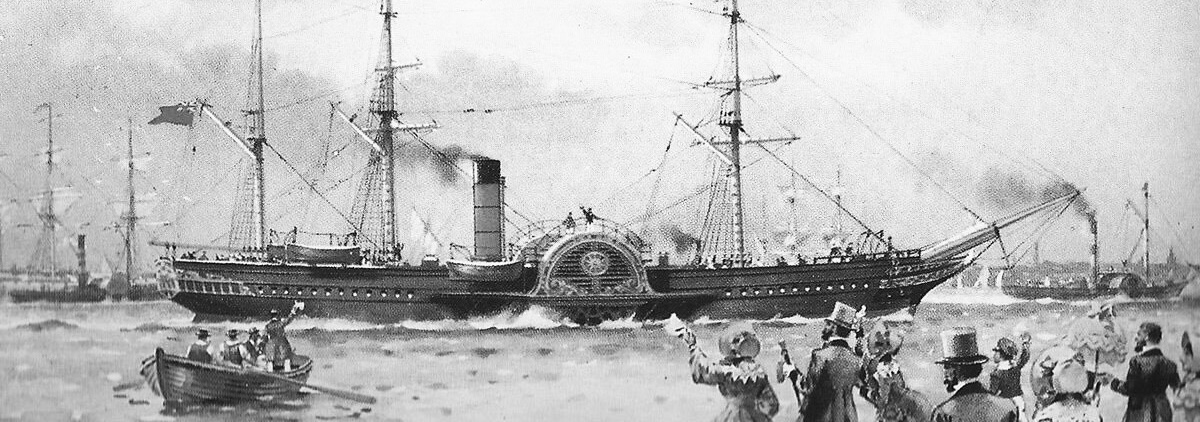
Britannia belongs to a very particular technological moment: wooden hull, paddle propulsion, and sailing rig retained as part of the ship’s overall reliability and economy. The visual signature is immediate—low, long hull lines, side paddle boxes, and a single funnel—an aesthetic that reads more like “early industrial transport” than the steel leviathans people picture when they hear “ocean liner.”
Cataloging tip: many period images of Britannia are engravings or later paintings of an early profile. When a listing claims “photograph of RMS Britannia,” treat it carefully—verify medium, date, and provenance, and watch for confusion with later ships named Britannia.
Service History (Summary)
1840: a schedule begins. Launched on 5 February 1840, Britannia sailed on 4 July 1840 from Liverpool for Halifax and Boston—an inaugural voyage commonly treated as a keystone in establishing regular, contracted mail steamship service across the North Atlantic. In collecting terms, this is the “institutional birth” phase: ports, dates, mail, and route language matter more than luxury rhetoric.
1840s: the working Atlantic. Through the decade she appears in compiled voyage records and company histories as a steady mail-and-passenger ship, with occasional headline mishaps (ice and groundings appear in multiple secondary summaries). This is a good evidence-first zone: if you publish an incident, anchor it to a date and place, then seek contemporary reporting or official records when possible.
1849 onward: name-change trap. Britannia left Cunard service in 1849 and was renamed Barbarossa. Later references commonly track her into German/Prussian naval service, ending with her being sunk as a target ship in 1880. This long afterlife under another identity is where auction listings can go sideways—especially when a seller uses “Cunard Britannia” as a generic hook.
Interpretive Notes
Britannia is a “foundational proof” ship: she matters less because of singular glamour and more because she helped normalize the idea that an Atlantic crossing could be routinized. That makes her a great candidate for evidence-led collecting—items with dates, ports, postal context, and early-company framing.
Practical checks:
1) Route language: Liverpool–Halifax–Boston references are high-signal for the early Cunard era.
2) Identity control: Confirm you’re not looking at a later Britannia (many ships carried the name). Use year, operator, and propulsion clues.
3) Afterlife awareness: For 1849+ items, verify whether the object is actually tied to Barbarossa (and which navy), not Cunard service.
4) Measurement drift: Early ship particulars may be reported in differing conventions—cite your source and avoid false precision.
Sources (Selected)
Use these as a starting index; corroborate technical particulars and any operational claim you publish with contemporary reporting, registers, and archival material where possible.
- Ocean Liner Curator — Sources (master bibliography)
- Wikipedia — RMS Britannia (1840) (starting index; verify against primary/compiled records)
- Norway Heritage — Britannia (Cunard) (compiled voyage/incident notes; cross-check)
- Chris’ Cunard Page — Britannia (fleet history summary; cross-check)
- Victorian Web — Paddle Steamer Britannia (historical narrative; verify particulars)
- The Mariners’ Museum — Britannia (1840) model/object record (contextual reference)