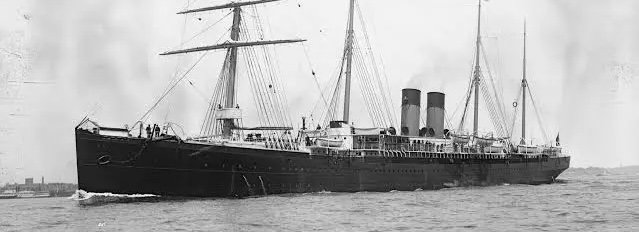
RMS Britannic (1874)
White Star Line · entered service 1874 · Ship Guide
Overview
RMS Britannic was a larger development of White Star's first generation and the elder sister of Germanic. Built by Harland & Wolff, launched on 3 February 1874, and entering Liverpool–New York service on 25 June, she combined large steerage capacity with saloon accommodation and enough performance to take part in the Atlantic speed competition of the 1870s.
Her long career is best understood in two broad phases: nearly a quarter century of regular North Atlantic passenger work, followed by government service as a Boer War troop transport. Those phases generated very different kinds of surviving material and should be treated separately in cataloging.
Key Facts
A Bridge Between White Star Generations
Britannic belongs between the first Oceanic-class ships and the later twin-screw express liners. She was larger and more powerful than the earliest White Star steamers but still retained a single screw and sailing rig, making her another useful example of gradual technological change.
This transitional character appears in visual material. Early photographs and illustrations may emphasize masts and yards, while later images—especially government-service views—can look very different.
Migration at the Center of the Ship
The roughly 1,500 steerage berths are among the most historically important facts about Britannic. She was a major migration carrier, and that role generated a huge body of practical documentation: passenger lists, sailing cards, agency material, tickets, and port records.
First-class accommodation mattered to prestige, but the volume business of lower-cost passage was central to the economics of the ship. The ordinary journeys of thousands of emigrants belong at the center of the narrative, not at the margins.
1876 Record Passages
In late 1876 Britannic achieved both westbound and eastbound record passages. These performances complicate the familiar idea that White Star avoided speed competition. The company could emphasize comfort and still exploit record passages for publicity.
As with other early “Blue Riband” claims, direction and date matter. The safest phrasing is tied to a particular crossing rather than treating the honor as a permanent formal title.
Long North Atlantic Service
From 1874 through the end of the century, Britannic remained a durable working liner on the Liverpool–New York route. That longevity makes her more than a technological stepping stone; she was part of the everyday transport infrastructure of the immigrant era.
The long service also means accommodation, fittings, and operational details could change. A specification from the mid-1870s should not automatically be projected onto material from the 1890s.
HMT 62 and the Boer War
In 1899 the British government requisitioned Britannic for troop transport during the Second Boer War. The ship's administrative and visual identity shifted sharply from commercial passenger service to military transport.
Collectible material from this phase tends to be documentary—official photographs, transport paperwork, letters, notices, and military references—rather than the passenger-oriented ephemera of the White Star years. A strong attribution ideally includes a transport number, unit, date, or official heading.
Retirement
After government service, the ship returned to White Star but was by then obsolete compared with newer tonnage. She was sold for breaking in 1903, closing a career that had spanned nearly three decades of rapid change in liner technology.
Passenger Culture and Material Record
Britannic's long civilian career generated a broad range of surviving material. Passenger lists and sailing cards are especially valuable because they tie the ship to specific departures, ports, and dates, while advertisements can show how White Star marketed regularity, speed, and accommodation to different passenger groups.
Steerage material deserves particular attention. The majority of those carried were not traveling in the saloon spaces most often reproduced in later books. Immigration-linked records, family papers, and tickets can therefore recover a much larger part of the ship's human history.
Visual Change Across a Long Career
Because Britannic served for decades, photographs should not be assumed to depict one unchanging configuration. Rig, deck fittings, paint, and operational details could evolve, and the later troopship phase introduced an especially different visual context.
This is important when using images for dating or reconstruction. An illustration copied from an early publicity source may not accurately represent the ship late in life, and a Boer War image should not be used as generic evidence for 1870s passenger configuration.
Why the Record Moment Matters
The 1876 speed achievements are historically useful because they show White Star participating directly in the prestige competition of the Atlantic. They also demonstrate that “comfort versus speed” is too crude a framework for the company. In practice, reliability, passenger appeal, and performance all mattered.
For curatorial writing, the best approach is to preserve the specific record context while keeping it proportionate. The ship's historical value rests just as much on migration and long service as on a brief period of record distinction.
Interpretive Notes
This is the 1874 White Star Britannic, not the later 1914 hospital ship or the 1930 motor liner. Build year should accompany the name whenever ambiguity is possible.
For collecting, the strongest anchors are date, route, agent information, and service phase. A White Star passenger document and a Boer War troopship photograph belong to the same hull but very different historical contexts.
Evidence-first ship guide