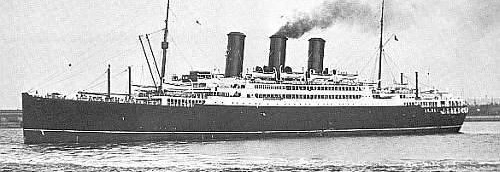
RMS Caledonia
Anchor Line · 1925 · Ship Guide
Overview
RMS Caledonia was an Anchor Line ocean liner built on the River Clyde by Alexander Stephen & Sons and launched in 1925. She was conceived as a solid postwar-era transatlantic ship rather than a “record-breaker”—a working liner on the Glasgow–New York run, with a typical paper trail of passenger lists, sailing notices, company brochures, and onboard stationery.
Her narrative arc shifts sharply at the outbreak of World War II: in September 1939 she was requisitioned by the Royal Navy, converted into an armed merchant cruiser, and renamed HMS Scotstoun. After early-war patrol actions attributed to armed merchant cruisers, Scotstoun was torpedoed and sunk on 13 June 1940 north of Ireland.
Evidence-first note: “Caledonia” is a high-reuse name (multiple merchant ships and at least one prominent naval training ship carried it). For publish-ready attribution, anchor on the printed ship name and era markers: 1925–1939 passenger service as RMS Caledonia, and 1939–1940 wartime service as HMS Scotstoun. If the item is WWI-era or earlier, it may refer to a different Caledonia entirely.
Key Facts
Design & Construction (Context)
Caledonia fits the 1920s “rebuilding and rationalization” moment for Atlantic travel: ships intended to carry steady passenger volumes and mail, with practical economics rather than prestige speed. For collectors, that usually means the surviving paper record is route-and-company heavy—tickets, passenger lists, baggage labels, and house-style stationery—often attractive, but not always uniquely ship-specific unless the vessel name is printed.
The 1936 accommodation reclassification and late-1930s upgrades are useful dating cues. Items that emphasize “tourist class” terminology, modernized interiors, or updated accommodation language can often be placed in the mid-to-late 1930s—especially when paired with a sailing date.
Service History (Summary)
1925–1939: Glasgow–New York passenger service. Caledonia entered service in October 1925 on the Glasgow–New York run. Interwar documents typically appear as Anchor Line passenger lists, sailing cards, promotional brochures, and onboard print.
1936–1938: Reclassification and modernization. In March 1936, accommodation is commonly reported as revised from First/Second/Third into Cabin/Tourist/Third classes. In 1938, sources commonly describe further work including third-class remodeling and new propellers.
1939–1940: Armed merchant cruiser service as HMS Scotstoun. Requisitioned in September 1939, she was converted for patrol duty. Compiled accounts credit her with capturing the German tanker Biscaya (19 October 1939) and, with HMS Transylvania, sinking the German freighter Poseidon (21 October 1939)—events that sometimes surface in wartime ephemera and commemorative naval material.
13 June 1940: Loss. HMS Scotstoun was torpedoed and sunk north of Ireland on 13 June 1940, with survivors rescued by HMS Highlander.
Northern Patrol as HMS Scotstoun
The Admiralty requisitioned Caledonia on 30 August 1939 and completed her conversion into HMS Scotstoun on 15 October. Armed merchant cruisers used the range and endurance of passenger liners for blockade patrol, but their commercial origins left them vulnerable against submarines and surface warships.
In October 1939, Scotstoun was credited with taking the German tanker Biscaya and, together with HMS Transylvania, helping sink the German freighter Poseidon. Those actions belong specifically to her Royal Navy identity, not to RMS Caledonia passenger service.
The 13 June 1940 Sinking
At 07:16 on 13 June 1940, U-25 torpedoed Scotstoun about 80 nautical miles west of Barra. The first hit struck the stern; after a long interval, U-25 fired again and a second successful torpedo caused the ship to sink by the stern.
U-boat records give a complement of 352: seven dead and 345 survivors. HMS Highlander rescued the survivors and landed them on the Clyde the following day.
Why Caledonia Matters
Caledonia/Scotstoun illustrates the rapid wartime transformation of a conventional interwar Atlantic liner into a naval auxiliary. For collectors, RMS and HMS are firm chronological boundaries: passenger lists and Anchor Line ephemera belong to one identity; patrol records and loss documentation to the other.
Interpretive Notes
In collecting terms, Caledonia produces two distinct documentary families: (1) interwar passenger service materials (passenger lists, menus, stationery, brochures) and (2) wartime naval service materials (armed merchant cruiser context, patrol narratives, naval correspondence). Both are legitimate, but they should be cataloged differently.
High-confidence ship attribution usually requires at least one hard anchor: printed ship name, a dated sailing (or itinerary), a labeled deck plan, or an identifiable photograph. Items that only say “Anchor Line” or “Glasgow–New York” should be treated as company/route material unless the ship name appears.
Practical tip: if an item is described as “HMS Scotstoun / RMS Caledonia,” confirm which name is actually printed on the piece. Wartime naval paperwork and postwar commemorative summaries can sometimes conflate names—your catalog record can acknowledge both, but keep the object’s printed identity as the primary label.
Evidence-first ship guideSources (Selected)
Use these as a starting index; corroborate technical particulars, dates, and the U-boat attribution with ship registers and naval loss records where possible.
- Ocean Liner Curator — Sources (master bibliography)
- Wikipedia — RMS Caledonia (1925) (starting index; verify against registers)
- Uboat.net — Caledonia (loss record index; useful cross-check)
- Wrecksite — HMS Scotstoun / RMS Caledonia (location summary; treat as a lead)
- Clydeships — Clyde-built ship index results for “Caledonia” (builder context; follow through to specific entry)