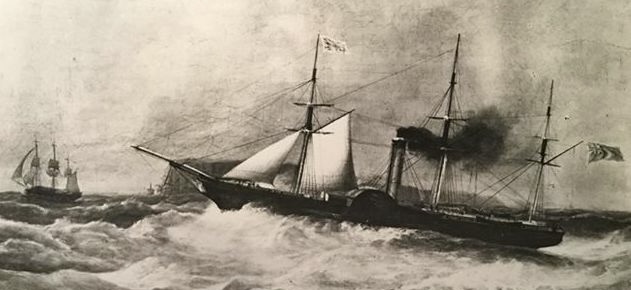
RMS Cambria
Cunard Line · 1845 · Ship Guide
Overview
RMS Cambria was an early Cunard transatlantic mail steamer of the wooden paddle-steamer era, entering service in 1845 on the Liverpool–Halifax–Boston route. She belongs to the formative period of regular steamship Atlantic travel, when reliability, contracted mail carriage, and schedule discipline mattered more than the later language of floating palaces and highly developed luxury hierarchy. In that sense, Cambria is best understood as an early service liner: important not because she represents the mature Edwardian liner type, but because she stands within the infrastructure that helped make routine steam Atlantic passage normal.
In interpretation, Cambria should be placed in the first sustained Cunard mail-steamer world. She was a significant ship of regular steam service, but not yet a late-nineteenth- or twentieth-century express liner in the fully developed modern sense.
Key Facts
Figures for early steamships can vary slightly between summaries, especially where period measures, registry conventions, or later compiled fleet lists differ in format. For cataloging, keep the wording and units of the cited source whenever possible.
Design & Construction Context
Cambria belonged to the early Cunard generation that made regular transatlantic steam communication commercially and operationally credible. She was not a giant by later standards, nor was she intended as a luxury monument. Her importance instead lies in dependable scheduled service: mail contracts, Atlantic regularity, and the disciplined paddle-steamer system that helped steam supplant older assumptions about ocean passage.
As a wooden paddle steamer with three masts and one funnel, Cambria sits in a transitional visual world. She still retained traits associated with earlier hybrid maritime practice, yet her real historical meaning lies in routine steam operation on a fixed Atlantic service rather than in sail-era improvisation.
Service History (Summary)
1844 construction and launch: Cambria was built by Robert Steele & Co. at Greenock and launched on 1 August 1844 as part of Cunard’s developing North Atlantic steam-mail network.
1845 entry into service: Her maiden voyage began on 4 January 1845 on the Liverpool–Halifax–Boston route. This placed her within the core Cunard mail and passenger service linking Britain with British North America and the northeastern United States.
Mid-1840s Atlantic operation: In service, Cambria belonged to the early era of timed Atlantic steam crossings, when scheduled performance and reliable mail carriage were central to a ship’s value. She appears in Cunard passenger-list archive volumes covering the later 1840s, confirming her place in the regular Halifax/Boston service pattern.
Frederick Douglass crossing: Cambria also has wider historical significance because Frederick Douglass sailed aboard her in 1845 on his departure for the British Isles. That association gives the ship a place not only in steamship history, but also in a broader nineteenth-century Atlantic intellectual and political history.
1853 alteration: One recorded later modification was the removal of the mizzen mast in 1853, a reminder that even early steamers were not static objects but working vessels subject to operational adjustment.
1854 war service: During the Crimean War she served as a transport, showing how useful mail steamers could be repurposed for military logistics when imperial conflict demanded it.
1856 chartered service: She was later chartered by the European & Australian Line for Marseilles–Malta service, marking a shift away from her original Cunard Atlantic context.
1860 disposal: In 1860 she was sold to Italy, ending her Cunard career and closing her most historically important identity phase as an early Atlantic mail steamer.
Expansion of the Early Cunard Service
Cambria and her near-contemporary Hibernia represented an enlargement of Cunard's first mail-steamer model. They offered greater passenger and cargo capacity than the original four ships while retaining the wooden hull, side-wheel propulsion, and sail rig of the early 1840s fleet.
Her maiden departure from Liverpool on 4 January 1845 for Halifax and Boston placed her directly into the contracted mail system that made Cunard's early reputation. The historical distinction is regularity: these ships were expected to sail on schedule across seasons, carrying government mail as well as fare-paying passengers.
Government and Mediterranean Service
Like many commercial steamers of the period, Cambria was drawn into government transport during the Crimean War. She later appeared on Mediterranean service, including a Marseilles–Malta charter, before the end of her Cunard career.
Those later assignments remind researchers that an early Atlantic mail steamer could accumulate documentary lives far beyond its best-known route. A dated object should therefore be read against the ship's actual deployment rather than assuming every reference belongs to Liverpool–Halifax–Boston service.
Interpretive Notes
This is an early steam-mail liner, not a later luxury superliner: Cambria belongs to the foundational steam-service era. She should not be described using assumptions drawn from later express liners with much larger scales, more elaborate class systems, or more developed interior programs.
Route function matters more than glamour language: the ship’s real importance lies in regular Cunard service on the Liverpool–Halifax–Boston run. Her historical value is tied to schedule, mail, and steam reliability.
She stands in the wooden paddle-steamer phase of liner history: this places her in a distinct technological and visual world from later iron, steel, screw-propelled Atlantic liners.
Her Frederick Douglass connection is historically meaningful: although not part of the ship’s engineering story, it gives Cambria a wider Atlantic-human history that deserves careful mention.
Later military and charter phases should be separated from her Cunard identity: Crimean War transport service and later Mediterranean employment belong to different interpretive frames from her original North Atlantic mail-steamer life.
Evidence-first ship guideSources (Selected)
- Ocean Liner Curator — Sources (master bibliography)
- Norway Heritage — Cambria fleet summary, dimensions, launch date, maiden voyage, and later service notes
- University of Liverpool Digital Heritage Lab — Cunard passenger-list volumes confirming Cambria in the 1845–1849 Halifax/Boston service record
- History Ireland — Frederick Douglass aboard Cambria and route context
- GG Archives — Cunard fleet list entry for Cambria
- Nova Scotia Historical Digital Preservation Initiative — RMS Cambria fleet summary