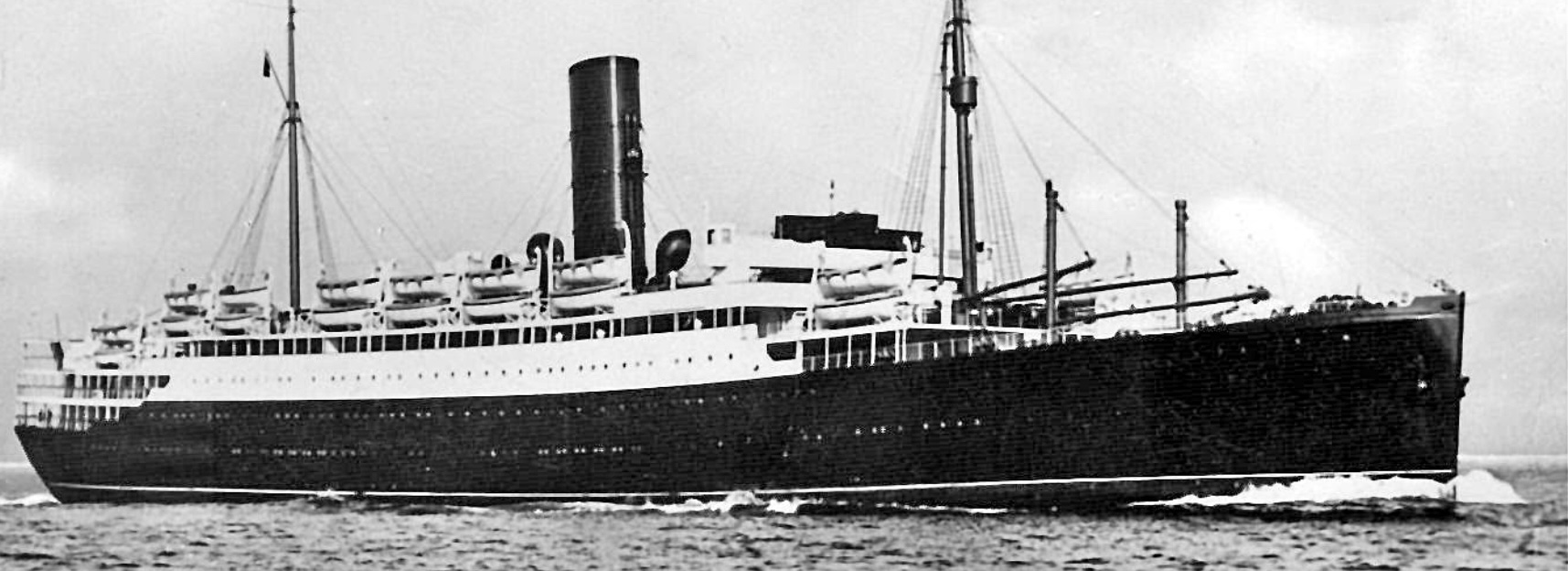
RMS Cameronia
Anchor Line · 1921 · Ship Guide
Overview
RMS Cameronia was a British-built Anchor Line ocean liner launched in late 1919 and placed into commercial service in 1921, designed for postwar transatlantic passenger traffic linking the River Clyde with North American ports. In her peacetime identity she sits in the “workhorse liner” category—large, modern enough to feel interwar, but not marketed as a speed champion—so the surviving paper trail tends to be route-and-company material (Anchor Line passenger lists, sailing notices, brochures, baggage labels) rather than “celebrity ship” memorabilia.
Her longest documentary shadow comes from service as a troop transport: she was repeatedly requisitioned and employed in wartime and postwar government charters, later being renamed Empire Clyde under Ministry control before final scrapping in 1957. Core facts and a service outline are well summarized in modern ship registers and compiled histories, but publish-ready collecting claims still benefit from object-level anchors (printed ship name, date, route, or a clearly identified photograph). (See sources below.)
Evidence-first note: “Cameronia” is a repeated name in Anchor Line history. Be careful not to mix this ship (launched 1919; service from 1921; later Empire Clyde) with the earlier Anchor Line Cameronia of 1911 that was sunk in 1917. Confirm build era, dimensions, and —best—printed dates before locking an attribution. (Starting index: Wikipedia entries for both vessels.)
Key Facts
Design & Construction (Context)
Cameronia belongs to the immediate post–World War I rebuilding wave: ships ordered or completed during the transition from wartime control back to commercial passenger markets, where the goal was steady capacity and reliability rather than record speed. Her machinery is generally described as turbine-driven twin-screw propulsion—an interwar “modern” baseline that can help date technical language in brochures and onboard print.
For collectors, this era often produces a specific blend of material: traditional “ocean liner” passenger lists and stationery alongside more practical travel documentation tied to migration flows and government charters. That mixed paper trail is a clue to why “Anchor Line / Cameronia” items can show up in both leisure travel contexts and in movement-of-people narratives (trooping, resettlement, assisted passage).
Service History (Summary)
1921–mid 1930s: Transatlantic liner service. After entering service in 1921, Cameronia operated on Anchor Line routes connecting Glasgow (and associated UK call points) with North American ports. Surviving passenger lists show routings that can include New York and Boston, with calls via Londonderry/Londonderry-area ports in some sailings—use those printed details as strong dating/identification anchors when you catalog ephemera.
1930s–1945: Troop transport roles. Compiled histories describe periods of trooping use before and during World War II, including Mediterranean operations. A frequently cited episode is the May 1941 evacuation of troops from Crete (operational narratives often list her among major troop carriers), followed by continued troopship employment. During Operation Torch-era Mediterranean operations, Cameronia was damaged by a torpedo off Algiers on 22 December 1942; some accounts note an aircraft-delivered torpedo and highlight that U-boat claims in the area were not necessarily confirmed—an example of why you should treat single-source “who hit her” statements cautiously.
1947–1953: Postwar trooping and migration carriage. After the war, Cameronia returned to service and is commonly described as employed in trooping duties, including movements connected to Palestine, and later refitted (1948) for a single-class configuration reported as 1,266 passengers. In this final working phase, she is repeatedly described as carrying emigrants (including voyages to Australia), and the resulting paperwork tends to look different from classic prewar “saloon-era” ephemera.
1953–1957: Empire Clyde and disposal. In 1953 she was renamed Empire Clyde under Ministry control, continued in managed service, and was scrapped in 1957—commonly reported as arriving at Newport for breaking in October 1957.
A Postwar Anchor Line Workhorse
Cameronia entered service in 1921 into a North Atlantic market still being reorganized after the First World War. Her Glasgow-centered passenger trade made her particularly important to Scottish and immigrant traffic rather than to the prestige express market dominated by larger liners.
Passenger lists and sailing notices are therefore especially valuable for this ship because they document ordinary transatlantic movement over a long period rather than a short flagship career.
Wartime Transport and Damage
During the Second World War Cameronia again became a government transport. On 22 December 1942 she was damaged in the Mediterranean during an air attack, an incident that survives in wartime merchant-shipping records and should be separated from the ship's peacetime passenger identity.
Her continued usefulness after that damage reflects the durability of the interwar liner as a transport platform: accommodation and route could change radically while the same hull remained in service.
Empire Clyde
In the postwar period the ship passed into government control and was renamed Empire Clyde. That later identity belongs to a separate operational phase and is an important cataloging boundary for photographs, official papers, and movement records from the 1950s.
Interpretive Notes
Cameronia is a ship where attribution errors are more likely to come from name re-use and route generalization than from deliberate fraud. Three practical checks help:
1) Confirm the era: if the item predates 1920, it cannot be this Cameronia.
2) Look for route specifics: “Glasgow–New York,” “New York & Boston to Glasgow,” and dated sailings are high-value anchors.
3) Watch the later name: anything printed as Empire Clyde belongs to the post-1953 phase and should be cataloged as such, even when sellers keep using “Cameronia.”
Collection categories that often surface include passenger lists, menus, letterhead, baggage labels, and company brochures (interwar); then photographs, wartime correspondence, and postwar movement documents (trooping/emigration). Cataloging works best when you treat “liner-era” material and “government charter” material as related but distinct documentary families.
Practical tip: if a listing claims “WWII troopship artifact from RMS Cameronia,” ask what the object itself says. A printed date, unit context, or port sequence is far more valuable than a seller description.
Evidence-first ship guideSources (Selected)
Use these as a starting index; corroborate technical particulars and any casualty figure you publish with ship registers, convoy records, and contemporary reporting where possible.
- Ocean Liner Curator — Sources (master bibliography)
- Wikipedia — RMS Cameronia (starting index; verify particulars against registers)
- GG Archives — Cameronia passenger lists (useful for printed route/date anchors)
- Uboat.net — Cameronia damage note (useful for attribution nuance on the 22 Dec 1942 incident)
- Wikipedia — SS Cameronia (1911) (name-confusion guardrail; do not conflate with this ship)