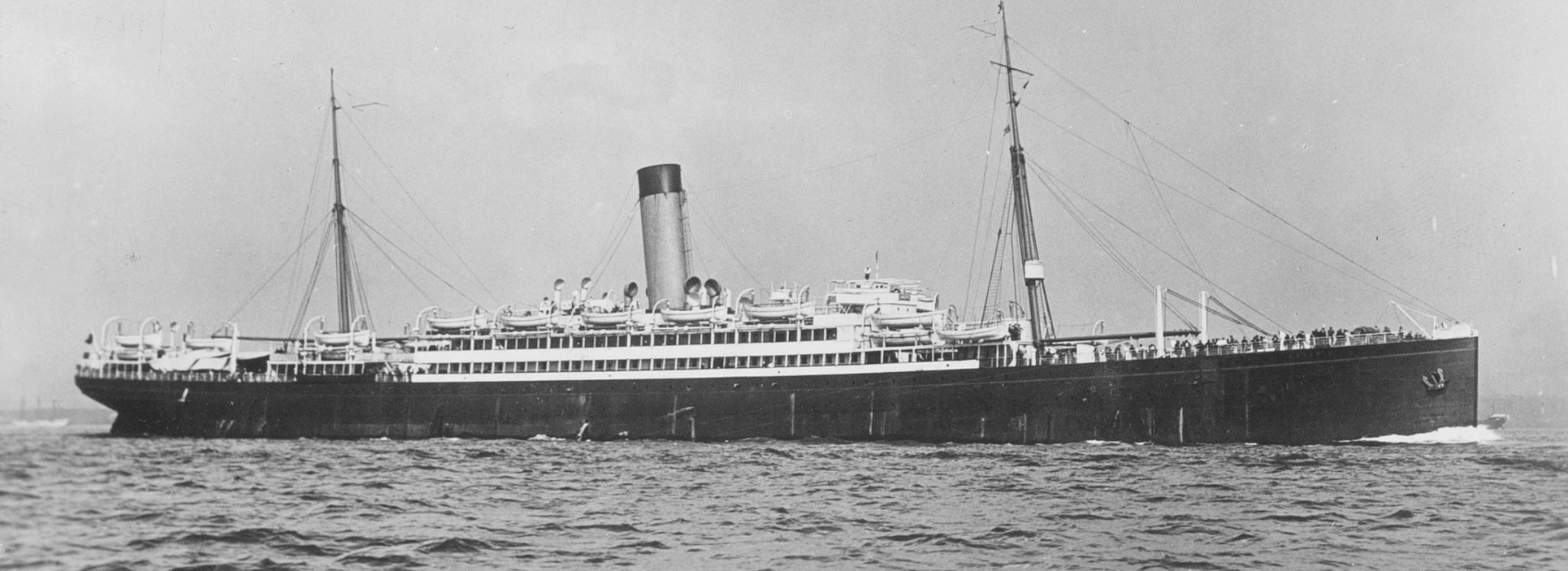
RMS Canopic
White Star Line · 1900 · Ship Guide
Overview
RMS Canopic began life outside the White Star Line. Built by Harland & Wolff at Belfast for the Dominion Line and launched on 31 May 1900 as Commonwealth, she entered service on the Liverpool–Boston route later that year. In 1903, as shipping services were reorganized within the International Mercantile Marine network, she transferred to White Star Line and was renamed Canopic.
Her White Star career was notable less for glamour or record speed than for durability and geographic range. She became closely associated with the company's Boston–Mediterranean service, later undertook wartime work, and after the First World War served routes to Canada and other North Atlantic ports before being withdrawn and broken up in 1925.
Key Facts
Commonwealth: A Dominion Line Beginning
Commonwealth was conceived for Dominion Line rather than White Star. Her combination of approximately 12,000 gross tons, moderate 16-knot speed, substantial third-class capacity, and twin-screw machinery suited the practical requirements of passenger and migrant traffic between Britain and North America.
This original identity matters when interpreting early photographs, passenger lists, advertisements, and other ephemera. Material dated before the 1903 transfer belongs to the Dominion Line phase and should not automatically be cataloged as White Star simply because the same hull later became Canopic.
Transfer to White Star Line
In 1903, Commonwealth passed to White Star Line as services were reorganized among companies controlled within the International Mercantile Marine combine. Renamed Canopic, she began White Star service in early 1904.
The transfer places her alongside several other ships that entered White Star through inter-company reassignment rather than direct construction for the line. That broader corporate context helps explain why White Star's fleet in the first decade of the twentieth century contained ships with quite different design origins and intended markets.
Mediterranean and Boston Service
Canopic became strongly associated with White Star's service linking North American ports with the Mediterranean, particularly Naples and Genoa. She operated in company with vessels such as Romanic, Republic, and Cretic, serving a market in which migration traffic was at least as important as elite tourism.
Her accommodation—especially the large third-class capacity—reflects that role. The ship is therefore particularly relevant to the history of migration networks linking southern Europe with the United States and Canada.
War and Postwar Service
During the First World War, Canopic was taken into wartime service. After the conflict she returned to commercial operations, but her route pattern became more varied than before the war.
In the early 1920s she appeared on Liverpool–Halifax–Boston and Liverpool–Quebec–Montreal services and later on other North Atlantic combinations including calls involving Bremen, Southampton, New York, Hamburg, and Philadelphia. These late-career movements make route and date especially important when attributing passenger documents or port photographs.
Withdrawal
By the middle of the 1920s, Canopic belonged to an earlier technological and commercial generation. After roughly a quarter-century of service under two names and two principal operators, she was withdrawn in 1925 and broken up at Briton Ferry in Wales.
Her long career is a useful reminder that the working history of White Star Line extended well beyond its famous express liners. Ships such as Canopic carried large numbers of ordinary passengers across multiple routes for decades and formed much of the operational fabric behind the better-known prestige fleet.
Why Canopic Matters
Canopic is especially valuable as a case study in corporate transfer, migration service, and route flexibility. Her identity changed from Dominion Line's Commonwealth to White Star Line's Canopic, while her practical passenger role remained central.
For attribution work, three distinctions are particularly useful: whether material predates or follows the 1903 transfer, whether it belongs to the Mediterranean/Boston era or the later Canadian and North Atlantic routes, and whether the ship is identified by her original or later name.
Interpretive Notes
The ship was not built for White Star: early material belongs to the Dominion Line Commonwealth phase.
Tonnage figures differ slightly: published references list values around 12,100–12,300 gross tons, likely reflecting differing dates or measurement conventions.
Route context matters: Canopic served several distinct route systems over a long career, so a generic “White Star transatlantic” label can obscure useful historical information.
Evidence-first ship guideSources (Selected)
This list is intentionally conservative.