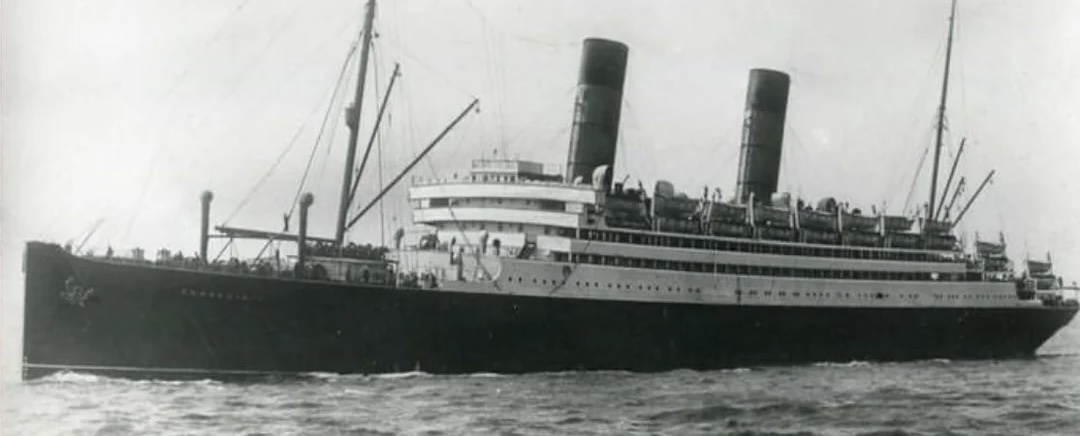
RMS Carmania
Cunard Line · entered service 1905 · Ship Guide
Overview
RMS Carmania was one half of one of the most useful real-world engineering comparisons in liner history. Built by John Brown & Co. at Clydebank, launched on 21 February 1905, and entering Liverpool–New York service that December, she used steam turbines while near-sister Caronia retained conventional reciprocating machinery.
The comparison allowed Cunard to judge turbine performance, economy, and maintenance under closely matched commercial conditions. Carmania's later career added two very different identities: rescue work during the Volturno disaster and wartime service as the armed merchant cruiser HMS Carmania, including the celebrated 1914 battle with Cap Trafalgar.
For wider historical context, see Propulsion and Machinery in the Liner Age.
Key Facts
The Turbine Experiment
Cunard's decision to build two closely matched ships with different machinery turned ordinary commercial operation into a large-scale engineering comparison. Carmania's three turbines drove three shafts, while Caronia used reciprocating engines and twin screws.
The significance lies in operating evidence. Fuel use, speed, vibration, maintenance, and reliability could be compared under similar route conditions. The turbine ship's performance helped validate the propulsion choice later adopted for Lusitania and Mauretania.
Passenger Service
Carmania entered Cunard's main North Atlantic trade and was marketed through the familiar Edwardian themes of steadiness, scale, reliability, and modern engineering. Her passenger career generated the usual ecosystem of lists, menus, brochures, postcards, stationery, and route material.
Accommodation changed over time, especially after the war, so a single capacity figure should not be treated as permanently representative. Class terminology can be a useful dating tool when interpreting surviving ephemera.
Fire and Return to Service
A significant onboard fire in 1910 interrupted the ship's commercial career and required repairs before she returned to service. This episode creates a useful chronological boundary for photographs and descriptions, particularly where fittings or accommodation changed during repair work.
The Volturno Disaster
In October 1913, Carmania responded to the burning emigrant liner Volturno. Severe weather complicated rescue work, and the episode involved multiple ships rather than one heroic vessel acting alone.
This is important interpretively because later retellings can isolate one participant from the broader international response. Carmania's role belongs within that collective rescue context.
HMS Carmania
After the outbreak of the First World War, the ship was converted into an armed merchant cruiser. Royal Museums Greenwich dates the Liverpool conversion to 7–14 August 1914, when eight 4.7-inch guns were installed.
On 14 September 1914, HMS Carmania fought the German auxiliary cruiser Cap Trafalgar near Trindade Island. The German ship sank; Carmania survived despite extensive damage and numerous shell hits.
The battle became the most famous episode of her career, but it should not retroactively redefine the passenger liner. Naval photographs, battle accounts, and wartime relic claims belong to a distinct provenance phase.
The museum's cited images are watercolour drawings: William Lionel Wyllie's armed-cruiser view is catalogued as made in 1914–1916, while Charles Edward Dixon's battle scene was made in 1923. The latter is a retrospective depiction of the 1914 action, so its production date and the event date should be kept separate.
Postwar Return and Final Years
After wartime service, Carmania returned to civilian passenger work. Refit and reduced accommodation reflected a different postwar travel market from the one for which she had been built.
She continued operating into the early Depression period before withdrawal and scrapping in 1932. The long career therefore spans prewar engineering experimentation, civilian rescue history, armed naval service, and postwar commercial adaptation.
Collecting Profile
Surviving material spans several distinct worlds: peacetime Cunard brochures and passenger lists, Volturno-related reporting, naval photographs, battle commemorations, and postwar cabin-class ephemera. The strongest catalog records identify which phase an object belongs to rather than using the ship name alone.
Interpretive Notes
The turbine-versus-reciprocating comparison with Caronia is one of the strongest interpretive anchors for this ship and should be made explicit whenever machinery history is discussed.
Wartime material requires stronger provenance than ordinary company ephemera. A claim that an object relates specifically to the Cap Trafalgar battle should ideally rest on dated, event-specific evidence rather than association alone.
Evidence-first ship guide