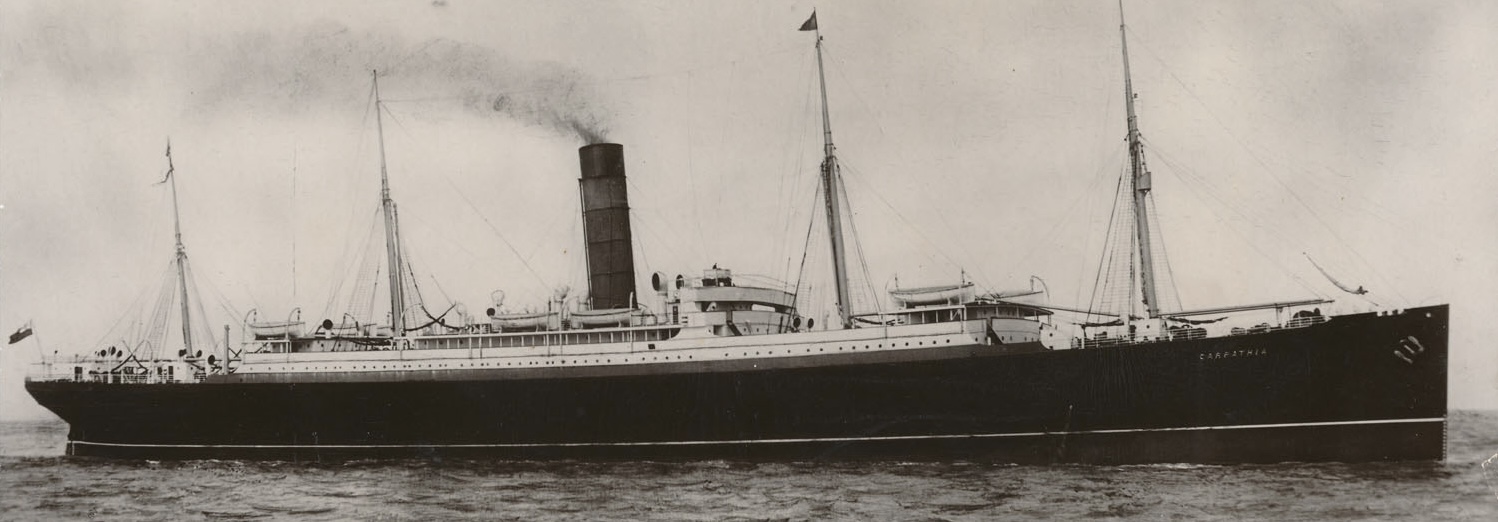
RMS Carpathia
Cunard Line · entered service 1903 · Ship Guide
Overview
RMS Carpathia was a Cunard transatlantic passenger steamship built for steady service rather than record speed. Launched by Swan Hunter & Wigham Richardson on 6 August 1902 and entering Liverpool–Queenstown–Boston service in May 1903, she belonged to the practical working fleet that carried emigrants, families, and ordinary travelers across the Atlantic in large numbers.
Her place in public memory is dominated by the night of 14–15 April 1912, when she answered Titanic's distress calls and reached the wreck site after the liner had sunk. That rescue made Carpathia famous, but the ship's historical value is richer than one event: nearly a decade of migration-oriented service came before it, and a wartime transport career followed.
Key Facts
A Working Liner Before a Famous Rescue Ship
Carpathia was not designed to compete for the Atlantic speed record. Her commercial value lay in dependable service, substantial passenger capacity, and economical operation. Large third-class accommodation placed migration at the center of the ship's business, while first- and second-class spaces supported travelers with different means and expectations.
This practical role matters to what survives today. Working liners produced enormous quantities of ordinary operational paper: passenger lists, menus, baggage labels, stationery, tickets, sailing notices, and immigration-linked documents. These objects can look less glamorous than luxury brochures, but with a firm date and voyage context they are among the richest sources for understanding how Atlantic travel actually worked.
1903–1912: Cunard Service
After her maiden voyage, Carpathia became closely associated with Cunard's Liverpool–Boston service, although route patterns shifted over time and later included New York and seasonal Mediterranean work. That flexibility was typical of intermediate liners whose commercial value depended on being useful across more than one traffic pattern.
Her passenger career belongs to the broader early-20th-century story of mass movement by sea. A single voyage might carry migrants, tourists, returning residents, families visiting relatives, and travelers moving onward by rail after arrival. That social breadth is an essential part of the ship's identity.
15 April 1912: The Titanic Rescue
In the early hours of 15 April 1912, Carpathia diverted after receiving Titanic's distress calls. By the time she reached the reported position, Titanic had already sunk. Carpathia embarked survivors from lifeboats and carried them to New York.
The rescue is unusually well documented. Wireless traffic, inquiry testimony, passenger accounts, crew evidence, newspapers, and later institutional research all preserve parts of the chronology. That abundance of evidence is an advantage, but it also means rounded figures can acquire false precision when repeated without context. Survivor counts and timings may vary slightly depending on which document or counting convention is being summarized, so precise claims should be tied to specific records.
The rescue also changed the afterlife of ordinary Cunard objects. A menu, postcard, or piece of stationery from Carpathia is often marketed as “Titanic related,” but association alone is not provenance. Only a date, voyage link, passenger ownership, inscription, or other evidence can connect an artifact to the rescue episode itself.
War Service and Loss
During the First World War, Carpathia continued to serve in transport roles. On 17 July 1918, while westbound in ballast from Liverpool toward Boston, she was torpedoed by the German submarine U-55 in the Southwest Approaches. Five people were killed.
The loss closed a career that had already passed through three very different documentary worlds: routine migration-era passenger service, a globally famous rescue operation, and wartime transport. Treating those phases separately produces a more accurate historical picture than allowing the 1912 episode to define the entire ship.
Interpretive Notes
Carpathia is a particularly good example of why evidence-first writing matters. The famous rescue has generated powerful mythology, but the surviving documentation is rich enough that the underlying chronology can usually be reconstructed without relying on legend.
For attribution, voyage context remains crucial. Date, ports, class marking, printed company wording, and provenance can distinguish an ordinary Cunard object from something genuinely connected to April 1912. The ship's broader passenger and wartime histories deserve equal care.
Evidence-first ship guide