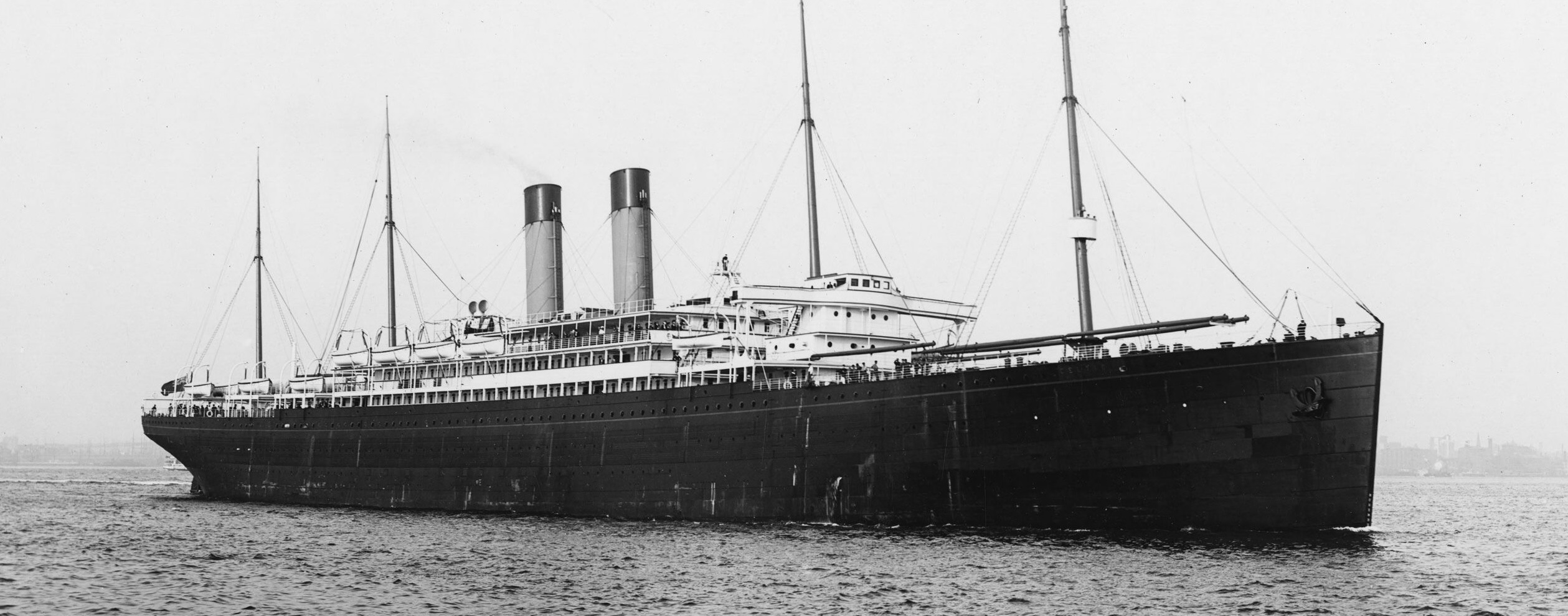
RMS Celtic
White Star Line · entered service 1901 · Ship Guide
Overview
RMS Celtic was the first of White Star Line's four great early-20th-century passenger-and-cargo ships later grouped as the “Big Four.” Built by Harland & Wolff at Belfast as yard no. 335, she embodied White Star's preference for scale, comfort and carrying capacity over record-breaking speed.
Her importance is therefore larger than a list of incidents. Celtic helped establish the commercial logic that White Star would continue to develop: very large ships could compete through dependable service, cargo capacity and passenger accommodation without trying to win the Atlantic speed race.
Key Facts
The First of the Big Four
Celtic surpassed Great Eastern in gross tonnage and briefly became the world's largest ship by that measure. Her size was not paired with express-liner machinery. Harland & Wolff records show two quadruple-expansion engines driving twin screws for a service speed of roughly 16 knots.
This was deliberate. The Big Four were built around the economics of volume: extensive passenger accommodation, substantial cargo space and moderate speed. Cedric, Baltic and Adriatic developed the same idea at progressively greater scale.
North Atlantic Service
Celtic entered Liverpool–New York service in July 1901. The exact sailing date illustrates a small but useful source problem: Harland & Wolff and modern summaries agree on the construction chronology, while published maiden-voyage dates are commonly given as either 25 or 26 July. The guide therefore retains the uncertainty rather than presenting a false precision.
Her peacetime career was dominated by ordinary Atlantic work rather than speed records. That routine service—passengers, emigrants, mail and cargo—is central to understanding why the Big Four were commercially important despite later being overshadowed by the Olympic class.
First World War
During the First World War Celtic was taken into government service and at one stage operated as an armed merchant cruiser before transport work better suited her size and economy. She survived two serious wartime attacks: a mine off the Isle of Man on 15 February 1917 and a torpedo attack on 31 March 1918. Both caused casualties and damage, but neither sank the ship.
Her survival is an important part of the ship's biography, but should not be inflated into a claim of invulnerability. The documented record is simply that the hull survived two major wartime incidents, was repaired, and returned to commercial service afterward.
Final Grounding
After the war Celtic returned to White Star service in a very different migration and passenger market. On 10 December 1928 she grounded on rocks near Cobh, Ireland. Salvage as an intact liner was not practical and she was dismantled where she lay over the following years.
That ending makes Celtic a useful bookend to the Big Four story: the ship that opened White Star's great-capacity era in 1901 remained in service into the period when newer motor ships and changing Atlantic traffic were reshaping the business.
Evidence-first ship guide