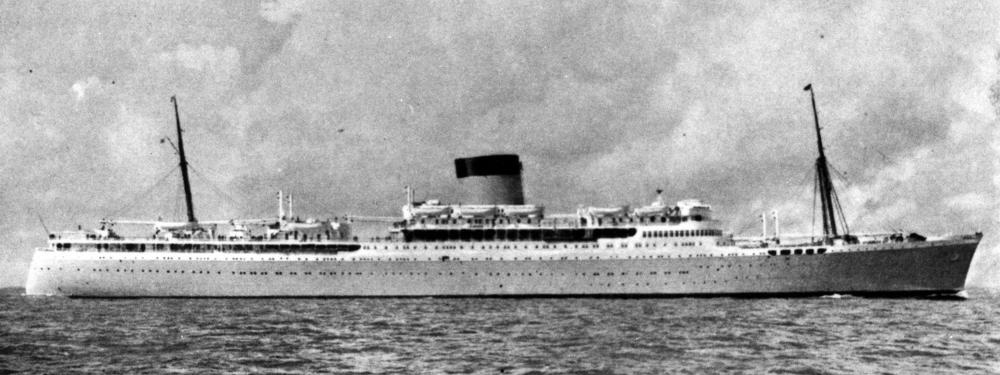
RMS Edinburgh Castle (1948)
Union-Castle Line · entered service 1948 · Ship Guide
Overview
RMS Edinburgh Castle was one of Union-Castle's two large postwar mail liners built to restore the Southampton–South Africa service after wartime losses. Launched in 1947 and entering service in late 1948, she and sister Pretoria Castle became the largest ships in the company's fleet at the time.
Her career spanned the rebuilding years after the Second World War, the modernization of the Cape Mail service in the 1960s, and the final decline of scheduled passenger shipping to southern Africa. She remained on the route until 1976.
Key Facts
Rebuilding the Cape Mail Fleet
Union-Castle emerged from the Second World War with major losses and a fleet that needed extensive rehabilitation. Edinburgh Castle and Pretoria Castle were ordered as part of the company's immediate effort to restore the prestige and capacity of the Cape Mail service.
Scarcity shaped the design. The British & Commonwealth staff archive records that the ships were based substantially on the prewar Capetown Castle concept, but used steam turbines rather than diesel machinery. Wartime shortages also affected construction materials and fitting-out practice.
Princess Margaret and the Launch
Edinburgh Castle was launched at Belfast on 16 October 1947 by Princess Margaret. Royal Museums Greenwich preserves a photographic album documenting the launch, making the event unusually well represented in archival material.
The ceremony reflected the symbolic role attached to large postwar passenger liners. Ships such as Edinburgh Castle were presented not only as commercial vessels but as visible evidence of industrial recovery and renewed overseas connections.
Southampton to South Africa
The liner entered Cape Mail service in December 1948. Her regular voyages connected Southampton with Las Palmas, Cape Town, Port Elizabeth, East London, and Durban, carrying passengers, mail, and substantial cargo.
Like other Union-Castle mail ships, she was part of a highly disciplined timetable. The service depended on regular departures and arrivals rather than record-breaking speed, and the ships functioned as both passenger transport and commercial infrastructure between Britain and southern Africa.
Passenger Arrangement
Published sources generally place her passenger capacity at about 755, divided between First Class and Tourist Class. The ship's public rooms followed Union-Castle's established two-class pattern and were designed for long ocean passages rather than short leisure cruising.
Her arrangement should be understood in the context of the route: passengers could spend nearly two weeks aboard, and the ship also carried a large crew and significant cargo. She was a working mail liner rather than a hotel ship optimized solely around recreation.
Construction Economy and Operating Compromises
Postwar shortages influenced details that would have been handled differently before 1939. The British & Commonwealth record notes, for example, that pitch pine was substituted for teak in deck sheathing and that labor-saving construction methods were used because skilled shipyard labor remained scarce.
The ships also developed a reputation for noticeable propeller vibration, especially in Tourist Class areas. Later machinery and propeller work attempted to improve both performance and passenger comfort.
The 1965 Acceleration Refit
In 1965 Union-Castle accelerated the Cape Mail schedule. To keep the older Edinburgh Castle and Pretoria Castle competitive with newer ships, both underwent major refits.
The work included hull cleaning and streamlining, changes to propellers and machinery, and revised mast arrangements. The modifications increased speed by roughly one knot and enabled the sisters to maintain the new approximately eleven-and-a-half-day timetable.
Changing Appearance
The 1965 refit also changed Edinburgh Castle's profile. Her foremast was reduced, the mainmast removed, and a smaller signal mast installed farther aft, bringing her external appearance closer to the newer Pendennis Castle.
Later interior improvements included expanded air-conditioning and additional private bathroom facilities. These changes reflected a broader effort to keep older liners attractive as air travel increasingly competed for the same passengers.
Why Steam Power Mattered
Unlike several prewar Union-Castle mail ships, Edinburgh Castle and Pretoria Castle used steam turbines. The choice reflected both available machinery and the realities of immediate postwar construction.
This made the sisters somewhat unusual within a company that had extensive experience with large motor ships. Their steam plant remained reliable enough for decades of scheduled service but became increasingly expensive as fuel costs rose sharply in the 1970s.
The Final Years
By the mid-1970s, the commercial foundation of the Cape Mail service had weakened. Jet aviation had captured much of the passenger market, while containerization changed cargo handling and rising fuel prices penalized large steam-powered ships.
Edinburgh Castle began her final passenger sailing from Southampton on 5 March 1976. She then made a one-way cargo voyage toward the Far East and was broken up at Kaohsiung that June.
Why Edinburgh Castle Matters
The ship matters because she was one of Union-Castle's first major postwar statements. She restored capacity after wartime destruction and then remained in service long enough to witness the entire postwar arc of the route, from reconstruction and renewed demand to accelerated timetables and final decline.
She also provides the clearest baseline for understanding Pendennis Castle. The later ship grew directly from the operating experience and design assumptions embodied by Edinburgh Castle and Pretoria Castle.
Collecting Profile
Surviving material includes Union-Castle brochures, deck plans, menus, postcards, passenger lists, sailing schedules, photographs, luggage labels, and Cape Mail ephemera. Launch material is especially notable because Royal Museums Greenwich preserves a dedicated photographic album from the 1947 ceremony.
Items from before and after the 1965 refit can often be distinguished visually by changes to the mast arrangement, making photographs and postcards particularly useful for chronological identification.
Interpretive Notes
Sources disagree on the precise maiden-voyage month: some later summaries say November 1948, while the British & Commonwealth staff record gives December. The guide uses December because it is tied directly to the ship-specific company-history record.
Beam figures are inconsistently reproduced: some derivative sources give 74 ft, but the British & Commonwealth record and other ship data give 84 ft. The latter is used here.
Passenger totals vary slightly by source and date: the guide therefore uses a rounded overall figure rather than presenting one class breakdown as immutable throughout the career.
Evidence-first ship guideSources (Selected)
- Ocean Liner Curator — Sources (master bibliography)
- British & Commonwealth Staff Register — Edinburgh Castle (3)
- Royal Museums Greenwich — launch album for RMS Edinburgh Castle
- Royal Museums Greenwich — Union-Castle archival material, including Edinburgh Castle stability particulars
- British & Commonwealth Staff Register — Union-Castle fleet history