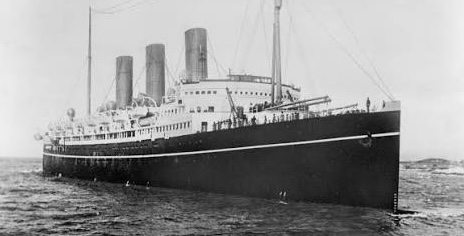
RMS Empress of Asia (1913)
Canadian Pacific · Trans-Pacific Service · Ship Guide
Overview
RMS Empress of Asia was one of Canadian Pacific's great early twentieth-century Pacific liners. Built by Fairfield at Govan as the near-sister of Empress of Russia, she entered service in 1913 for the Vancouver–Yokohama–Hong Kong trade and quickly became associated with high-speed trans-Pacific operation.
Her career spanned both world wars. During the First World War she served as an armed merchant cruiser and transport. Between the wars she returned to passenger service across the Pacific. Requisitioned again during the Second World War, she was carrying troops toward Singapore when Japanese aircraft set her ablaze on 5 February 1942.
Key Facts
Fairfield's Pacific Empress Pair
Empress of Asia and Empress of Russia were built as a matched pair for Canadian Pacific's expanding trans-Pacific service. Fairfield's yard records identify them as yard numbers 485 and 484 respectively. Their turbine machinery and quadruple-screw arrangement placed them among the fastest large passenger ships operating in the Pacific before the First World War.
The pair also introduced a cruiser stern to this class of Canadian Pacific liner. That feature, combined with three funnels and a balanced two-masted profile, gave them a markedly modern appearance compared with many older ships then serving the route.
Trans-Pacific Speed and Prestige
Empress of Asia entered commercial service in 1913 and quickly demonstrated the speed expected of her design. Published Canadian Pacific fleet histories record a trial speed of 21.43 knots. In 1914 she completed a Yokohama-to-Vancouver passage in roughly nine days, two hours, and forty-four minutes.
These voyages mattered commercially. Canadian Pacific's trans-Pacific system was not just a steamship service: it connected with the company's railway across Canada, creating an integrated route between East Asia, the Pacific coast, and Atlantic connections to Europe.
First World War Service
With the outbreak of the First World War, Empress of Asia was taken into naval service as an armed merchant cruiser. Royal Navy records list her in commission from August 1914 until March 1916, armed with eight 4.7-inch guns.
Her wartime duties included patrol and transport work in the Indian Ocean and surrounding waters. After her armed merchant cruiser period she continued in government service before eventually returning to commercial Canadian Pacific operations.
Return to the Pacific
Between the wars Empress of Asia resumed the trans-Pacific passenger trade. She carried travelers, mail, and cargo between Canada and East Asia during a period when Canadian Pacific's Pacific fleet evolved around newer ships but still depended heavily on established prewar tonnage.
Her longevity is important. By the late 1930s she was no longer a new prestige liner, yet she remained a useful and recognizable part of the company's Pacific network more than two decades after entering service.
Second World War Troop Service
During the Second World War Empress of Asia again entered military transport service. Her final voyage came during the desperate Allied effort to reinforce Singapore in early 1942.
She sailed with Convoy BM 12 carrying troops from Bombay toward Singapore. Canadian veterans records give a troop complement of 2,235 aboard the ship during the final approach.
The Loss off Singapore
On 5 February 1942, as BM 12 approached Singapore, Japanese aircraft attacked the convoy heavily. Empress of Asia was set on fire. Other ships in the convoy were also hit or damaged, including Félix Roussel and City of Canterbury.
With the ship burning, the captain moved her toward shallow water near a lighthouse while evacuation and rescue proceeded. Contemporary naval records emphasize that the ship was lost to fire rather than an immediate catastrophic sinking from bomb impact.
Canadian records identify 15 soldiers killed in the attack and note that crewman Douglas Richard Elworthy later died of wounds. The great majority of the troops and crew were successfully removed from the burning liner—an important distinction from many wartime passenger-ship losses in which casualties were far higher.
Why Empress of Asia Matters
Empress of Asia connects several major strands of ocean-liner history: prewar Pacific expansion, railway-linked global passenger networks, the military conversion of liners during the First World War, interwar commercial service, and the use of passenger ships as troop transports during the Second World War.
Her pairing with Empress of Russia also adds depth to Canadian Pacific's Pacific story. Together they show the company's ambitions immediately before 1914, while the later careers of Empress of Australia and Empress of Japan illustrate how that network continued to evolve across the interwar period.
Interpretive Notes
Built in 1912, completed in 1913: the ship was launched in November 1912 but entered the fleet as a completed vessel in 1913. Both dates appear in historical summaries depending on whether construction year or service year is being emphasized.
Loss terminology varies: some sources describe her simply as bombed and sunk; operational accounts make clear that air attack started the fatal fire and that the ship was abandoned after being brought toward shallow water.
Casualty figures should be stated carefully: Canadian records distinguish between soldiers killed in the attack and at least one crewman who later died of wounds. This guide preserves that distinction rather than collapsing the numbers into a single undifferentiated total.
Evidence-first ship guideSources (Selected)
- Ocean Liner Curator — Sources (master bibliography)
- GG Archives — Canadian Pacific Line fleet list
- Clydeships — Fairfield yard records, Empress of Asia yard no. 485
- Naval-History.Net — First World War armed merchant cruiser service
- Naval-History.Net — China Station diary and Convoy BM 12
- Veterans Affairs Canada — final voyage and casualty record