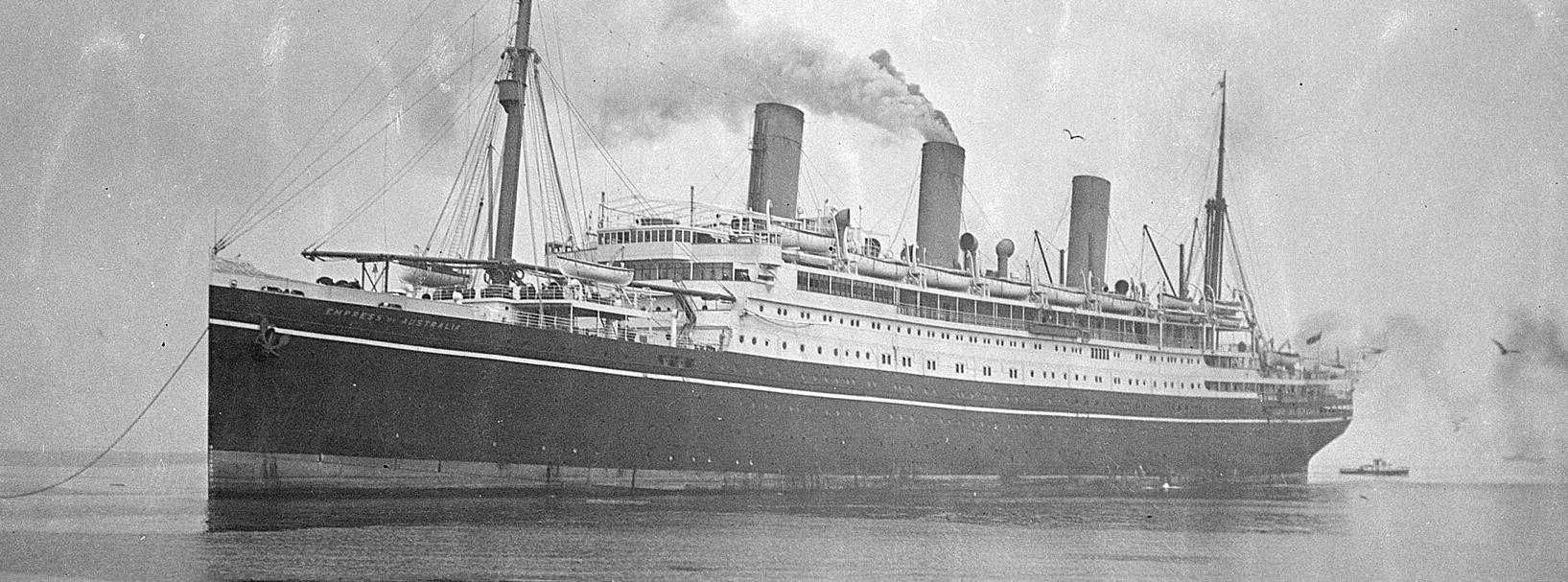
RMS Empress of Australia
Canadian Pacific · in CP service from 1922 · Ship Guide
Overview
RMS Empress of Australia began life as the German liner Tirpitz, launched by AG Vulcan at Stettin on 20 December 1913 for Hamburg-America Line. War interrupted the intended career, and the ship ultimately passed into British hands after Germany's defeat.
Canadian Pacific acquired the vessel in 1922, rebuilt her, and gave her a new identity as Empress of Australia. That postwar transformation led to a remarkably varied career spanning trans-Pacific service, trans-Atlantic work, extensive cruising and special voyages, Second World War troop transport, and continued trooping into the Korean War era before disposal in 1952.
Key Facts
Tirpitz: The Interrupted German Identity
The ship's first identity belongs to prewar German liner planning. Built for Hamburg-America Line as Tirpitz, she reflected the large, comfortable passenger ships being developed immediately before the First World War.
Because war intervened, the intended German commercial career never unfolded normally. Construction-era and German material therefore belongs to an interrupted phase rather than to a long mature service history.
Postwar Transfer
After the war, the liner passed out of German ownership as part of the broader redistribution of merchant tonnage. Canadian Pacific eventually acquired the ship in 1922 and rebuilt her for an entirely new commercial system.
This transition is a major provenance boundary. German Tirpitz material, British transitional references, and Canadian Pacific Empress of Australia material should be kept distinct even though all concern the same hull.
Rebuilding as Empress of Australia
Canadian Pacific did not merely repaint and rename the ship. Rebuilding adapted the vessel for the company's own service expectations and created the identity under which she became best known.
The resulting ship joined the broader “Empress” brand, an identity that extended beyond individual vessels into brochures, baggage labels, menus, stationery, and route advertising. That shared branding makes ship-specific attribution especially important.
Pacific Service
Empress of Australia served on Canadian Pacific's Pacific network, linking Vancouver with Asian ports and fitting into the company's transcontinental rail system. Passenger travel, mail, and high-profile tourism all formed part of that commercial role.
For collecting, a Canadian Pacific item is not automatically ship-specific. The strongest evidence is the ship name printed on the object, a date, a voyage, or another direct link to Empress of Australia.
Atlantic Service
The ship later took on trans-Atlantic assignments as well. In June 1927 she began Southampton–Cherbourg–Quebec–Montreal service, demonstrating how flexible a large liner could become inside Canadian Pacific's worldwide system.
A 1928 passenger list also preserves a particularly revealing detail of the company's integrated rail-and-sea concept: passengers could arrange inland railway travel through the broader Canadian Pacific network. The ocean voyage was part of one continuous transportation product.
Cruising and Special Voyages
Like many interwar liners, Empress of Australia could be used for cruising and special itineraries when scheduled route demand allowed. Such voyages created a different type of passenger experience from regular transport service, emphasizing destinations and leisure rather than simple point-to-point travel.
Cruise brochures therefore belong to a separate commercial context from Atlantic or Pacific passenger lists even when they concern the same ship.
Second World War Troopship
During the Second World War, Empress of Australia served as a troop transport. This wartime identity replaced normal passenger scheduling with military logistics and generated a different archive of movement orders, troop references, convoy context, and official documentation.
Wartime photographs and records should be cataloged as military transport material rather than simply as Canadian Pacific passenger ephemera.
Postwar Trooping and Final Years
The ship continued in troop transport roles after 1945 and remained useful into the Korean War period. By then the hull had accumulated nearly four decades of physical life across German, British, and Canadian contexts.
Canadian Pacific finally disposed of the aging vessel in 1952, selling her to British shipbreakers. Her longevity is a strong example of how a ship designed before the First World War could remain operational into the early postwar era through repeated adaptation.
Collecting and Attribution
The ship's layered identity makes evidence discipline essential. An object marked Tirpitz, an interwar Canadian Pacific menu, and a wartime troopship photograph all concern one hull but should never be flattened into one generic category.
Shared “Empress” branding can also mislead. A Canadian Pacific logo, crest, or china pattern may be authentic to the company without proving use aboard this specific ship. Ship-specific naming, date, route, provenance, or documented deaccession are much stronger anchors.
Interpretive Notes
This is the 1913-launched former Tirpitz, not a later ship that briefly carried the Empress of Australia name. Original name and launch year are the safest disambiguators.
The strongest narrative structure is layered: German design intent, postwar transfer, Canadian Pacific rebuilding, Pacific and Atlantic service, wartime troopship use, and final postwar transport. Each phase is historically real and deserves its own provenance context.
Evidence-first ship guide