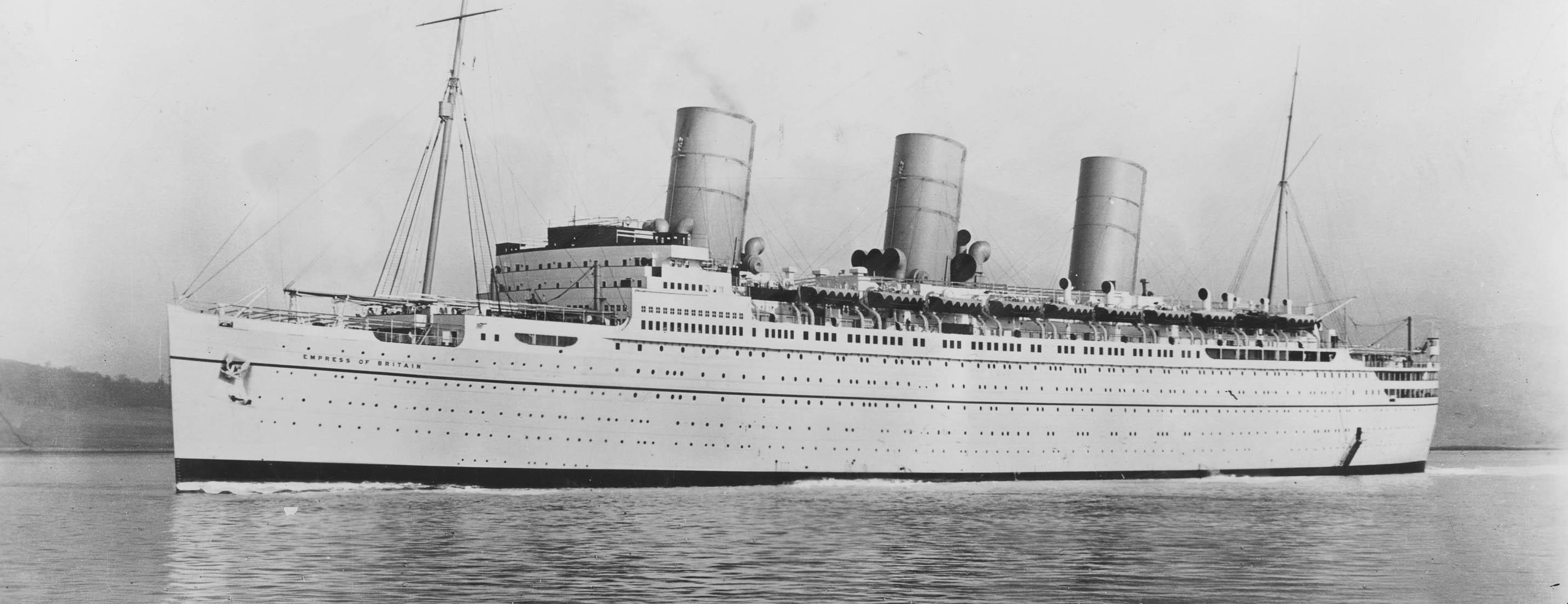
RMS Empress of Britain
Canadian Pacific · entered service 1931 · Ship Guide
Overview
RMS Empress of Britain (the 1930/31 Canadian Pacific liner) was built as an interwar flagship for the Southampton–Quebec service, combining high speed with a “grand hotel” approach to public rooms and presentation. In most summaries she is described as the largest and most prestigious ship in Canadian Pacific’s fleet at the time of her completion—an identity that matters for interpretation because it shaped how the line marketed the ship, how press coverage framed her, and what kinds of printed onboard material were produced.
Her historical profile is also inseparable from her wartime loss. Converted for troopship duty early in the Second World War, she was attacked off the west coast of Ireland in late October 1940—first by air attack that set her ablaze, then subsequently torpedoed and sunk. That sequence produces common collecting confusions: peacetime passenger-era ephemera, wartime troop-era paperwork, and later commemorative material can be blended together in listings unless you date and describe the object precisely.
This page summarizes widely published reference facts and keeps interpretation clearly separate. Where figures vary by measurement convention (especially length and tonnage), wording is restrained.
Key Facts
Canadian Pacific’s Interwar Flagship Strategy (Context)
The early 1930s North Atlantic was a competitive “prestige corridor,” even as economics tightened. For Canadian Pacific, Empress of Britain functioned as a statement ship: large enough to compete in attention with European flagships, fast enough to market as modern and efficient, and visually impressive enough to anchor cruise itineraries as well as scheduled Atlantic work. That hybrid identity helps explain why surviving ephemera can include both transatlantic “liner” pieces and cruise-era material with different formatting, itineraries, and onboard programming styles.
Curatorial phrasing that stays safe: “flagship” is best used when supported by contemporary publicity or reliable fleet summaries, not solely by later collector lore.
Service History (Summary)
Entering service in 1931, Empress of Britain worked Canadian Pacific’s Atlantic passenger service in the summer season, with winter cruises widely noted in ship histories. In broad outline, this is the era that produces abundant survivable paper: passenger stationery, printed menus, deck plans, souvenir booklets, ship’s orchestra programs, and photographic postcards. When pieces are postmarked or voyage-dated in writing, they become especially useful for pinning a specific configuration and graphic style to a specific year.
With the outbreak of World War II, she was taken up for troopship duty. A museum summary notes troop movements from the wider Commonwealth (including Australia and New Zealand) as part of her wartime role, reflecting a very different operational life than her peacetime service and a different category of documentation (orders, movement cards, troopship mail).
October 1940 Loss (Evidence-First Note)
The ship’s loss is commonly described as a two-stage event: an air attack disabled and burned her, followed by torpedoing that ultimately sank her. For collecting and attribution, that matters because it produces “edge claims” (e.g., “from the sinking,” “from the burning ship,” “survivor item”) that require higher standards of evidence than ordinary ship-associated ephemera.
Collector caution: “survivor item” and “from the ship” are not interchangeable. Without solid documentation (contemporary letters, service records, dated photos, or an institutional chain of custody), label conservatively: “Canadian Pacific Line (period), associated with Empress of Britain.”
Collecting Profile (What Tends to Survive)
In the market, you’ll most often encounter: (1) Canadian Pacific passenger stationery and lettercards (sometimes voyage-dated), (2) menus and programs (often undated—date by typography, logo variants, and address lines), (3) postcards and press imagery, (4) cruising ephemera (itinerary booklets, passenger lists, souvenir folders), and (5) wartime-leaning material that is frequently generic unless the ship is explicitly named.
A practical method: (1) separate by era (prewar passenger / wartime troopship / postwar commemorative), (2) check whether the ship name is printed as part of the original piece, and (3) prioritize items that can be anchored by date (postmark, voyage reference, or dated onboard imprint).
A two-stage wartime loss: the 1940 destruction of Empress of Britain should not be reduced to a single attack. German aircraft first damaged the ship severely; while efforts were being made to save and tow her, a U-boat attack completed the loss. Keeping those stages separate preserves the actual chronology and avoids attributing the entire sinking to only one weapon or attacker.
That distinction also matters for photographs and survivor narratives. Material from the air attack, the damaged-but-still-afloat period, towing attempts, and the final sinking may document different moments in the same disaster and should not be collapsed into one undifferentiated event.
Why the sequence matters: the initial air attack did not immediately produce the final sinking. The damaged liner remained afloat long enough for salvage and towing efforts to matter, which means the ship passed through an intermediate state between attack and loss. That period generated its own eyewitness accounts and operational decisions.
The episode also illustrates why wartime liner history benefits from event-level chronology. A single sentence saying that the ship was “sunk in 1940” loses the relationship among air power, salvage attempts, submarine action, and the final abandonment of a vessel that had previously served both passenger and wartime roles.
Interpretive Notes
Peacetime and wartime material must be separated: passenger-era ephemera, troopship documentation, and commemorative material can easily be conflated because they concern the same famous hull.
The 1940 loss was a sequence, not a single event: air attack, fire, salvage efforts, and subsequent torpedoing belong to the same loss chronology and should be described in the correct order.
Evidence-first ship guide