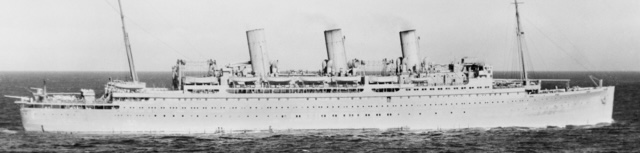
RMS Empress of Canada (1922)
Canadian Pacific Steamships · entered service 1922 · Ship Guide
Overview
RMS Empress of Canada was one of Canadian Pacific Steamships’ major interwar liners, conceived for long-distance imperial and commercial service and ultimately employed across both Pacific and Atlantic contexts. She belonged to the prestigious “Empress” tradition, but her historical importance lies not only in prestige: she also illustrates the changing commercial life of large liners between the wars, including regular liner work, world cruising, and eventual wartime transport duty. By the time of her loss in 1943, she had moved far from her original peacetime role and had become part of the global military logistics network of the Second World War.
In collecting and interpretation, Empress of Canada is best divided into four distinct phases: Atlantic introduction and St. Lawrence service, transpacific Canadian Pacific service, 1930s cruising and mixed employment, and wartime transport service. Menus, brochures, passenger lists, cruise material, and military references should not be merged casually, because they belong to materially different documentary worlds.
Key Facts
Design & Construction Context
Empress of Canada was built for Canadian Pacific at a moment when the company was reaffirming its ambition to maintain a global liner network linking Britain, Canada, and Asia. Her size, speed, and accommodation profile placed her firmly within the upper tier of interwar Canadian passenger shipping, even if she does not occupy quite the same popular memory as some of the era’s most famous Cunard or White Star liners.
She is also significant as a transitional ship. Her career demonstrates how large liners of the 1920s were expected to serve multiple roles: scheduled liner work, seasonal route adjustment, prestige travel, and later luxury cruising. This makes her especially valuable for interpreting the evolving economics of the interwar passenger trade, when many great liners increasingly depended on cruising and flexible deployment as migration patterns changed.
Service History (Summary)
1920–1922 construction and entry into service: Built by Fairfield at Govan, Empress of Canada was launched on 18 August 1920, completed in May 1922, and made her maiden voyage on 5 May 1922 from Liverpool to Quebec and Montreal. Her initial service therefore belongs to the Atlantic and St. Lawrence side of Canadian Pacific operations rather than immediately to the Pacific.
Early Canadian Pacific liner service: After entering service, she was employed on both Atlantic and Pacific routes for Canadian Pacific. This phase is the correct interpretive setting for passenger lists, brochures, route literature, shipboard ephemera, and commercial photography tied to normal civilian operation.
Pacific identity and prestige role: She became especially associated with Canadian Pacific’s transpacific service between Vancouver and the Far East. In that setting she represented a long-distance imperial and commercial link rather than a simple North Atlantic migrant carrier. This Pacific identity is central to understanding the ship’s place within Canadian Pacific history.
1930s cruising and mixed employment: Like many large liners in the interwar period, Empress of Canada also developed a substantial cruising life. This phase should be treated distinctly from scheduled liner work, because cruise brochures, itineraries, and onboard material reflect a leisure-travel market rather than regular route transport.
Second World War service: Requisitioned for wartime duty, she became a troop transport and operated within the much harsher logic of military necessity. Once in this role, the ship’s documentary profile shifted from passenger culture to transport and war-service history.
Final voyage and loss: In March 1943, while carrying troops and personnel in the South Atlantic, she was attacked by the Italian submarine Leonardo da Vinci. Torpedoed on 14 March 1943 west of Sierra Leone, she was lost after the attack, with heavy loss of life. Her destruction illustrates how thoroughly large passenger liners had become exposed to long-range submarine warfare during the global conflict.
Interpretive Notes
This is a Canadian Pacific global liner, not merely an Atlantic ship: Empress of Canada should be placed within the larger Canadian Pacific network joining Atlantic and Pacific operations, not confined narrowly to one oceanic frame.
The Pacific phase matters greatly: because Canadian Pacific’s “Empress” branding is often associated with imperial long-distance service, Pacific-context material may be especially important in defining the ship’s public identity.
Cruise-era material belongs to a different interpretive world: 1930s cruise brochures and related ephemera should not be read as ordinary route literature. They reflect the interwar adaptation of large liners to new passenger markets.
Wartime references should be separated from civilian passenger culture: troop transport records, Admiralty control, and sinking accounts belong to military history rather than to peacetime liner promotion.
Her loss has wider historical meaning: the destruction of Empress of Canada shows how even major, prestigious passenger vessels could be absorbed into global war and destroyed far from their original commercial routes.
Which Empress of Canada? this guide concerns the 1922 liner, not the former Duchess of Richmond that took the name in 1947 and not the later 1960 ship. The repeated name is a provenance hazard: an undated postcard or passenger reference should never be assigned by name alone when three different vessels can plausibly fit.
The 1922 ship combined Canadian Pacific’s North Atlantic role with cruising and later wartime transport. Her loss to the Italian submarine Leonardo da Vinci on 14 March 1943 is also a case where casualty and survivor totals vary among sources. Preserving that disagreement is better evidence practice than choosing a falsely exact number merely for neatness.
The ship’s prewar Pacific and cruise associations should also be kept distinct from the later troopship phase. A peacetime passenger artifact and a wartime loss document may concern the same hull while answering very different historical questions about route, audience, and purpose.
Evidence-first ship guide