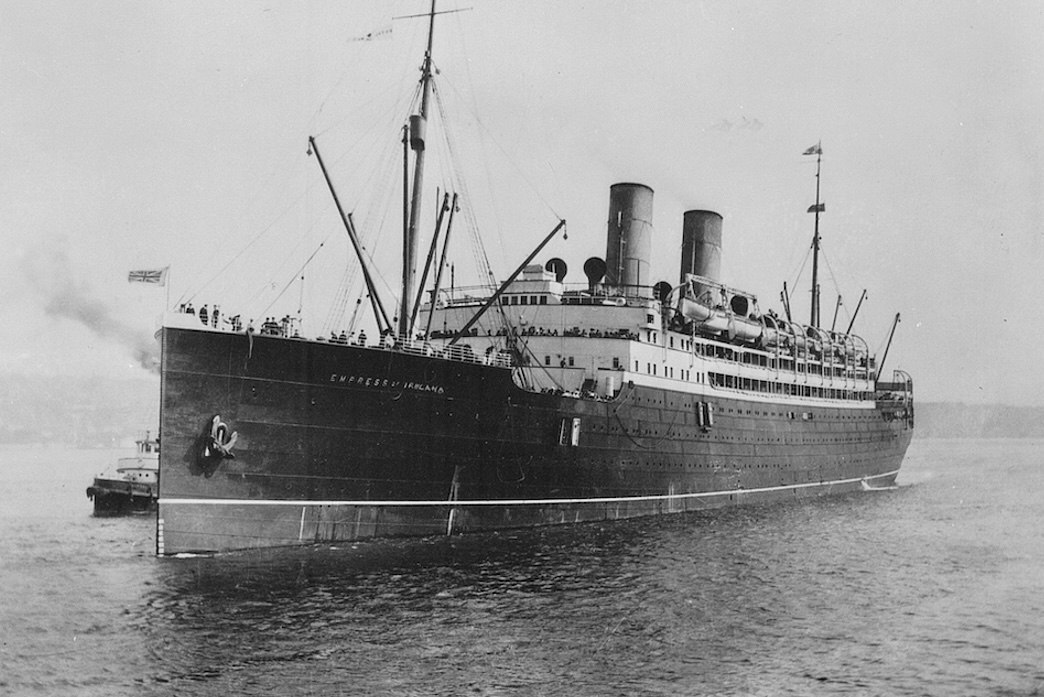
RMS Empress of Ireland
Canadian Pacific · entered service 1906 · Ship Guide
Overview
RMS Empress of Ireland was one of Canadian Pacific's principal prewar Atlantic liners, built by Fairfield Shipbuilding & Engineering at Govan for the Britain–Quebec route. Launched on 27 January 1906 and entering service that June, she formed part of Canadian Pacific's integrated rail-and-sea system linking transatlantic passengers directly into inland Canada.
Her public memory is dominated by the collision with the Norwegian collier Storstad in the early hours of 29 May 1914. The ship sank in roughly fourteen minutes. Parks Canada records 1,477 people aboard and 1,012 deaths. Yet the disaster came only after eight years and 95 successful return voyages carrying immigrants, families, tourists, mail, and ordinary travelers.
Key Facts
A Canadian Pacific Atlantic Liner
Empress of Ireland was built for Canadian Pacific's Atlantic system, not simply for an isolated ocean crossing. The voyage formed one segment of a larger transport chain in which passengers could connect from the ship into rail service across Canada.
That integrated model shaped company advertising, ticketing, baggage handling, and route language. Canadian Pacific material may therefore document both ocean and inland travel, making the ship part of a much broader mobility network.
Migration and Passenger Life
Parks Canada emphasizes that tens of thousands of immigrants reached Canada aboard Empress of Ireland. Her second- and third-class accommodation is therefore just as important to the ship's story as the more frequently illustrated first-class interiors.
The vessel carried different social worlds at once: wealthier travelers, migrants, families, crew, and people moving onward through Canadian rail connections. Passenger lists and immigration records can recover those individual journeys in ways that generalized disaster narratives cannot.
Material Culture of Routine Service
Before 1914, the ship generated a normal working archive of menus, stationery, passenger lists, postcards, baggage labels, deck plans, company forms, and route brochures. Much of this surviving material documents routine service rather than the final voyage.
This distinction matters because the market often upgrades any period Canadian Pacific object into a “disaster artifact.” A genuine company menu from 1910 can be historically important without having any connection to the sinking.
The Final Voyage
Empress of Ireland left Quebec on 28 May 1914 bound for Liverpool. In fog near Pointe-au-Père, the Norwegian collier Storstad struck the liner's starboard side during the early hours of 29 May.
The flooding progressed with extraordinary speed. The ship listed heavily and sank in roughly fourteen minutes, leaving little time to organize evacuation. The rapid loss is central to understanding the casualty scale and should be kept at the center of any technical interpretation of the disaster.
Casualty Figures and Evidence
Parks Canada gives 1,477 people aboard and 1,012 deaths. Older or alternative sources sometimes present slightly different totals, reflecting the difficulty of reconciling passenger and crew lists after a catastrophe.
For evidence-first writing, exact casualty figures should therefore be tied to a named source rather than presented as if every historical record agrees perfectly. The Parks Canada figures provide the clearest institutional baseline used here.
The Wreck as Archaeological Evidence
Parks Canada describes the wreck as the country's most structurally complete early-twentieth-century ocean liner and the sole surviving wreck of a pre-First World War Canadian Pacific liner. This gives the site unusual archaeological importance in addition to its memorial significance.
The wreck can preserve evidence that written sources cannot: structural arrangement, damage pattern, surviving fittings, and traces of onboard material culture. At the same time, its protected status means collecting narratives around alleged wreck relics require particular caution.
Wreck Relics and Provenance
Disaster-associated objects attract strong stories, and those stories can outgrow the evidence. A piece sold as “recovered from Empress of Ireland” should ideally be supported by documented salvage history, dive records, permits, institutional chain of custody, or contemporary provenance.
Without that support, a conservative label is stronger scholarship than a dramatic claim. “Canadian Pacific, period, associated with the Empress of Ireland story” is fundamentally different from “salvaged from the wreck.”
Modern Memory
The disaster was long overshadowed internationally by Titanic, but Canadian public history, museum work, scholarship, and archaeology have restored much of its significance. Modern commemorative objects and exhibitions form a legitimate later layer of the ship's material history.
That afterlife should be distinguished from original 1906–14 shipboard material. A modern museum publication can be valuable evidence about remembrance without pretending to be an artifact from the operating ship.
Classes, Community, and the Human Record
The loss is often summarized through totals, but the human record is far more granular. Passenger lists identify families, children, crew members, immigrants, returning residents, and travelers from many backgrounds. Canadian Museum of History work on the children lost aboard is one example of how institutional research can recover individual lives from what might otherwise remain an abstract casualty figure.
For curatorial work, this is important: the ship's history should not be reduced either to architecture or to statistics. The surviving documentary record allows the disaster to be studied as a collection of individual journeys interrupted within a working migration system.
Company Ephemera Versus Ship-Specific Evidence
Canadian Pacific produced a large volume of branded paper, and authentic company material from the right decade is not automatically specific to Empress of Ireland. Ship attribution is strongest when the vessel's name is printed in the original design, when a dated voyage is present, or when a named passenger or traceable ownership history links the object directly to the ship.
This distinction is especially important because the disaster adds market value. Period company stationery can be genuine without being a wreck relic, final-voyage artifact, or even material used aboard this particular ship.
Interpretive Notes
The disaster should not erase eight years of routine migration and transport history. Empress of Ireland was first a working Canadian Pacific liner, then a catastrophe site, and now an archaeological and memorial landscape.
For collecting, the safest method is to separate shipboard material, contemporary 1914 disaster material, documented wreck material, and modern commemorative material into distinct provenance categories.
Evidence-first ship guide